
By Lehlohonolo Lehana.
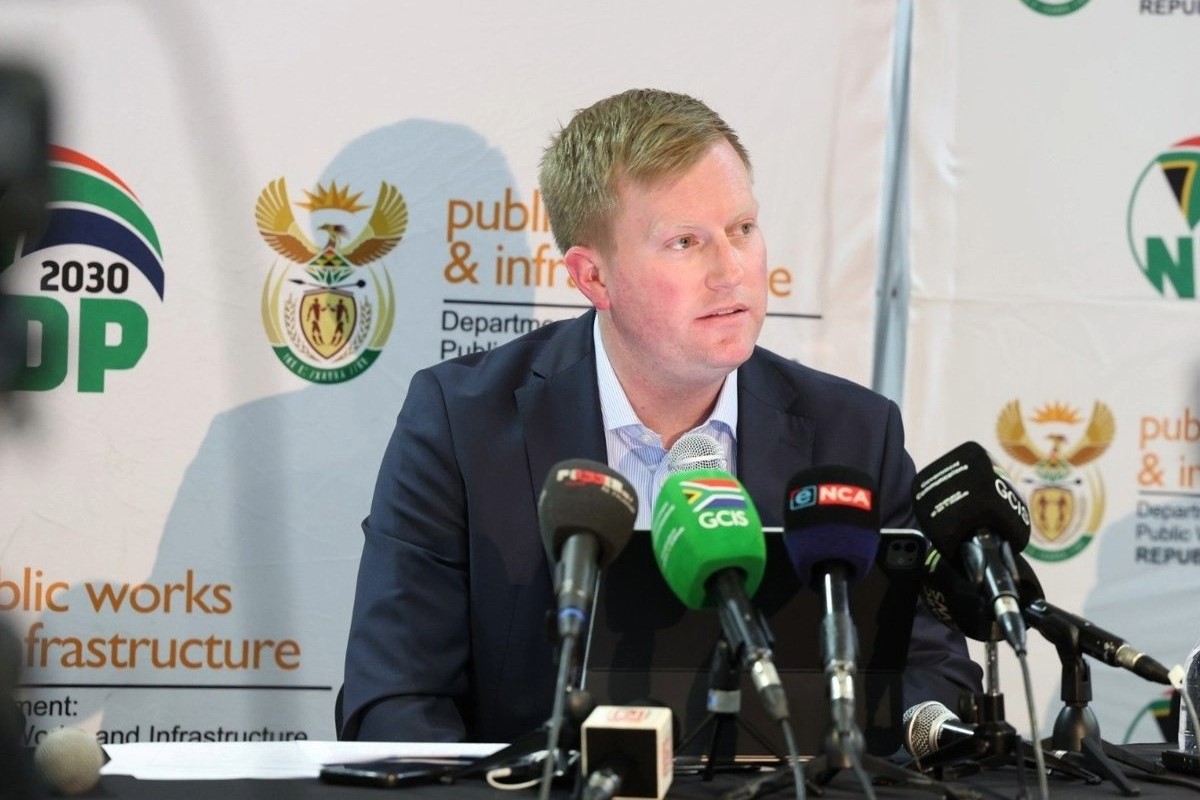
The Minister of Public Works and Infrastructure (DPWI) South Africa Dean Macpherson and the head of Infrastructure South Africa (ISA) Mameetsi Masemola briefed the media on the progress of Strategic Integrated Projects, status of the Project Preparation Pipeline and important milestones of the Adopt-A-Municipality Pilot Programme.
Speaking at a media briefing on Sunday, 23 August 2026, Head of Infrastructure South Africa Mameetsi Masemola said ISA was officially established by government in 2020 to provide a single point of coordination for the country’s priority infrastructure pipeline.
“Our mandate is provided in the Infrastructure Development Act. We are mandated to identify and prioritise strategic infrastructure. We are also mandated to prepare and package projects to move them from being concepts to bankability thus attracting public funding as well the mobilisation of private sector financing,” Masemola said.
Masemola also explained that as Infrastructure South Africa, they are also mandated to coordinate the national pipeline of priority projects in the form of strategic integrated projects.
“We are also mandated to monitor and report on projects as well as enabling the ease of doing business vigorous through regulatory unblockings in line with regulations of IBA, “Masemola said.
Masemola revealed at this year’s Sustainable Infrastructure Development Symposium South Africa (SIDSSA), South Africa has an infrastructure gap of more than R1 trillion.
South Africa has experienced consistent under investment in infrastructure for three decades, with only a brief spike around the 2010 World Cup.
To combat this, government has committed approximately R1.07 trillion under the medium-term expenditure framework to revive energy, transport, and water networks.
SIDSSA is the annual flagship event organised by the Investment and Infrastructure Office (IIO) within The Presidency.
The symposium commenced with a site visit this morning to the Cape Flats Recharge Project conducted Macpherson joined by Ministers and Mayors from the continent.
The Cape Flats Aquifer Recharge Project is an award-winning municipal water project.
A Memorandum of Understanding (MoU) has been signed between ISA and the National Building Institute (NBI), the Infrastructure Technical Assistance Facility (ITAF) and Zutari.
Zutari, a proudly South African company, has played a pivotal role in delivering infrastructure and advisory services across the Middle East for over two decades.
The MoU is part of efforts to enhance collaboration and support infrastructure projects in South Africa.
Macpherson said SIDSSA would be bringing together government, project sponsors, investors, financiers and technical professionals to convert those commitments into viable infrastructure projects and functioning assets.
“This year, we have seven African Ministers joining the Summit from, among others, Kenya, Botswana and Zimbabwe, as well as nine African Mayors from cities such as Nairobi, Maputo, and Douala in Cameroon – the most in the conference’s six-year history,” Macpherson said.
He said in addition to the Premier of Gauteng, there are seven Members of the Executive Council from across South Africa’s nine provinces attending.
“And – for the first time ever – we will be having 13 mayors from important metropolitan and regional areas across South Africa, as well as three members of the mayoral committee joining as part of our City to City Connect conversations.”
“Over 1 200 delegates will enter our doors over the upcoming days as we work to turn South Africa into a construction site.”
President Cyril Ramaphosa will also address the event.
Macpherson said the value of SIDSSA must be measured by whether projects are prepared, financed, procured and completed.
“Municipal infrastructure is essential to service delivery and economic growth. Reliable water, sanitation, electricity, roads and waste services determine whether communities and businesses can function.”
“Improving these systems requires more than additional funding. Municipalities also need credible project preparation, technical capability, sustainable funding models and plans to operate and maintain assets over their full lifecycle,” he said.