
By Kevin Rademeyer, Sports Journalist.
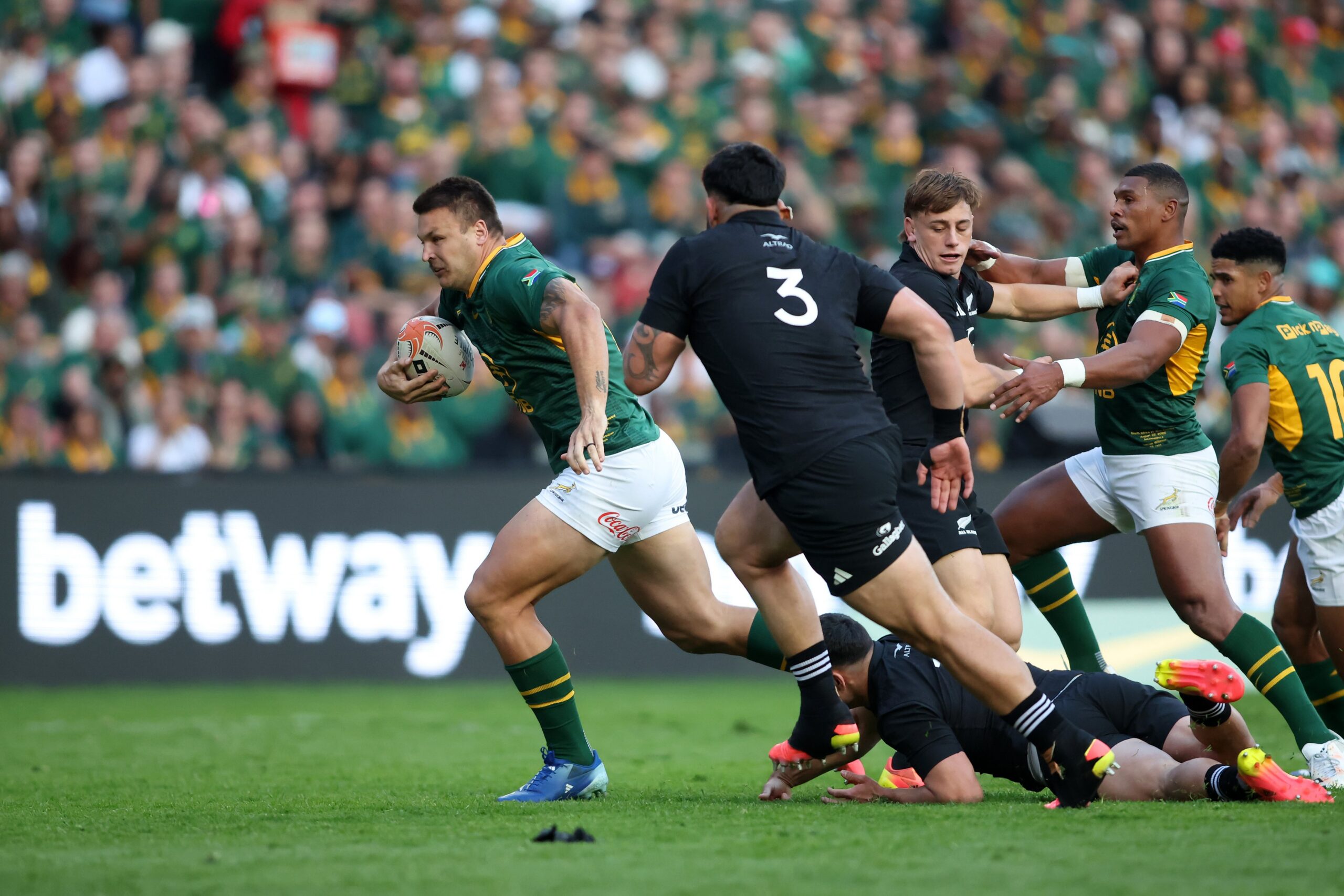
It may not have been the most fluent match to watch. The ball was in play for only 22 minutes. There were bad mistakes from both sides, and the 62 000-crowd left Ellis Park in silence, but the match lived up to its brutal billing.
Two heavyweights, punching, hoping to land the vital blow. The intensity can not be matched by any other team, or by any other sport. It is not always pretty, but breathtaking, nonetheless.
The 33 -16 scoreline, and the five tries to one, indicate that the All Blacks dominated the Springboks. People who missed the game would believe it was one way traffic. They would be wrong. The performance and stats, tell a different story.
South Africa lost the opening Test of the Greatest Rivalry series because New Zealand were better when the match reached its most important moments, not because the Springboks were outplayed for 80 minutes.
The Boks dominated the scrum. They had 61 per cent of the territory, won the penalty count 14 -10 and repeatedly drove the All Blacks backwards at the set piece. They spent long periods camped inside New Zealand territory.
But nine visits into the All Blacks 22 produced just 0.9 points per visit. Their season average is around 5.5.
That is the uncomfortable statistic. South Africa did much of the hard work, then allowed New Zealand to escape. This can only be done if the defending team has a burning desire to defend their own tryline.
The defining passage came shortly before the hour mark. The Springboks had earned a scrum penalty in front of the posts and had three points available. Instead, they chose another scrum, confident that their dominance could produce something more.
It was an entirely understandable decision. On another day, the All Blacks concede again, a player goes to the sin bin and South Africa walk away with seven points or more.
This time, the gamble failed.
The extended stoppage while Eben Etzebeth changed his boots gave New Zealand something they badly needed: time. Time to breathe, regroup and prepare for another defensive stand. When play eventually resumed, the Springboks lost the scrum on their own put in and the All Blacks escaped.
A few minutes later, after a brilliant Damien Mckenzie run, and a solid scrum on the Springboks line, the All Blacks scored, and the game had slipped away.
Rassie Erasmus later confirmed that the instruction from the coaches’ box had been to take the three points. That tells its own story.
South Africa do not need to abandon their identity in Cape Town. They simply need to recognise when the match is asking for a different answer. New Zealand were ruthless enough to punish them for every opening.
The All Blacks’ ability to strip the ball in contact caused problems South Africa had not fully anticipated. The Springboks conceded 23 turnovers, an extraordinary number for a side built around possession, pressure and repeat phases.
Then came the smaller moments that became decisive.
Malcolm Marx lost the ball while attempting to ground what looked like a certain try. A restart went dead. Two yellow cards arrived late in the contest. New Zealand, meanwhile, kept finding ways out of trouble and eventually found ways through the Springbok defence.
Once South Africa were reduced to 13 men, Will Jordan delivered the final blow.
That is the part Erasmus and his players must take seriously. Not the 33 points. Not the noise around the defeat. The moments.
The All Blacks had enough hunger to stay alive when South Africa were in control and enough composure to take their chances when the game finally opened.
Ellis Park can do strange things to visiting teams. It is one of rugby’s great stages, and opponents understand that surviving the first wave in Johannesburg can change everything. New Zealand arrived carrying the memory of their heavy defeat in Wellington and looked determined not to be overawed by the occasion.
South Africa has to respond and Erasmus has chosen not to tear up the blueprint. His selection for Cape Town is effectively an acknowledgement that much of the forward battle was won in Johannesburg.
The starting pack is largely unchanged. Siya Kolisi is in line to return from his hamstring problem, although he still must come through training. If cleared, his presence will be significant, not simply because he is captain, but because of what he brings as a ball carrier, breakdown operator and emotional leader.
Pieter Steph du Toit remains captain for now and will earn his 100th Test cap, while Ox Nché reaches his 50th. Behind them, however, Erasmus has made changes that reveal how he believes the first Test was lost.
Cobus Reinach replaces Grant Williams at scrumhalf, while Handré Pollard comes in for Sacha Feinberg Mngomezulu at flyhalf. That is a selection built around control.
Reinach brings experience and tempo management. Pollard brings perhaps an even more important commodity in a match of fine margins: judgement. He knows when to attack, when to kick, when to squeeze territory and when three points are worth considerably more than another attempt to break the opposition from five metres. That may be the clearest lesson from Ellis Park.
Ethan Hooker replaces Cheslin Kolbe on the wing, while the bench has been strengthened by the return of Thomas du Toit and Lood de Jager.
Then there is Deon Fourie, a selection that could only really make sense in South African rugby. Now primarily a loose forward, Fourie provides cover at hooker and brings with him a remarkable understanding of the chaos these matches can produce. He was a crucial figure in the 2023 World Cup final against New Zealand and has earned another opportunity to influence the rivalry.
André Esterhuizen provides the versatility. Cameron Hanekom offers energy. Feinberg Mngomezulu remains available to change the game, while Morne van den Bergh provides scrumhalf cover.
It is not a retreat. They are doubling down on their strengths. It is refinement.
The Springboks have looked at the opening Test and essentially decided that the foundations were strong enough. What needs changing is how they use those foundations when the pressure reaches its highest point.
That gives Cape Town a fascinating edge. The altitude is gone. The scenery changes. The pressure does not.
South Africa now need to win in Cape Town to keep the series alive, before the contest moves to Soweto and then Baltimore. The margin for error has narrowed, but the opportunity remains. And perhaps that is where the Springboks are most comfortable.
South Africans have always had a particular affection for being counted out. The danger now is allowing the defeat at Ellis Park to become a psychological burden rather than a lesson.
There was plenty to build on. They dominated the scrum. They won territory. They controlled large sections of the match and created enough opportunities to win it.
What they lacked was the final layer: accuracy, patience and ruthlessness.
New Zealand had it. The All Blacks will not suddenly become less dangerous. Will Jordan and Cam Roigard have already demonstrated how quickly they can turn a small opening into a scoreboard problem.
But the first Test also showed that New Zealand can be put under enormous pressure, and on another day, that pressure gets turned into points. That should give South Africa belief.
Erasmus has already made the bigger point. This series will not be decided by the team that wins the opening Test. It will be decided by the team still standing when the fourth Test is finished.
South Africa lost the first battle. They have not lost the 100-year war yet. They will have no desire to retreat, or to surrender. They will not want a repeat of 1996, and to be a part of history. They will not want to relinquish their number one spot and allow the All Blacks to take the trophy home, for the next eight years.
So, Cape Town becomes the response, and if the Springboks can turn the dominance they showed at Ellis Park into points, the Greatest Rivalry will have its second, third and fourth act.
Springboks team to face All Blacks in Cape Town
Springboks: 15 Damian Willemse, 14 Kurt-Lee Arendse, 13 Jesse Kriel, 12 Damian de Allende, 11 Ethan Hooker, 10 Handre Pollard, 9 Cobus Reinach, 8 Jasper Wiese, 7 Pieter-Steph du Toit (c), 6 Siya Kolisi/Paul de Villiers, 5 Ruan Nortje, 4 Eben Etzebeth, 3 Wilco Louw, 2 Malcolm Marx, 1 Ox Nche
Replacements: 16 Deon Fourie, 17 Gerhard Steenekamp, 18 Thomas du Toit, 19 Lood de Jager, 20 Andre Esterhuizen, 21 Cameron Hanekom, 22 Morne van den Berg, 23 Sacha Feinberg-Mngomezulu.
Venue: DHL Stadium, Cape Town
Date: Saturday, 29 August, 2026
Kick-off: 17:10 (local SAST),
Referee: Nika Amashukeli (GRU)
Assistant Referees: Karl Dickson (RFU), Angus Gardner (RA)
TMO: Eric Gauzins (FFR).