
By Lehlohonolo Lehana.
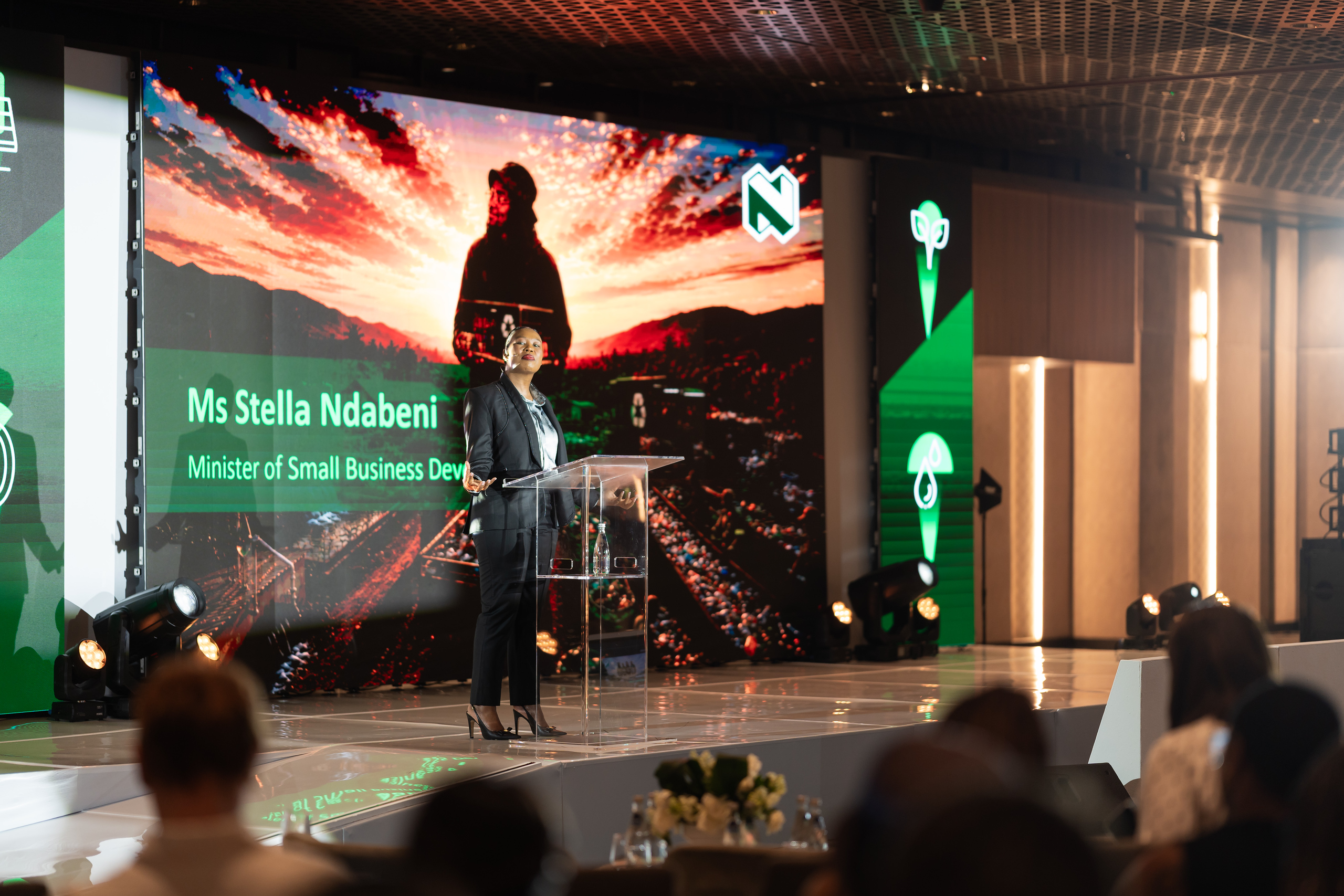
Caption: Minister of Small Business Development in South Africa Stella Tembisa Ndabeni in Houghton, Johannesburg.
Minister of Small Business Development Stella Tembisa Ndabeni delivered the keynote address at the Nedbank Green Economy Indaba 2026 at The Houghton Hotel in Houghton, Johannesburg.
The fourth Indaba aims explore opportunities across renewable energy, sustainable agriculture, waste management, green technology, skills development and access to finance, while positioning young people and small enterprises at the centre of the green economy.
The Indaba brought together policymakers, development agencies, investors, entrepreneurs, corporates and funders committed to building a more sustainable and inclusive economy.
The event forms a key pillar of the bank’s Green Economy Social Impact Strategy, which seeks to cultivate and scale enterprises that address environmental challenges while creating jobs and stimulating economic growth.
“South Africa should not view the green transition only as an environmental obligation. It also holds enormous potential both for broader industrialisation and small enterprise development”, said Ndabeni.
She said the high level of youth unemployment made it imperative to ensure young people benefited from opportunities created by the transition to a greener economy.
According to the latest Quarterly Labour Force Survey, about five million South Africans aged 15 to 34 were unemployed in the second quarter of 2026.
“The unemployment rate among young people aged 15 to 34 stood at 47.4 per cent, compared with a national unemployment rate of 33.6 per cent,” Ndabeni said.
She also cited Stats SA data showing that 58.7% of unemployed young people aged 15 to 34 had no previous work experience in the first quarter of 2025.
Ndabeni said the Department of Small Business Development had strengthened its collaboration with universities, including through engagement with Deans of Commerce, to support knowledge creation, entrepreneurship and innovation.
She also highlighted the department’s partnership with the Small Enterprise Development Finance Agency and the Technology Innovation Agency, aimed at bridging the gap between technology development, commercialisation and sustainable enterprise.
One of the event’s standout moments was a Dragons Den-style pitching competition, where young entrepreneurs operating in the water & sanitation, waste & recycling, renewable energy and regenerative agriculture sectors presented their businesses to a panel of industry leaders and professionals. The entrepreneurs competed for a share of R710 000 in funding and business support, designed to help accelerate their growth and impact. The businesses that stood out and walked away with prize money include; MHS Farming, Greatful Agriculture and Malesedi.
“We are encouraged by the work Nedbank and its partners are already undertaking through its Green Economy Social Impact Strategy, particularly the focus on youth partnerships in areas such as e-mobility, textile-waste recycling, the blue economy and sustainable agriculture”, added Ndabeni.
Since its launch in 2023, the Green Economy Indaba has evolved into one of South Africa’s leading platforms for dialogue, collaboration and action, creating pathways for emerging businesses to access funding, markets, mentorship and strategic partnerships. More importantly, it has demonstrated that environmental sustainability and economic growth are not competing priorities but mutually reinforcing drivers of long-term prosperity.
South Africa’s transition to a greener economy presents a significant opportunity to create sustainable jobs, unlock innovation and build more resilient communities,” said Poovi Pillay, Executive Head of the Social Impact Unit at Nedbank. “Through our Green Economy Social Impact Strategy, we are intentionally supporting entrepreneurs and enterprises developing solutions to some of our country’s most pressing challenges in water and sanitation, waste and recycling, renewable energy and regenerative agriculture. We believe that business can be a powerful force for good when innovation, funding and partnerships come together.”
A further highlight of the Indaba was the announcement of a new partnership between Nedbank and Innovate Durban, aimed at strengthening KwaZulu-Natal’s innovation ecosystem and accelerating the growth of green enterprises.
Through the partnership, qualifying enterprises will be able to access funding support of up to R200 000, helping innovators transition from concept to commercialisation. Emphasis will be placed on businesses led by youth, women and persons with disabilities, ensuring broader participation in South Africa’s emerging green economy.
“We recognise that no single organisation can drive South Africa’s green transition alone,” added Pillay. “Partnerships are essential if we are to unlock the scale of impact required. Collaborating with organisations such as Innovate Durban allows us to combine resources, expertise and networks to create sustainable opportunities for entrepreneurs while helping communities thrive”.
The Nedbank Green Economy Indaba culminated in the prestigious awards where this year, the winners exemplified the innovation, entrepreneurship and determination required to build a thriving green economy. The top winners for the evening were Greatfuel Agriculture, Iphupholwethu, Nolengka Farm and Timbali, also noting Indalo & R Labs.
“Being able to play an integral part in this transition and making a lasting impact is the one of the reasons why the Nedbank Social Impact strategy exists”, concluded, Pillay.