
By Kevin Rademeyer, Sports Journalist.
Photo Credit: SA Rugby X.
Live from Johannesburg: The noise at FNB Stadium became almost physical as nearly 90,000 voices willed the Springboks to hold their line. New Zealand had started the fight, but South Africa were finishing it, squeezing the life out of the All Blacks in a second half of relentless pressure.
It felt less like the third Test of a series than a Rugby World Cup final.
In the end, South Africa had the scoreboard they wanted, 29 -24, four tries apiece and a 2 -1 series lead. But the numbers only begin to explain what happened in Soweto. This was brutal rugby, played at a ferocious pace, and for long periods there was very little between two teams determined not to blink first.
The difference was what happened after half time, and when the Springboks went behind.
New Zealand had begun with the confidence of a side determined to make South Africa uncomfortable. They moved the ball quickly, found space, and repeatedly asked questions of a Bok defence that was forced into desperate scrambling.
Ardie Savea was at the centre of it.
The All Blacks captain scored twice before being forced from the field with a shoulder injury in the first half. His departure was enormous. Not because New Zealand suddenly became a poor side, but because Savea had been the pulse of their performance. He was carrying, connecting, arriving, scoring.
Their leader was gone. The man that never gives up. That leads with action, not words. Without him, something small changed.
Rennie acknowledged as much afterwards, although he refused to hide behind the injury.
“I think the Springboks got a fair bit of momentum in the middle of the second half,” he said. The All Blacks had played at a high tempo early and had seen South Africa’s big men struggling with it. But penalties and errors allowed the Boks to slow the game down and establish territory.
That was the turning point.
South Africa did not suddenly become a different team. They became a better version of themselves as the match wore on. They did their basics exceptionally well. There is no team in the world that can beat the Springboks when they execute their strengths well.
At half time it was 12- 12. New Zealand had twice threatened to pull away, and South Africa had spent much of the opening period absorbing pressure. Then the Bok forwards began to impose themselves.
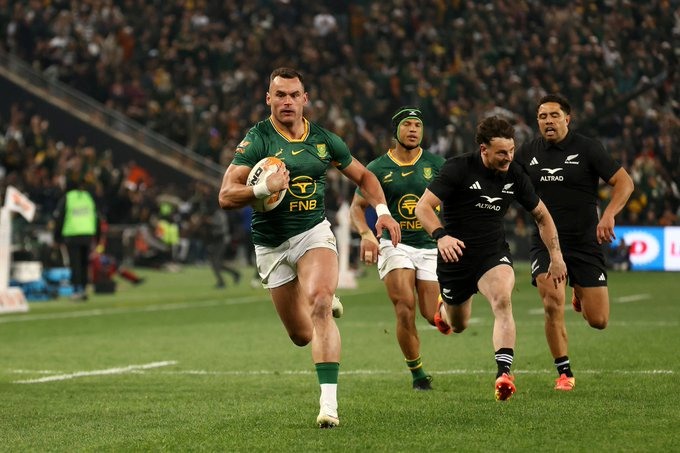
Jesse Kriel broke through, for an unbelievable individual try. A try that had strangers hugging each other. A moment in time that made many boys and girls in the crowd, dreaming of being a Springbok one day.
Malcolm Marx finished a powerful maul. Sacha Feinberg Mngomezulu kicked the points that mattered. Ethan Hooker, magnificent in the air and increasingly influential around the field, gave the Boks another dimension.
And the bench mattered.
South Africa’s replacements arrived into a game that was beginning to tilt towards the side with greater depth, greater experience and, crucially, a clearer understanding of how to win this sort of Test.
New Zealand, under Dave Rennie, are still building.
They are not far away. Rennie is right about that. The All Blacks carried the ball 881 metres to South Africa’s 684, made 472 carry metres to the Boks’ 427 and beat 34 defenders to South Africa’s 26. They also offloaded 10 times compared with the Boks’ two.
That is not the statistical profile of a beaten team. It is the profile of a dangerous team that failed to turn enough of its possession into control.
South Africa were more ruthless when the match narrowed.
They carried 102 times and passed 92 times, compared with New Zealand’s 137 carries and 169 passes. Yet the Boks produced nine clean breaks and repeatedly found ways to turn pressure into points.
Their kicking game was also calculated rather than merely conservative. South Africa put 19 kicks in play for 610 metres, with four contestable kicks and four kicks into the box. New Zealand kicked 20 times for 565 metres, with nine kicks into the box and seven contestable kicks.
The territorial battle was therefore not about who kicked more. It was about what each side did with the moments that followed.
And South Africa were increasingly clinical.
Rassie Erasmus called the match “epic”, an intense battle in which both teams lost vital players. He was also candid enough to admit that his side had left points and opportunities behind.
“We’re just happy we won,” Erasmus said.
That modesty was revealing. The Springbok coach knew this was no demolition. The All Blacks had come to Johannesburg to play, and they did. But when the game entered its decisive phase, South Africa owned the important moments.
The set piece was central to that.
Both sides won 100 percent of their scrums according to the match statistics, while South Africa completed all 12 of their lineout throws and New Zealand lost one from 11. The Boks retained two of their six restarts; New Zealand retained none.
Then came the scrum penalty try that dragged South Africa level before half time, and later the maul that allowed Marx to crash over after New Zealand kicked the ball dead deep in its own territory.
It was classic South Africa, but there was more to it than brute force.
The Boks attacked with width. They moved the All Blacks from touchline to touchline. Kurt Lee Arendse scored after one such sequence in the first half, while Kriel’s second half try came after New Zealand’s defence finally cracked.
For all the talk of power, this was a Springbok side willing to play. That is what makes the performance significant.
They can win ugly. They can win through the scrum and maul. But in Soweto they also showed they can stretch New Zealand, exploit space and keep attacking when the obvious option is to retreat into survival mode.
New Zealand’s response was admirable.
Will Jordan’s try briefly put them 17- 12 ahead in the second half. The All Blacks kept throwing passes, kept searching for the next opening and kept believing that the game could still be turned.
Then South Africa turned the screw.
Rennie admitted his side “couldn’t wrestle momentum back” once the Boks established control.
That sentence may prove more important than the five point margin. Because this is where the two teams currently differ.
New Zealand can match South Africa for long stretches. They can even make the world champions look vulnerable. Their statistics prove that. But South Africa have spent years learning how to survive the difficult passages and then punish an opponent when the door opens.
Savea’s injury made that door wider. His absence from the decisive passages was massive, particularly after he had scored twice and looked capable of disrupting South Africa throughout the contest. New Zealand will now have to travel to Baltimore without their captain after his shoulder injury was confirmed as serious enough to rule him out of the final Test.
Cheslin Kolbe also left the field early and has since been ruled out with a broken jaw, another reminder of just how costly this match was.
There was little elegance about the final stages. It was collision after collision, tackle after tackle, the sort of rugby in which reputations are made and bodies pay the price.
Siya Kolisi seemed to understand the occasion better than most.
His 55th Test victory as Springbok captain made him the most successful captain in the country’s history. He spent almost an hour emptying himself into the contest before South Africa finally took control.
That is Kolisi’s value. It is not simply the armband. He understands the emotional temperature of a Springbok Test and knows when a match needs leadership rather than decoration.
South Africa have now won seven of their past nine Tests against New Zealand, and they have done it by becoming extraordinarily good at the moments that matter.
The All Blacks will point to the missed opportunities, the errors and the loss of Savea. They should. Rennie is also right that the gap between these teams is not enormous.
But it is a gap.
At present, that’s the difference between a team still discovering what it can become and one that has spent eight years learning exactly who it is. New Zealand can match the Springboks for long stretches, but South Africa have developed an instinct for these moments, for the matches that tighten the chest and leave no room for error.
Before kick- off, Deon Fourie stood for the anthem with tears streaming down his face. In the crowd, grown men in green and gold wiped away their own. There was hope in the air, the kind that only a packed Soweto stadium can produce. Ninety thousand voices then carried the teams into a contest that had everything: courage, chaos, injuries, momentum swings and a finish that refused to breathe.
The day began with hope. It ended with something far greater. An extraordinary Test. A brutal night in Soweto, and undoubtably the game of the year.
Scorers
South Africa – Tries: Kurt-Lee Arendse, Penalty try. Jesse Kriel, Malcolm Marx. Conversions: Sacha Feinberg-Mngomezulu (2). Penalty: Feinberg-Mngomezulu.
New Zealand – Tries: Ardie Savea (2), Will Jordan, Samisoni Taukei’aho, Conversions: Ruben Love. Damian McKenzie.