
By Sandy McCowen.
The reopened inquest into the death of Black Consciousness Movement leader Steve Biko has been halted indefinitely, after the Biko family won an urgent court application for more time to prepare their case.
The Gqeberha High Court on Wednesday ordered that proceedings in the inquest be stopped while it reviews the decision by presiding Judge Isaac Madondo to refuse the family’s request for a postponement.
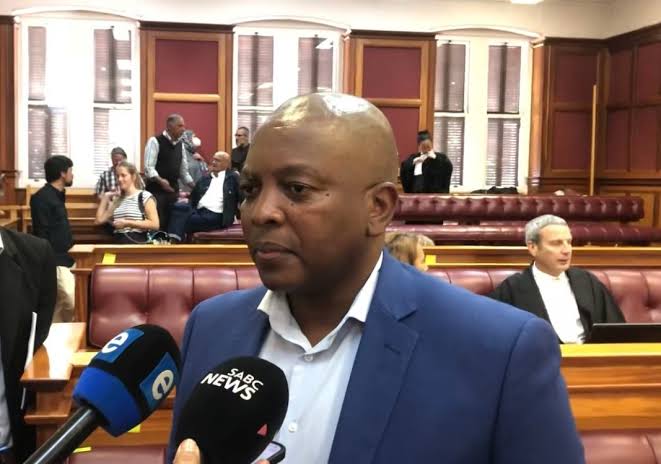
Outside court, Biko’s eldest son Nkosinathi said the family welcomed the decision with ‘heavy hearts’.
“This is not a matter to be celebrated, this is not about win or lose,” he said. “This decision by this court supports the fact that there is indeed a compelling case to pause the process and cure the ills of this inquest.”
The dramatic intervention came just three days before the 49th anniversary of Biko’s death in police custody on September 12, 1977.
The family says it is not seeking to delay the inquest unnecessarily, but wants an opportunity to properly examine thousands of pages of historical evidence before questioning those implicated in Biko’s death.
Representing the family, Advocate Dali Mpofu SC told the inquest court that they wanted an effective process in which Biko’s family could properly exercise its right to participate and question those accused of being involved in his death.
“There is no one in this country or anywhere who would like to see this matter finished as soon as possible more than Mrs Biko and Mr Biko,” Mpofu said.
“All they are asking for is that there should be an effective inquest where their right to participate and their right to question the alleged murderers of their husband and their father is going to be done in line with justice.”
The family only secured state funding for its legal representation on August 24, the day the reopened inquest began.
Their lawyer, Ngqiqo Sakhela then asked for a postponement to work through thousands of pages of historical records, much of which is in Afrikaans and has still to be translated.
The family’s concerns were reinforced by evidence from the state’s own investigating officer, Sergeant Fundiswa Dingiswayo, who told the inquest that she does not understand Afrikaans.
She also raised concerns about missing documents and gaps in the case file.
Madondo rejected the postponement application on August 26, saying the court was in a race against time because many of the people who may have information about Biko’s death are elderly.
He pointed to the death of Gabriel Ndlovu, a former Pretoria prison hospital detainee who died in April before he could give oral evidence.
Madondo also noted that the Biko family’s legal team had had about ten months to prepare for the inquest.
But the family argued that it could not properly participate until it had funding and access to the full body of evidence.
Armed with the High Court order, Advocate Dali Mpofu SC rushed downstairs to the inquest court, where a frail-looking former Security Branch officer, Jacobus Johannes Oosthuysen Beneke, and his advocate, Marius van Zyl SC, were already online from Pretoria and preparing for Beneke’s cross-examination.
After a brief meeting with Madondo in his chambers to present the order, Mpofu returned to court and placed it on record.
“In short, my Lord, these proceedings have been interdicted by court order and cannot proceed any further,” he said, asking that the inquest be adjourned indefinitely, bringing the inquest to a standstill.
Mpofu told the court that the review process must now move quickly, citing previous case law which established that decisions made during an inquest can be challenged through a legality review.
Madondo acknowledged that the High Court order was binding and said he had intended to adjourn the inquest until March next year to allow the family more time to prepare.
He urged the legal teams not to allow the review to drag on.
“You must not take ages to get this case organised,” Madondo said. “I pray, that you must not take ages or prolong this case unnecessarily, move with expedience.”
After the court adjourned, Nkosinathi told the media his family was concerned about the delays.
“We are very concerned about delays to a matter of this nature. But we are also concerned about having a performative process. We have been through that,” he said.
He added that it is very important that this inquest tell the nation what happened to Steve Biko.
The postponement leaves some of the most contentious evidence heard during the two-and-a-half-week inquest on the record.
Former Security Branch captain Daniel Petrus Siebert testified online from Jeffrey’s Bay that Biko was first interrogated 19 days after his arrest.
He was arrested with his close comrade Peter Jones on August 18, 1977, at a police roadblock near Grahamstown, now Makhanda, in the Eastern Cape.
He said the apartheid activist hit his head against a wall during an altercation with his interrogation officers on September 6, 1977.
Siebert said Biko became disoriented after the incident and was later handcuffed and shackled to a gate grille, standing up, crucifixion-style, by Sergeant Gideon Nieuwoudt on the orders of Major Harold Snyman.
He also testified that Nieuwoudt repeatedly assaulted Biko with a piece of cut-off garden hosepipe known among the interrogation team as the “Green Mamba”.
He said this was the only occasion the Black Consciousness Movement leader was interrogated.
But that version of events has been challenged by forensic evidence.
Forensic pathologist Dr Shakeera Holland told the inquest that her assessment of the original autopsy report indicated that Biko’s extensive injuries were sustained at different times over a period of days, rather than during a single confrontation.
She identified at least ten soft-tissue injuries consistent with repeated blows from a hosepipe.
The evidence of the former security branch officers has therefore left a stark question hanging over the proceedings: how and when did Biko sustain the injuries that contributed to his death?
Siebert and former Security Branch officer Jacobus Johannes Oosthuysen Beneke have maintained that the force used against Biko was necessary to subdue an uncooperative detainee.
Siebert described the confrontation as a “scuffle”, comparing it to a rugby maul.
The Biko family says it will now use the time to work through additional material, including records from the Truth and Reconciliation Commission and other archives, with the intention of strengthening the case and recalling Siebert for further questioning.
Nkosinathi said the family had already approached the South African Broadcast Corporation (SABC) for access to its extensive TRC archives.
“We know from the people that have appeared already, Siebert and in part Beneke, that they are here to tell us a third version of what happened,” he said.
“But we know what they said at the TRC. And it’s on record, and it’s on video, and it’s in their own words. We also know what they said at the first inquest.”
He said the family wanted to ensure the existing testimony remained available while the investigation was strengthened.
“Time is everything for this process,” he said.
For Biko’s children, however, the case is about much more than documents and legal arguments.
Nkosinathi standing with his younger brother outside court, reflected on how much time has passed since his father died.
He pointed to Samora, who was just two years old when Biko died.
“Just to measure time, this man was two years when our father died,” Nkosinathi said, referring to the well-known photograph of Samora sitting on their mother’s lap, crying with a bottle in his hand.
“I left a lot of milk on the table for him, you know, many years ago.”
Samora said the family was not concerned about reaching a quick conclusion.
“The process itself has been really daunting for us. And the success that we’ve achieved this morning basically highlights what we were always requesting,” he said.
“There’s no speed that needs to be manifested in this process. Let’s take our time so that at least on this occasion we can hear the real versions of what transpired.”
The Biko family will gather on Saturday with communities across the country to mark 49 years since his death.
Their father was 30 years old, when he died.
Nkosinathi said the family would attend a service at the church where Biko was baptised and served, before a wreath-laying ceremony at his grave.
They will also participate in a memorial lecture at Nelson Mandela University in Gqeberha, while churches around the country are expected to hold services in his memory.
For Nkosinathi, the continued remembrance of his father is itself a measure of the legacy Biko left behind.
“Usually, it’s also the time that we witness thousands of South Africans on their social pages celebrating his life,” he said. And legacies live when they live in people’s hearts. So, for us that is very meaningful.”