
By Kevin Rademeyer, Sports Journalist.
Photo Credit: US Open.
The scoreboard said 6-3, 7-6, 5-7, 6-2. The history said something more complicated.
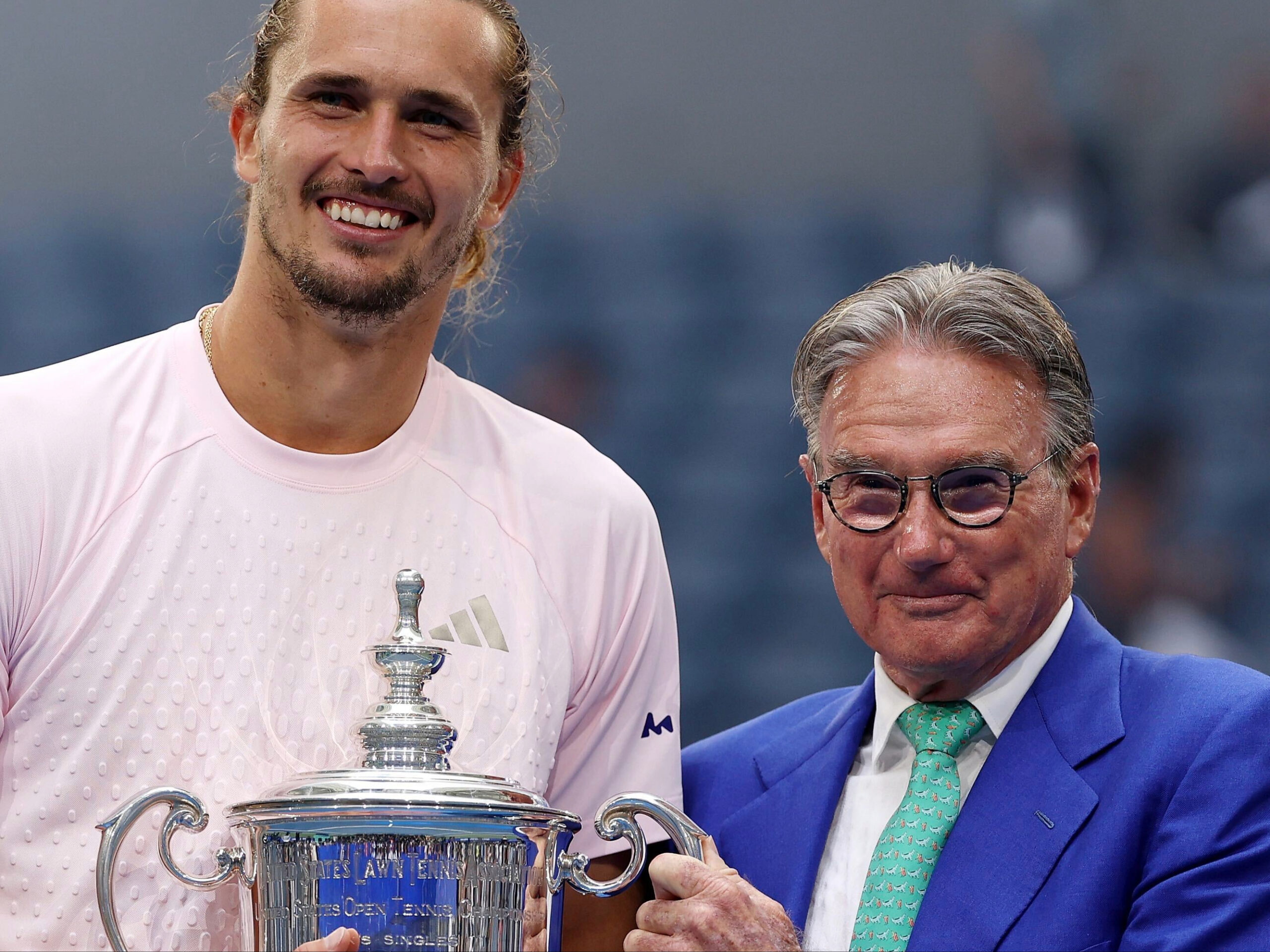
Alexander Zverev stood on Arthur Ashe Stadium on Sunday afternoon with the US Open trophy in his hands, six years after he had been two sets and a break from winning the same thing.
Around him, 23,000 people had spent much of the afternoon willing Ben Shelton towards a piece of American sporting history.
Zverev had other plans.
There was no great theatrical flourish when Shelton’s final return sailed long. In fact, the German walked back behind the baseline as though the point were still being played.
He had forgotten the score. He thought he was serving at 5-1, not 5-2, and for a few seconds didn’t even realise he had just won the US Open.
It was strangely fitting. After everything that had happened to him in New York, Zverev had become so absorbed in the business of surviving the next point that he had missed the moment when survival became triumph.
The final itself was not a masterpiece. It didn’t need to be.
Shelton had the noise, the serve and the weight of a national drought on his shoulders. No American man had won the US Open since Andy Roddick in 2003.
A victory would have made Shelton the first Black American man to win the men’s singles title in New York since Arthur Ashe, and his run had already transformed him from promising young player into the central character of the American tennis summer.
Zverev was the obstacle.
The German served 69 per cent of first serves and won 85 per cent of those points. He kept Shelton’s enormous forehand from dictating, absorbed the pace with that exceptional two handed backhand and, most importantly, refused to allow the occasion to change the way he played. He now leads Shelton 6 0 in their rivalry.
The first set turned on Shelton’s nerves. He double faulted on break point in the opening game and again on set point. Zverev took what was offered.
The second was tighter. Shelton held his nerve long enough to force a tie break, and Arthur Ashe sensed the possibility of a different afternoon. Then Zverev took the first five points. A forehand passing shot produced the first mini break, another fierce forehand down the line produced the second. Two unreturned serves later, he was 5-0 ahead.
That was the pattern. Shelton could create the noise. Zverev controlled the important moments.
Then, finally, came the third set.
At 6-5, with defeat one game away, Shelton broke through. He began swinging freely, particularly with the forehand, and suddenly the stadium had a pulse. He broke Zverev’s serve, pumped his fist, cupped his ear to the crowd and tried to drag the match somewhere emotional.
It worked, briefly.
Shelton took the set 7-5, ending a remarkable sequence of 66 consecutive service holds between the two players in their rivalry. The comeback was alive.
For about five minutes.
Zverev opened the fourth set by breaking Shelton. Then he broke again. The American fought until the final ball, but the German had already regained control. At 5-2, Shelton sent the championship point long.
The American dream had reached its limit.
Yet Shelton leaves New York with something valuable. He arrived after winning the Canadian Open, survived a quarter-final against Carlos Alcaraz that finished at 3.33am and then beat Frances Tiafoe in an all American semi final. He leaves as a Grand Slam finalist and with a new career high ranking of No 4.
Before the final, Shelton had spoken about the areas of his game that still needed work: his return, his baseline stability, even the construction of his service games. “The pursuit and hunger to get better, to find ways that I can improve,” he said, “it’s just a part of who I am and something that will never change.”
That is why this may be the beginning of something rather than the end of it.
For Zverev, however, the story has travelled much further.
At four years old, he was diagnosed with Type 1 diabetes. His mother, Irina, was told that his life and sporting ambitions would be restricted. She refused to accept that verdict.
“My son will be whatever he wants to be,” she told the family. “If he wants to be a tennis player, he’ll be a tennis player. If he wants to do something else, he’ll do something else. But this illness will not define us.” Zverev returned to that belief after winning in New York, crediting his mother as the person who never allowed the diagnosis to become a ceiling.
There is a particular power in that sentence because the US Open itself had seemed determined to contradict it.
Zverev began this tournament as the No 1 seed and nearly went home in the first round against Lorenzo Sonego. Then came Quentin Halys, another five setter that finished after 2am. He later admitted that at one point he looked at his team and thought, “Well, this is pointless because I’m not going to do anything here.”
Then he stayed.
He kept winning ugly. As he put it before the final, winning ugly is “a skill when you’re not playing great tennis”, adding with a smile: “I think I’ve mastered that right now.”
Sport is often sold through the grand gesture: the winning shot, the trophy, the celebration. The reality is usually less glamorous. It is the long rehabilitation, the second chance, the next serve after a double fault, the morning when you don’t feel like going back to work but go anyway.
Shelton discovered that there is a massive difference between winning and being a finalist on Sunday. He could not quite finish the job, but he had already changed the direction of his career.
Zverev discovered it much earlier.
Six years ago he led Dominic Thiem by two sets in this same final and served for the championship in the fifth. He lost. For years afterwards, the defeat became part of the description of him: immensely talented, physically imposing, repeatedly present at the business end of Grand Slams, but somehow unable to close the account.
Roland Garros changed that in June.
The US Open finished the argument.
Zverev is now only the fourth man in the Open era, after Jimmy Connors, Guillermo Vilas and Jannik Sinner, to win his first two Grand Slam titles in the same season. This was his sixth major final and his second Grand Slam trophy of 2026.
The match will be remembered in the statistics. The year will be remembered in the record books.
But perhaps the most enduring image is the man who didn’t know he had won.
For someone who spent his childhood being told that illness would limit his possibilities, who once wondered whether a tournament was already pointless, and who had previously watched a US Open championship disappear from his grasp, there was something wonderfully human about not immediately recognising the finish line.
He had spent so long learning to carry on that, when the moment finally arrived, he was still carrying on. That is where the inspiration lies. Not in pretending that hope makes the road easy. It doesn’t.
Hope is sometimes just refusing to leave the room. Zverev stayed. And now, he gets to leave New York with the trophy, the money and the glory.