
By David Herbling.
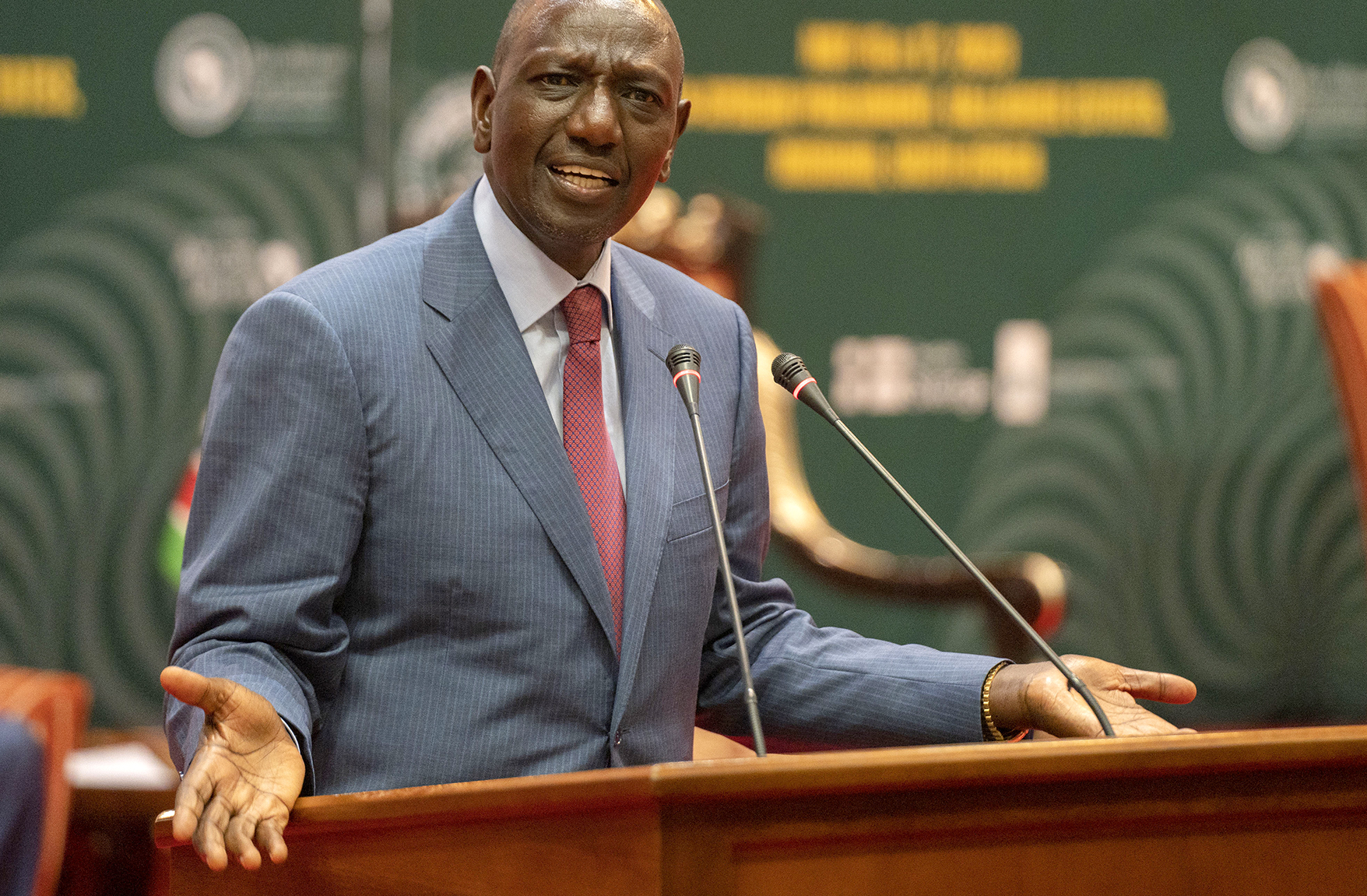
Kenya President William Ruto speaks during a climate change summit at the Pan African Parliament in Midrand, South Africa, on 17 May 2023. (Photo: Ihsaan Haffejee / Anadolu Agency via Getty Images).
President William Ruto’s $39 billion infrastructure plans could be starved of cash after a Kenyan court quashed his administration’s recent divestiture in East Africa’s most valuable company.
The sale of a 15% stake in Safaricom Plc to Vodacom Group was meant to provide $1.9 billion in seed capital for a newly established National Infrastructure Fund to finance a seven-year project rollout.
High court judges invalidated the deal on Tuesday, saying Kenya’s constitution doesn’t provide for divestitures as a means for the government to raise revenue. Other than Safaricom, Treasury has already pocketed $820 million from an initial public offering in Kenya Pipeline Co. earlier in the year.
The NIF hoped to leverage those privatisation proceeds to raise 10 times more financing from pension funds and banks. Ruto, who’s seeking a second term in elections less than a year away, may borrow more to sustain his infrastructure build-out or scale back his plans, analysts said.
“Ruto will try to plug the gap by leaning on further public-private partnerships and the NSSF, though this is highly unlikely to be sufficient, “said Edward Bach, senior Africa analyst at risk intelligence company Verisk Maplecroft, referring to the National Social Security Fund. “Ruto’s ambitions and the Fund will need to be significantly scaled back.”
The government, which doesn’t have much room to raise taxes, has pivoted to privatisation of state assets and securitisation of future tax revenue to raise project financing for the $141 billion economy.
“Our base case is increased borrowing from both domestic and external markets,” said Stellar Swakei, a macro, fixed-income and banking analyst at Renaissance Capital Kenya. “We expect the government to leverage available liquidity to finance infrastructure through the election.”
It may also seek more user-pays projects, such as tolled roads, according to Churchill Ogutu, head of research at Nairobi-based Capital A Investment Bank.
“They’ll revert to capital markets financing, securitisation and definitely borrowing as they resolve the legal issues,” Ogutu said.
Both Vodacom and Kenya’s Treasury have said they’ll appeal the decision.
The High Court said Safaricom’s pricing was arbitrary as authorities only hired a transaction adviser after reaching a 34-shilling per share price, denying Kenyans the chance of getting a better price for the public asset. It also tore into the decision to deposit the proceeds in the NIF, saying the fund doesn’t ringfence cash for specific projects.
Safaricom shares were down 4.7% by 1:27 p.m. in Nairobi, while Vodacom extended losses by dropping as much as 2.7% in Johannesburg.
© 2026 Bloomberg.