
By Kevin Rademeyer, Sports Journalist.
Mention Australia or 1999 to a South African sports fan and the memories arrive instantly. Donald. Run. Miss. Referee. Extra time. Klusener. Gibbs. Warne. Dropped catch. Larkham.
A lump in the throat. A tightening in the chest. For some, even now, a tear in the eye.
That is what Australia has become in South African sport. Not simply an opponent, but a country woven into some of the most painful defeats and most glorious victories of the past three decades.
In 1999, both the Proteas and Springboks came within a match of a World Cup final. Both lost to Australia. South Africa’s cricket defeat came after a tied semi- final at Edgbaston, while the Springboks were beaten in extra time at Twickenham.
Since then, the wounds have multiplied. The 2011 rugby quarter final. The 2023 cricket semi- final. Each defeat added another memory to a sporting relationship already heavy with history.
But that is only half the story.
South Africa has also produced some of its most extraordinary victories against Australia. The 438 chase at the Wanderers. The first Test series win in Australia. The Springboks’ 1995 World Cup victory at Newlands. The Proteas Women’s stunning T20 World Cup semi- final triumph in Dubai in 2024.
That is why these encounters still feel different. They are never only about the next result. They carry the weight of everything that came before.
On Sunday, that history returns on two fronts.
At the Wanderers, the Proteas face Australia in the second ODI holding a 1-0 lead after a 67-run victory in Durban.
In Perth, the Springboks meet the Wallabies in a one-off Test at Optus Stadium, with Rassie Erasmus making 13 changes to the side that defeated New Zealand 43-28 in Baltimore.
Both matches matter in their own right. Both also offer a glimpse towards 2027, when the Cricket World Cup will be staged in South Africa, Zimbabwe and Namibia, while the Rugby World Cup heads to Australia.
For South African supporters, though, the build-up is about more than future tournaments. It is about memory. And perhaps, after all these years, redemption.
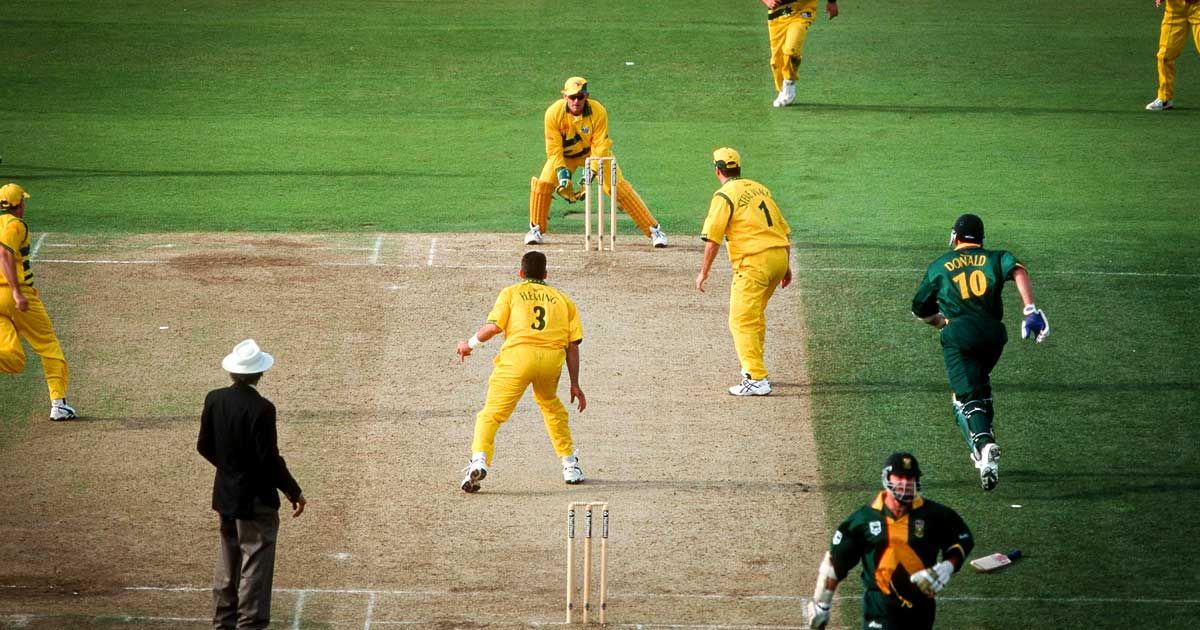
On 17 June 1999, South Africa needed 214 to beat Australia at Edgbaston and reach their first World Cup final.
They reached 213.
Lance Klusener had taken the match by the throat, smashing the first two balls of the final over for four. South Africa needed only one run from four deliveries.
Then came the moment that has lived in South African sporting memory ever since.
Klusener hit towards a fielder and set off. Allan Donald didn’t. By the time the ball reached Adam Gilchrist, Donald was stranded.
Run out. Distraught. What did the world witness.
The match was tied at 213-213, but Australia advanced because they had finished higher in the Super Six standings.
There was another wound inside that wound.
Four days earlier at Headingley, Herschelle Gibbs dropped Steve Waugh when Australia were in serious trouble. Waugh went on to score 120 not out as Australia won by five wickets.
That result helped Australia finish above South Africa in the standings and ultimately gave them the advantage when the sem-i final ended in a tie.
Then came Twickenham.
The Springboks were defending world champions. Australia wanted their place in the final. After 80 minutes, the teams were locked at 18-18.
Extra time
Jannie de Beer and Matt Burke exchanged penalties before Stephen Larkham, a flyhalf who had never kicked a Test drop goal, struck from 48 metres.
It sailed over. Australia won 27-21.
For a country still carrying the extraordinary emotional weight of the 1995 World Cup triumph, it was a brutal reversal. Four years earlier, Joel Stransky had used a drop goal to win South Africa the World Cup.
At Twickenham, an Australian drop goal ended their defence.
The ghosts kept coming
The contest produced another painful chapter in Wellington in 2011. South Africa dominated possession and territory in their World Cup quarter final against Australia but could not turn that pressure into enough points.
Australia won 11-9.
Referee Bryce Lawrence became a major part of the South African post match debate, with criticism focused on his interpretation of the breakdown. Whatever the arguments around the officiating, the result remained brutally simple: Australia advanced.
Twelve years later, the Proteas Men were back in a World Cup semi- final against the same opponent.
Kolkata. November 2023. South Africa were 24-4. David Miller responded with an extraordinary 101 from 116 balls to drag them to 212.
The bowlers fought back, reducing Australia to 193-7. But Australia found a way through again.
Travis Head and the lower order held their nerve. Australia reached 215-7 and won by three wickets.
Those are the defeats that shape the mood whenever these two countries meet.
But there is another side to the story. When South Africa answered back
On 12 March 2006, Australia scored 434-4 at the Wanderers.
South Africa chased it.
Herschelle Gibbs made 175 from 111 balls. Mark Boucher finished unbeaten on 50. The Proteas reached 438-9 with one ball remaining. It remains one of the defining matches in ODI history.
Then came Perth in 2008. Graeme Smith’s South Africa chased 414 against Australia and went on to win the series 2-1, their first Test series victory on Australian soil.
There was the Springbok victory in the opening match of the 1995 World Cup, too.
Newlands was packed. Nelson Mandela was there. South Africa were playing their first World Cup match after the end of sporting isolation and facing the defending champions.
The Springboks won 27-18.
Joel Stransky scored 22 points through a try, conversion, four penalties and a drop goal. Pieter Hendriks scored the other South African try after beating David Campese on the outside.
That victory helped change the atmosphere around the tournament and strengthened the belief that South Africa could beat the world’s best.
The women’s game has produced its own answer. In the 2024 T20 World Cup semi- final in Dubai, the Proteas Women ended Australia’s run of three successive titles. Anneke Bosch smashed an unbeaten 74 from 48 balls as South Africa chased 135 with eight wickets and 16 balls to spare.
For one night, the balance of history tilted.
Now comes Sunday
The Proteas arrive at the Wanderers with the ODI series already in their hands, if only narrowly.
Matthew Breetzke’s second ODI century and Marco Jansen’s explosive 75 helped South Africa reach 296 in Durban. Jansen then produced a spectacular catch before Keshav Maharaj took four wickets as Australia collapsed against spin and were bowled out for 229.
Aiden Markram could return for the second match, while Australia could bring back their official ODI captain, Pat Cummins. Josh Inglis has been ruled out with a finger injury, with Alex Carey expected to take the gloves.
It is Pink Day, an occasion that raises money for cancer research and treatment, but the cricket itself will have little sentiment.
South Africa want to strengthen their position in the series. Australia need a response.
Then, thousands of kilometres away, the rugby takes centre stage.
Erasmus has effectively put a new group of Springboks on the field. Only Eben Etzebeth and Ethan Hooker remain from the starting XV that defeated New Zealand in Baltimore.
André Esterhuizen will captain the side. Handre Pollard returns at flyhalf. Malcolm Marx is on the bench, alongside a group of experienced players who give Erasmus plenty of options when the game begins to tighten.
Australia have selected a strong side under Les Kiss. Harry Wilson will captain the Wallabies as they attempt to claim a significant scalp against the world champions.
The Springboks, meanwhile, have something to prove of their own.
This is not simply rotation. It is an examination of the depth Erasmus hopes will carry South Africa towards the 2027 World Cup.
So Sunday carries two questions.
Can the Proteas take another step towards winning an ODI series against the team that has broken South African hearts so many times?
And can a reshaped Springbok side travel to Perth and prove that the depth behind the first choice team is ready for the biggest stage?
For South African supporters, Australia is never just Australia.
It is Gibbs at Headingley. Klusener at Edgbaston. Donald standing his ground. Larkham from 48 metres. Bryce Lawrence. Miller in Kolkata.
But it is also Gibbs on 175. Boucher raising his bat at the Wanderers. De Villiers finishing the chase in Perth. Stransky against the world champions at Newlands. Bosch taking Australia apart in Dubai.
That is the contradiction at the heart of this contest.
Australia carries some of South Africa’s deepest sporting scars. It also carries some of the country’s most cherished victories. On Sunday, the past will be sitting somewhere in the stands. The players, however, have only the next ball.