
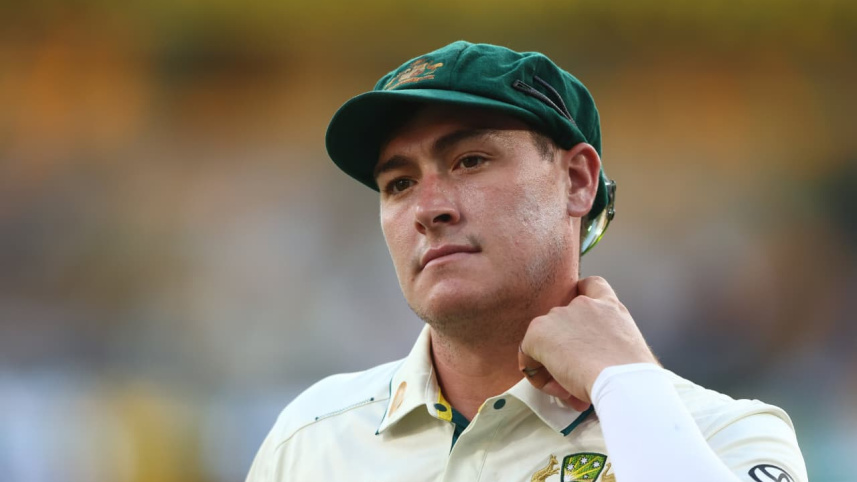
By Estea Rademeyer, Sports Journalist.
Photo Credit: Cricket Australia X.
Live from Durban: South Africa had Australia under pressure at 124 for six. By the time Matt Renshaw finally departed, the visitors had turned a precarious position into a commanding first innings total, leaving the Proteas with a demanding task in the opening Test at Kingsmead.
Renshaw’s 190 was the defining performance of the second day, an innings built on patience, discipline and an astute understanding of the situation. Supported by Nathan Lyon, who made 42, the left hander helped Australia reach 484 all out, establishing a substantial advantage after South Africa had threatened to bowl them out cheaply on the opening afternoon.
The ninth wicket partnership of 134 was the largest by an Australian team away from home since 1894. It was also an indictment of South Africa’s inability to finish the job when the opportunity presented itself.
Renshaw reached his second Test century almost a decade after his first, but the milestone was only part of the story. Having arrived at the crease with Australia in trouble on Friday, he batted for 465 minutes and faced 397 deliveries, gradually expanding his scoring range as the innings progressed.
His early approach was cautious. He left well outside off stump, absorbed the pace of Anrich Nortje and Marco Jansen, and resisted the temptation to force the game. Once the second new ball arrived, he began to find the boundary more regularly, while carefully managing Lyon’s exposure to the strike.
South Africa’s spinners struggled to contain him. Keshav Maharaj and Simon Harmer conceded 143 runs between them for one wicket in 48.2 overs, allowing Renshaw to rotate the strike and keep Australia’s innings moving.
Wiaan Mulder acknowledged afterwards that the Proteas could have made life more difficult for the Australian. “Bowling to him, it just seemed like he got off strike so easily,” he said. “Sometimes it felt a bit easy for him.”
The admission reflected a wider problem. South Africa had worked hard to take six wickets, but their intensity faded when the tail resisted. Renshaw repeatedly found singles behind square or straight down the ground, ensuring he faced the first delivery of successive overs and shielding Lyon from the more demanding passages of play.
The Proteas also paid for the workload placed on their fast bowlers. Nortje delivered 28 overs, Jansen 31 and Mulder 27, a significant burden in the opening match of a three Test series. With Kagiso Rabada unavailable through injury, South Africa lacked the additional strike power that might have ended the partnership sooner.
Mulder was the pick of the attack, finishing with four for 68 and taking wickets with both the first and second new balls. He also explained why his bowling style can be effective when conditions offer movement.
“I’ve always tried to bowl faster,” he said. “But in the end, there have been very successful bowlers at my pace. It’s about accepting who you are and trying your best every time.”
There was little to fault in Renshaw’s execution. He understood that time at the crease would benefit Australia, particularly by tiring South Africa’s seamers and reducing their capacity to exploit the conditions later in the match.
The consequences became apparent when the Proteas began their reply. Ryan Rickelton was dismissed after facing only three deliveries, handing Australia an early breakthrough and adding to the pressure on a batting line up that now needs a substantial contribution from its senior players.
South Africa have an opportunity to respond, but they cannot afford another extended period of passive cricket. Australia have shown how to build an innings under pressure and how to exploit a tiring attack.
Renshaw made the difficult look straightforward. South Africa, having done the hard work on the first day, allowed him and Lyon to turn the contest in Australia’s favour. The Proteas now need to demonstrate that they can show the same patience and application with the bat.