
By Lehlohonolo Lehana.
President Cyril Ramaphosa says municipalities will no longer have an automatic right to provide water and electricity, introducing a compulsory licensing system under a revised local government policy.
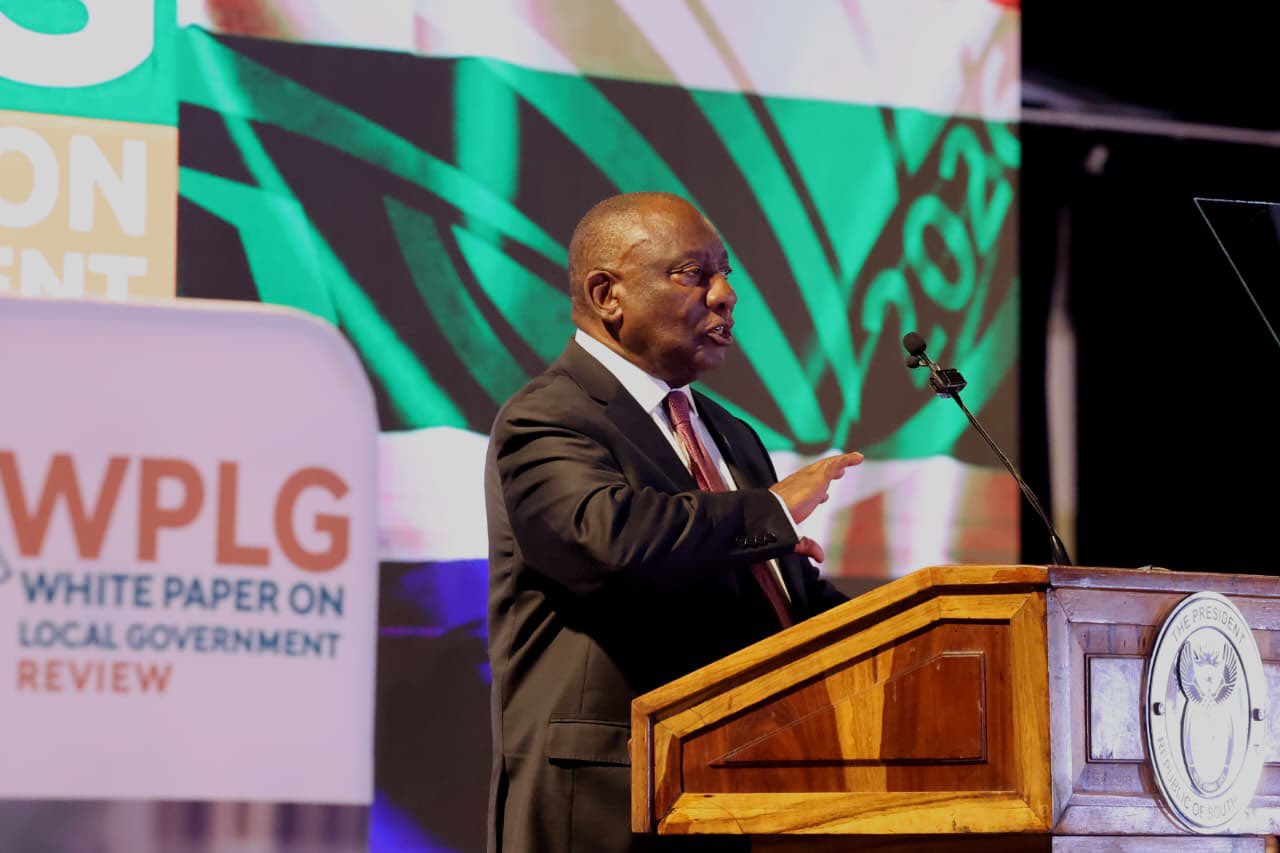
Ramaphosa was speaking at the launch of the revised White Paper on local government in Ekurhuleni on Thursday, 22 October 2026.
The president said, the municipalities will need to obtain formal licenses to distribute and supply water and electricity, rather than holding an automatic mandate.
The revised White Paper builds on the national dialogue on the future of local government, including the resolutions of the 2022 Presidential Local Government Summit, stakeholder consultations and ongoing government efforts to address structural and operational challenges affecting municipalities.
It aims to rectify long-standing institutional weaknesses and address the structural challenges plaguing municipalities across the country.
Ramaphosa said, government must acknowledge, without qualification, that too many municipalities were failing to meet the needs and expectations of the people they were meant to serve. He said the situation could not continue.
He said too many communities had grown accustomed to unreliable services, deteriorating infrastructure and unresponsive municipal administrations.
“Nearly three decades after the original White Paper was adopted, we are undertaking a bold reset of the local government system. Local government is the sphere of government closest to the people.
From the biggest metro to the smallest village, it is where the promise of democracy is most directly experienced. It is also where the failure to deliver services is most acutely felt.”
The president said the policy document represented a reform that went to the heart of the relationship between the government and the public.
He said local government impacted the water flowing from taps, the electricity lighting homes, the roads residents travelled on, the refuse collected from streets and the communities in which children were raised.
Ramaphosa said the policy document was not simply about changing legislation or rearranging institutions. Rather, it aimed to transform the lived experience of citizens by addressing structural weaknesses and outdated assumptions.
He admitted that many of the challenges plaguing local government were systemic, explaining that apartheid’s spatial engineering left a local government system divided along racial lines and marked by unequal revenue potential.
Cooperative Governance and Traditional Affairs (CoGTA) Minister Velenkosini Hlabisa said the revised White Paper will introduce a differentiated funding approach and strengthen merit-based appointments to improve municipal performance and service delivery.
Hlabisa said the review was informed by lessons learnt over the past 28 years, including the shortcomings of a funding model that applied a largely uniform approach to municipalities with different needs and capacities.
“The funding model, the one-size-fits-all, has shown it doesn’t work. If you treat a metro like a small, deep rural municipality in terms of allocation of resources, you are missing the point,” the Minister said.
The revised White Paper proposes a differentiated approach to municipal funding, recognising that metropolitan municipalities and smaller rural municipalities have different responsibilities, resource requirements and service delivery challenges.
Meanwhile, National Treasury is also planning the first comprehensive overhaul in 23 years of the law governing municipal finances.
Speaking during the tabling of the Medium-Term Budget Policy Statement in Parliament on Wednesday, Finance Minister Enoch Godongwana said the changes will require municipalities to adopt properly funded budgets, improve revenue collection and strengthen accountability.
The amendments will also give Treasury stronger powers to investigate financial misconduct, recover losses and intervene earlier when municipalities face financial distress. Godongwana said the reforms are intended to improve financial management while protecting basic services for poorer households.