
By Lehlohonolo Lehana.
President Cyril Ramaphosa said on Wednesday, 04 November, 2026 that the results from midterm elections in the United States would usher in a new era in world relations.
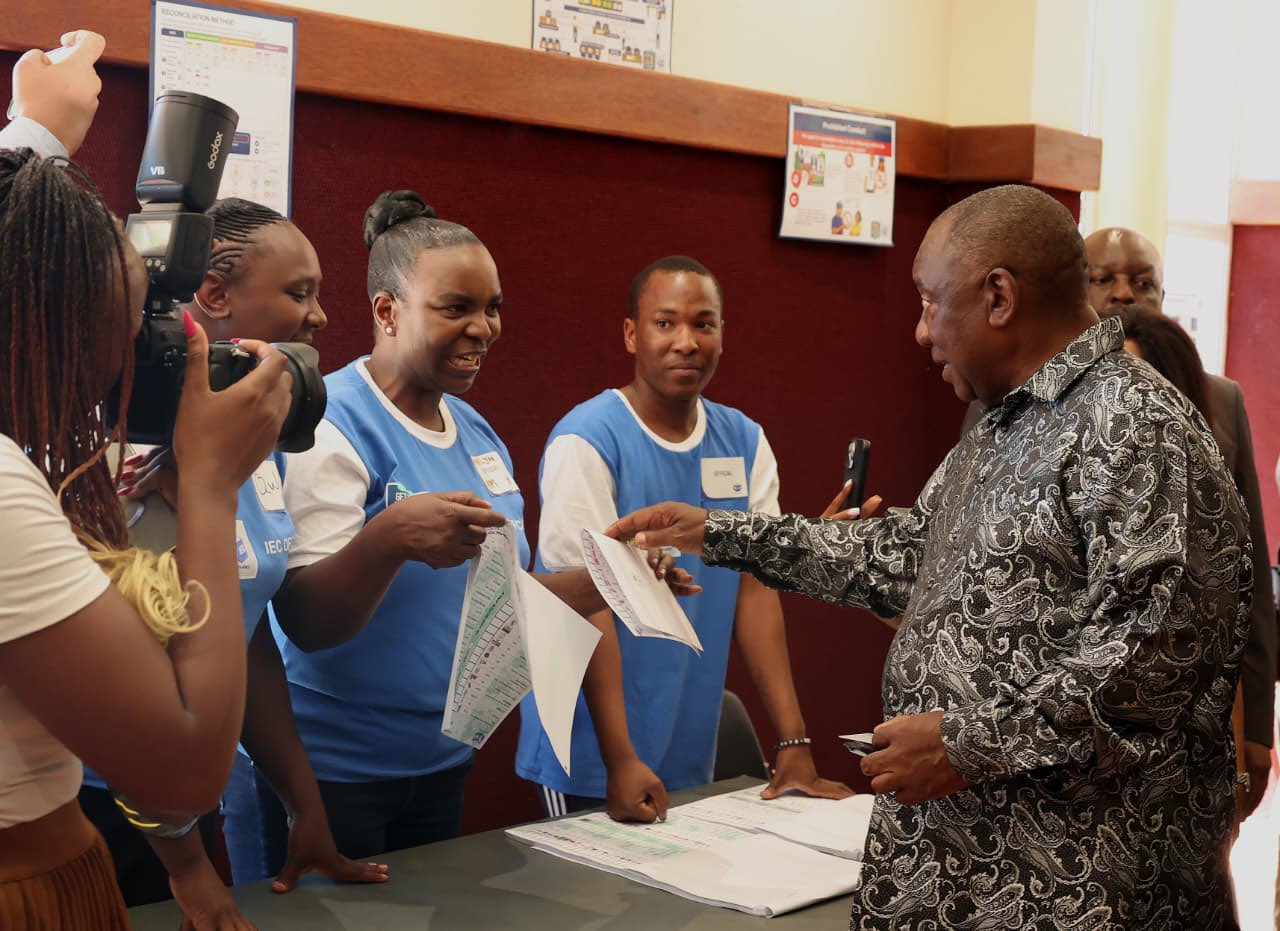
Ramaphosa was speaking at the centre of a media swarm outside the Hyde Park voting station where he cast his ballot.
Democrats captured majorities in both the Senate and House on Tuesday, scoring sweeping victories that reached deep into Republican strongholds as tens of millions of voters delivered a scathing rebuke to President Donald Trump.
Journalists questioned Ramaphosa on his response to the US midterm elections, where Democrats have taken the House and the Senate.
Ramaphosa described this as a “new era” dawning for the US: “We are always willing to have good relations with the USA.”
He reaffirmed South Africa’s commitment to maintaining good bilateral relations with Washington, while emphasising the country’s sovereignty and right to advance its national interests.
“The people of America have spoken, and possibly the change in the governorship of the House as well as the Senate will bring about some changes. We are always willing to have good relations with the United States. We will advance our own interests, as they too must.”
The outcome gives Democrats greater power to scrutinise the Trump administration, investigate its actions, block presidential nominees and challenge his legislative agenda. The new Congress is expected to take office in January 2027, creating a divided government for the final two years of Trump’s presidency.
AGOA
On the US government revoking South Africa’s access to Agoa, Ramaphosa said Pretoria’s focus was on “a bilateral trade agreement” between the countries.
“They [the US government] have left a door open [in terms of Agoa] to say that if they perceive that things have changed, and I don’t know what those things are, there may be readmission,” he said.
Ramaphosa says that “We must understand that Agoa is a unilateral trade arrangement, that the United States decides on the way we want to focus more on a bilateral trade agreement, where both parties sit down and negotiate trade, rules, trade, mechanisms, that, in our view, will enforce and reconfirm our own sovereignty, as well as the sovereignty of the United States.”
“There is a lot that both countries have to offer each other, and we prefer that they should be done on a negotiated basis. Whilst our industries benefited from Agoa, which is good, up till January, we’ve also seen how, through the trade and industry and competition department, we’ve been diversified, we’ve been spreading our wings, and going to various other countries.”
“So diversification has now become the order of the day. And even as the Liberation Day tariff increase process started. We started diversifying and many of our companies are already dealing with a number of other countries.”
LGE 2026
With regards to long queues at some voting stations, Ramaphosa said he was “so encouraged by how our people have come out to vote”.
The President suggested that the number of candidates and parties contesting this election made it unique.
“My view is that we’ve never really in years had a local government election like this,” he said.
Asked why he had switched his voting station from Chiawelo to Hyde Park, Ramaphosa said that it was a “sad” consequence of the change in IEC rules mandating South Africans to vote where they pay rates and taxes.
“It has always been a tussle where I belong,” Ramaphosa said, referring to Hyde Park vs Chiawelo.
Meanwhile Economic Freedom Fighters (EFF) leader Julius Malema and Democratic Alliance (DA) leader Geordin Hill-Lewis casted their votes in separate locations.
Malema cast his vote at Mponegele Primary School in Seshego, Polokwane, he expressed satisfaction with the IEC processes and emphasized that the EFF is relying heavily on young voters.
Hill-Lewis cast his vote in Edgemead, Cape Town (alongside DA Basic Education Minister Siviwe Gwarube).
He urged citizens to turn out in large numbers, warning that polls were tight and that sitting out the vote leaves the future of local municipalities to others.