
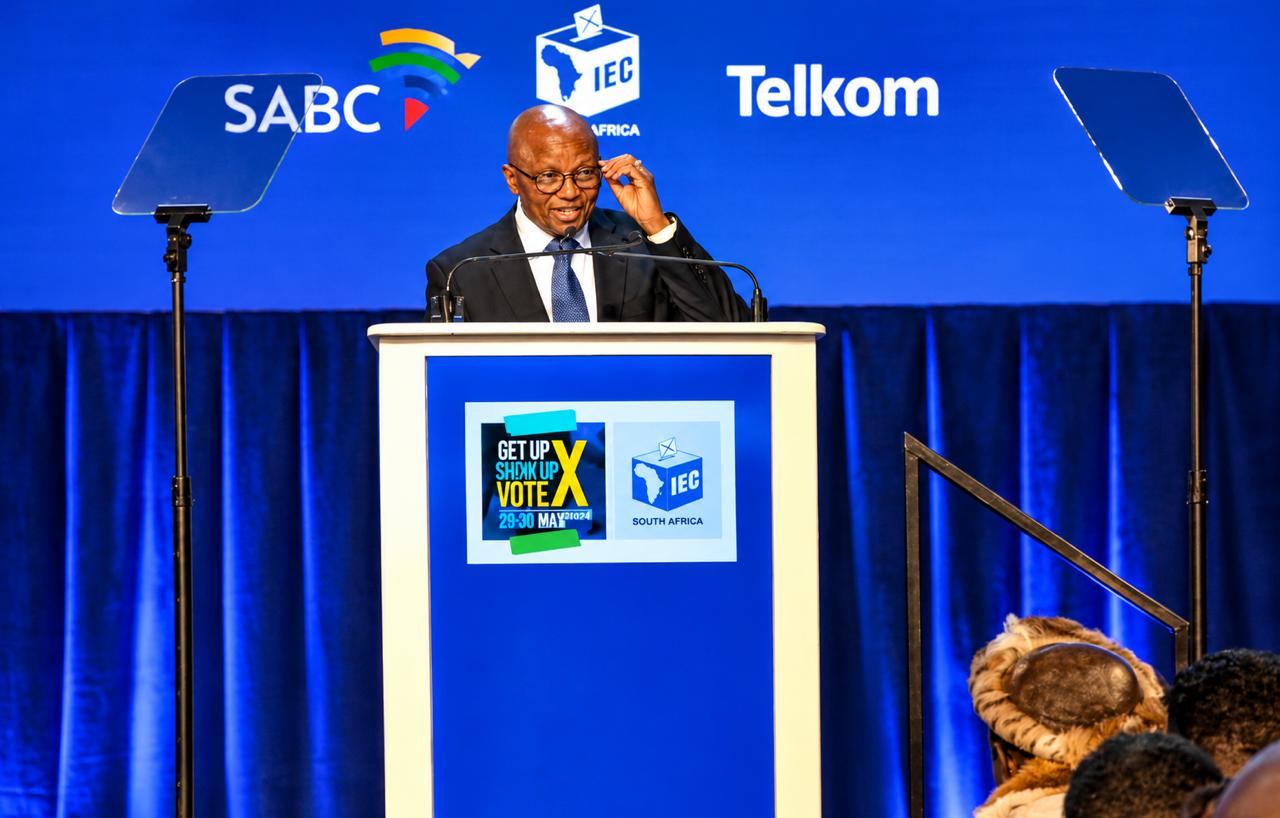
By Jacob Mawela.
Photo Credit: Jacob Mawela/Fullview.
The Independent Electoral Commission’s Chairperson Mosotho Moepya declared the 2026 Local Government Elections free and fair at the Official Declaration at the Results Operation Centre at Gallagher Convention Centre in Halfway House, Midrand, on the Sunday evening of November 8.
Moepya did so during a nationally televised address attended by President Cyril Ramaphosa, representatives of various political parties, members of the Electoral Commission’s leadership, election observers, members of the diplomatic corps, representatives of civil society, miscellaneous stakeholders and an international media corps.
The official declaration of results was announced amid what Moepya described as a low trust environment manifested through digital disinformation, destruction of ballot papers at some voting stations – leaving the commission with after-event challenges of revotes, adjudication and even the laying of criminal charges with the SAPS.
Moepya stated that at the moment of his address, all 213 municipal councils across South Africa had been finalised and declared – which translated to approximately 14.9 million South Africans casting their ballots in the 2026 Municipal Elections, from a total of 29.2 million voters who had been registered.
Breaking down the statistics to the gathering as well as to the viewers at large Moepya listed that the national turnout for the elections was 52%, representing an increase of 6.1 percentage points from the 45.9% turnout recorded in the 2021 Local Government Elections.
A total of 521 political parties and 636 independent candidates contested the elections, collectively fielding approximately 137,000 candidates across ward and proportional representation contests.
A total of 10,526 council seats were contested through the elections – which comprised 4,485 ward seats, 4,340 proportional representation (PR) seats, and 707 district council seats allocated through the 40% proportional representation component.
In addition, 994 district council seats, representing the remaining 60% component of district council representation, would be filled through the election of councillors by local municipalities in accordance with the legislative framework – he said.
Moepya then went to the highpoint of his address, listing the top five parties in the Elections as the ANC which received 30.89% of the vote and secured 3,164 council seats; the Democratic Alliance which received 24.60% of the vote and secured 1,527 council seats; uMkhonto weSizwe Party which received 9.61% of the vote and secured 701 council seats; the Economic Freedom Fighters which received 6.25% of the vote and secured 505 council seats; and ActionSA which received 5.68% of the vote and secured 219 council seats.
Other political parties and independent candidates collectively received 22.97% of the vote and secured representation across municipal councils.
With regard to municipal outcomes, the ANC achieved outright control in 51 municipalities and is the leading party in 120 municipalities; the DA achieved outright control in 12 municipalities and is the leading party in 29 municipalities; the Inkatha Freedom Party achieved outright control in 5 municipalities and is the leading party in 19 municipalities; the MK Party achieved outright control in 3 municipalities and is the leading party in 18 municipalities; and Rise Tsantsabane Communities achieved outright control in one municipality.
Moepye stated that of 213 municipalities, 72 councils have a party that secured an outright majority of seats and that in the remaining 127 municipalities, no political party obtained more than 50% of the seats – resulting in hung councils and 1.84% of Spoilt Votes.
Addressing Ramaphosa directly, Moepya said: “Mr President, there is another important dimension to the elections we are concluding today. The experience of government is encountered in neighbourhoods, streets, and services South Africans receive, or do not receive, from their municipalities. This places an enormous responsibility on those who have been elected today.”
Concluding his address, Moepya said: “As we declare these elections, we do so mindful that Section 65 of the Local Government Municipalities Act (2000) provides that objections could be adjudicated before the declaration of elections, as the Commission has done. In addition, Section 65 (7) provides that the Commission adjudicate objections after elections which the Commission will do.”
In his address, Ramaphosa’s key takeaways and core themes consisted of the directive on coalition negotiations; prioritising the needs of the masses; the further strengthening of democracy and the South Africa’s Constitution; the acknowledging of socio-economic realities and the expression of gratitude to key institutions which safeguarded the election.
Considering the horse trading which lie ahead of the November 4 polls, the president urged politicians to negotiate in good faith to form councils without further ado, stressing voters expectations regarding service delivery, as well as mitigatory factors to address maladies such as high youth unemployment and living costs.
“The right to vote is what gives our democracy its legitimacy. We celebrate the enduring strength of our democracy and the sovereign right of the people of South Africa to choose their representatives. And that is the significance of the elections whose results we are gathered here to acknowledge,” commenced the president in his address.
“Our Constitution declares South Africa a multi-party democracy, with universal adult suffrage, a common voters’ roll and regular elections. The participation of more than 540 political parties and nearly 137,000 candidates who stood for election bears witness to the multi-party nature of our democracy,” he continued.
“These elections have taken place at a time when our people face considerable challenges. Through these elections our people have made their political choices freely. And they will hold those they elected to account. They want water to come out of the tap and electricity that works. They want their refuse collected, their parks maintained and their streets safe,” Ramaphosa stressed.
“To the incoming councillors, the country wishes you well as you take up your responsibilities. The election is now over. The work of serving the people must begin. In municipalities where no political party has secured an outright majority, the elected representatives will need to find common ground,” he further stated.
“Councils must be constituted without delay. Parties must negotiate in good faith to elect office-bearers so that councils can get to work. Budgets must be passed on time. Those elected must find common ground and work together. Together, we must make local government an engine of service delivery, development and opportunity,” continued Ramaphosa.
“The newly elected councillors take office against the backdrop of far-reaching changes in our system of local government. The revised White Paper on Local Government envisages a bold reset of how municipalities function and are managed. It outlines a broad package of changes to strengthen municipalities and to ensure that services are delivered efficiently and reliably.”
The millions who turned out to vote have placed their trust in our democracy. Let us prove ourselves worthy of that trust.
“To all South Africans, our democracy belongs to you. Continue to participate in it, to defend it and to hold those who govern accountable. The ballots have been counted. The choices have been made. The responsibility now passes to those who have been elected,” added the president.
In conclusion, Ramaphosa said: “The people have spoken. Their verdict must be respected. Their concerns must be heard. And their expectations must now be met. Let us work together to make local government work for every South African.”