
By Lehlohonolo Lehana.
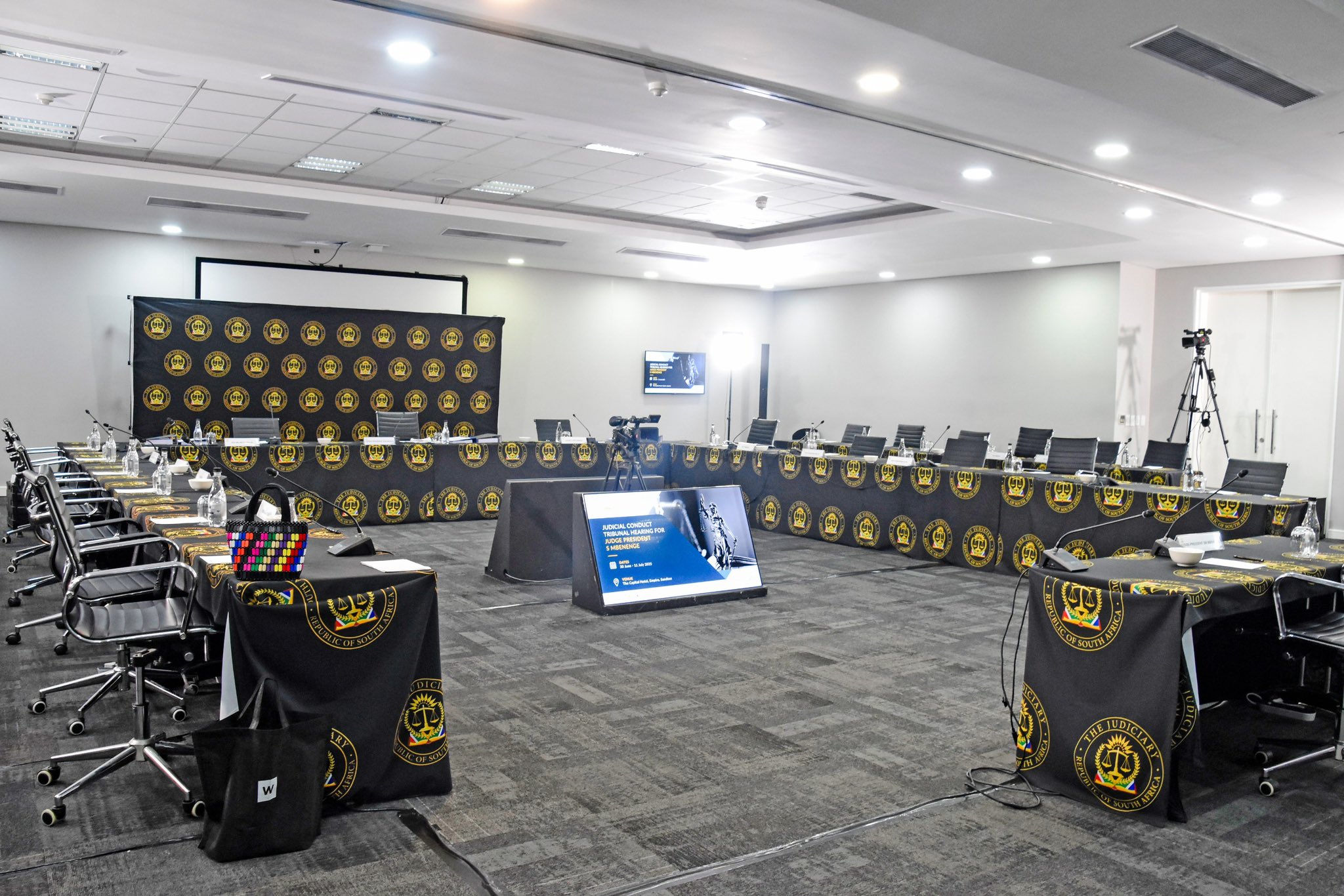
The Judicial Conduct Tribunal into Judge Belinda Hartle completed Day 3 of its hearings with the complainant, Thozama Semekazi, still on the witness stand.
Semekazi continued his testimony on the allegations he made that Hartle used a racist slur against him.
The Judicial Service Commission (JSC) announced in May that it decided to recommend Hartle’s suspension, following a Judicial Conduct Committee recommendation to the Chief Justice that a tribunal be appointed. If the tribunal finds her guilty of gross misconduct for remarks, which Hartle denies making, she could face impeachment.
The JSC clarified that only the President can suspend a judge, and that Hartle would keep sitting until he decides.
The tribunal, presided over by Justice Boissie Mbha, began hearing evidence on Monday and it is expected to run until 18 November.
Semekazi, who worked as a clerk for more than 20 years, stated in his complaint that he had gone to Hartle’s secretary’s office late on 15 May 2025 to drop off files for case flow management.
According to him, Hartle, after seeing the pile of documents, swore at him several times and used the k-word while in front of her secretary, Shakira Frost, who appeared amused at her outburst.
Semekazi said he had been transferred from Mthatha to the East London in July 2024 and had been assigned to manage the case flow roll for the first time, without any training.
The rolls and files had to be ready by noon on Wednesdays. There were usually about 15 files.
However, the day before the alleged incident, he said he could not compile the roll because his computer was not working.
On 15 May 2025, a colleague assisted him, a process which took until about 4pm.
When he took the files to Frost’s office, Hartle arrived and shouted insults at him, including a reference to “bleddy f*** k***”, before both her and Frost left the room.
He said he had cried when reporting the incident to his manager and then when he fetched his children from school that afternoon. The following day he saw a doctor and was admitted to a mental health facility where he was diagnosed with severe depression, he said.
During his testimony before the tribunal on Monday, Semekazi raised his voice and hands, apparently mimicking what Hartle had said to him on the day of the alleged incident.
Hartle admitted to using “one expletive”, which she said was not directed at Semekazi but rather at the incompetence of the general office, and emphatically denies using the k-word.
Hartle’s advocate, Jan Heunis, told the tribunal that the charges against her are “trumped-up”.
He accused Semekazi of being an emotionally unstable employee who was often absent from work and relied on others to do his work.
He said the files were delivered a day late and on the day of the incident, a Thursday, the judge had just come out of court after a long day, during a busy week.
“She expressed her dismay at the registrar’s office by using one expletive for which she immediately apologised,” he said.
On Day 2, Semekazi faced tough questions from Heunis SC. He questioned Semekazi on his recollection of what the judge actually said, acknowledging that the judge used a swear word but disputing that it was a racial slur.
He put to Semekazi a statement from the judge’s secretary, who was present in the room on the day.
Heunis also questioned Semekazi’s recollection of events by drawing attention to his employment and medical history, a line of questioning that was shut down by Tribunal president Justice Boissie Mbha.
Heunis put to Semekazi that his complaint was made in retaliation against a news article written by Judge Hartle’s husband, the journalist Ray Hartle, which implicated Semekazi in corruption allegations at the Mthatha High Court. This point Semekazi disputed.
On Day 3 (Wednesday 11 Nov), the defence presented video evidence that it said could challenge the complainant’s account of events.
Arguing that the recordings should be made available to the tribunal, Heunis said there were “mutually destructive” versions of what occurred in Frost’s office on 15 May.
He said it was “vitally important” to establish whether or not Semekazi was “a truthful witness”.
His credibility is a pivotal issue. The recordings will show that he lied.”
Evidence leader advocate Benny Kalakgosi objected, describing this as an “ambush” and raising the issue of the authenticity of the recordings.
Tribunal president Justice Mbha ruled that Kalakgosi must consult with Semekazi, go through the recordings with him, and then make further submissions on the issue.
The tribunal comes just a month after the Supreme Court of Appeal (SCA) ruled that using the k-word amounts to hate speech even when it is said in a private conversation.
SCA found that racist language does not become acceptable simply because it is used behind closed doors, as the circumstances of a conversation do not change the racist and hateful nature of the word.
In its judgment on 7 October 2026, the SCA dismissed an appeal by businessman Willem Hendrik Ackerman, who had challenged a finding that his repeated use of the k-word during conversations with another white man amounted to unlawful hate speech.
While Hartle’s case concerns allegations of judicial misconduct rather than a hate speech complaint, the SCA ruling shows how seriously South African courts treat the use of racist language, regardless of the circumstances under which it is used.