
By Lehlohonolo Lehana.
President Cyril Ramaphosa has emphasised that the seventh administration is committed to significantly expanding infrastructure investment, as it is crucial for driving economic growth and ensuring efficient service delivery.
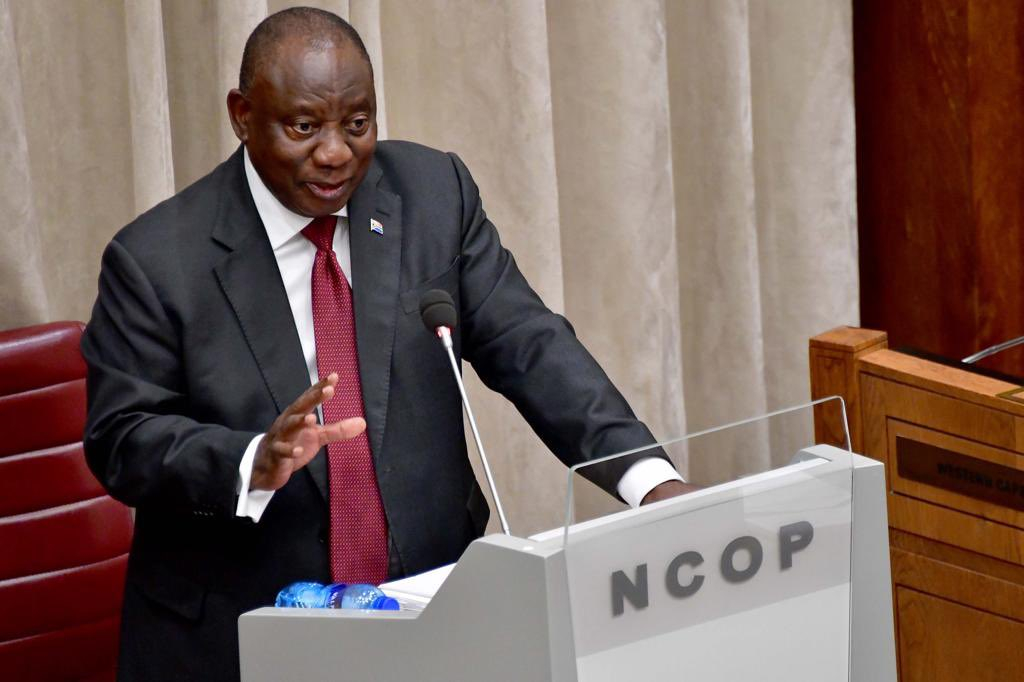
Ramaphosa was briefing the National Council of Provinces (NCOP) in Parliament on various national developments including government’s response to incidents of extortion against businesses and individuals, and progress in the fight against unemployment and poverty.
“The development of public infrastructure is necessary for effective service delivery and economic development. That is why we are determined as this administration to massively increase the scale of investment in infrastructure. Through this investment, we will turn South Africa into a building site,” the President said.
However, the President acknowledged that public infrastructure projects that are delayed or abandoned have a negative impact on the ability of communities to access services.
To address this challenge, the Department of Public Works and Infrastructure began the identification of delayed and abandoned projects within its portfolio during the sixth democratic administration.
Through a Presidential Proclamation in 2019, the Infrastructure Development Act was moved to the Minister of Public Works and Infrastructure.
The President explained that this enabled the Minister to develop a more holistic approach to infrastructure development in all spheres of government and the private sector through Infrastructure South Africa.
He highlighted that the Department of Public Works and Infrastructure has identified a number of key pillars to drive the infrastructure investment process such as institutional arrangements for implementation of the National Infrastructure Plan 2050.
“One of the other pillars is to ensure that there is better preparation and prioritisation of infrastructure projects. Other proposed reforms include multi-year budgeting for infrastructure planning and delivery, and speeding up permitting and approval processes.
“The task of identifying incomplete and abandoned infrastructure projects is being implemented throughout all provinces. The completion of these projects requires dedicated capacity that may not be readily available,” he said.
Motsoaledi refuses to answer NHI questions
Ramaphosa told Parliament he had a “fairly lengthy discussion” with Health Minister Aaron Motsoaledi after his recent comments on the NHI and behaviour in Parliament about the matter.
The DA’s Nicolaas Pienaar asked about the Presidential Health Compact and National Health Insurance (NHI), referring to Motsoaledi’s “belligerent” responses to questions, or lack thereof, in Parliament last week.
Motsoaledi slammed a medical aid’s estimation that delivering free, quality healthcare to the entire population would cost South Africa R1,3 trillion per year.
He also refused to answer questions from Shadow Minister of Health, Michéle Clarke, as to how much the NHI roadshow cost taxpayers when civil society groupings and medical stakeholders were not invited to participate.
“Tomorrow there is a debate about the NHI. I am going there and I don’t owe anybody an explanation,” Motsoaledi gestured wildly, raising his voice.
Motsoaledi took a very belligerent stance, in spite of your indication that you were open to discussions and in spite of widespread concerns regarding the NHI,” Pienaar told Ramaphosa in Parliament.
“Are you President, and Minister Motsoaledi, not concerned that the NHI Act is a breach of an individual’s right to dignity and freedom of choice as enshrined in section 10 the Constitution?
Ramaphosa said the process of engagement is “a true hallmark” of how he as a president functions and how the government he leads functions.
“To the extent that you may well have heard Motsoaledi, I want to assure you that he is one of those ministers who is open to engagement, to listening, and to talking.”
The president said he and the health minister had a “fairly lengthy discussion over lunch” the day before, where they discussed the matter.
Extortion
Ramaphosa was asked whether the government has considered the negative impact of the growing trend of protection fee and business extortion to the economy and the delivery of services such as schools and state infrastructure projects that has left many communities at the mercy of ruthless and unscrupulous gangs and criminals.
“The growth of criminal extortion in several parts of the country is contributing to a climate of lawlessness and fear. Extortion has a great economic cost, disrupting business activity, delaying or halting the construction of infrastructure, and generally raising the cost of doing business.The South African Police Service is directing its response to these crimes to areas where they are most prevalent,” Ramaphosa responded.
The SAPS has established the Eastern Cape Provincial Extortion Forum specifically to address extortion-related issues in the province.
An Organised Crime Task Team has also been established to investigate all extortion cases reported in the province. A multi-disciplinary approach has been adopted that includes Crime Intelligence and the Directorate for Priority Crime Investigation (known as Hawks).
Poverty and unemployment
“Much higher levels of inclusive growth are needed to achieve sustainable employment. That is why this seventh administration made up of the Government of National Unity (GNU) has placed inclusive economic growth as its apex priority. However, it will take time for such growth to meet the scale needed. This is why a range of complementary measures are required to address poverty and enable economic participation.
The Presidential Employment Stimulus enables support to public employment, livelihood support and enterprise development. The Presidential Employment Stimulus has contributed to over 2 million jobs and livelihood opportunities since its inception in 2020.
The Social Employment Fund, which is implemented by the Industrial Development Corporation under the Department of Trade, Industry and Competition, has created over 100,000 jobs,” he responded.
Government of National Unity
The key constitutive ideas of the Government of National Unity are set out in the Statement of Intent that was signed by all the constitutive parties.The 10 GNU parties agreed to certain basic principles, including a firm commitment to respect the Constitution and the rule of law.
“The principles included a commitment to promote accountability, transparency, integrity and good governance. The parties agreed on a Minimum Programme as the foundation of the work of the Government of National Unity. These were developed into priority actions that will form the basis for the Medium-Term Development Plan of government,” he responded.
As indicated in the Opening of Parliament Address, Ramaphosa said the GNU will dedicate the next five years to actions that advance three strategic priorities:
“Firstly, to drive inclusive growth and job creation. Secondly, to reduce poverty and tackle the high cost of living. Thirdly, to build a capable, ethical and developmental state. We will pursue growth that is inclusive and transformational. We have said that inclusive growth must support the empowerment of black South Africans and women.
“We will continue to pursue programmes that encourage broad-based black economic empowerment, employment equity and support to small- and medium-sized enterprises. We will continue to protect and uphold the hard-won rights of workers and continually strive to improve the conditions in which they work and live. In advancing our three strategic priorities, we will, among other things, massively increase the scale of investment in infrastructure,” he said.