
By Lehlohonolo Lehana.
The Minister of Forestry, Fisheries and the Environment, Dr Dion George has granted Eskom approval to continue operating eight of its coal-fired power stations outside the country’s pollution standards.
Eskom applied for exemption from the minimum exemption standards in terms of section 59 of the NEMAQA in respect of 8 Eskom facilities, namely, Lethabo, Kendal, Tutuka, Matla, Duvha, Majuba, Matimba and Medupi.
In May last year, then Minister Barbara Creecy granted Eskom permission to continue to operate Hendrina, Grootvlei, Arnot, Camden and Kriel at existing (Minimum Emission Standards) MES plant limits until March 31, 2030, after which the stations would be decommissioned.
She also directed Eskom to submit an application in terms of section 59 of the National Enviroment Management: Air Quality Act for exemptions in respect of Matla, Duvha, Tutuka and Kendal for a final determination.
Having received the exemptions for Hendrina, Grootvlei, Arnot, Camden and Kriel, Eskom indicated that it would be applying for MES exemptions for the four coal stations scheduled to continue operating after 2030.
Creecy’s decision followed an appeal of the National Air Quality Officer’s October 2023 MES decision, which Eskom said would lead to the shutting of 30 000 MW of capacity, as the cost of retrofitting the plants to meet air-pollution limits would be a prohibitive R300-billion. The application for exemptions was made in the context of extreme loadshedding in 2023 and was granted as the rotational power cuts began to ease in 2024.
Dr George stressed that the decision was a complex one, as it required “balancing South Africa’s energy needs to drive economic growth with the constitutional right to a healthy enviroment.”
He argued, however, that Eskom could not be given a “blanket waiver to continue polluting without accountability”, adding that South Africa could not remain trapped in a persistent cycle of energy insecurity and enviromental degradation that harmed public health.
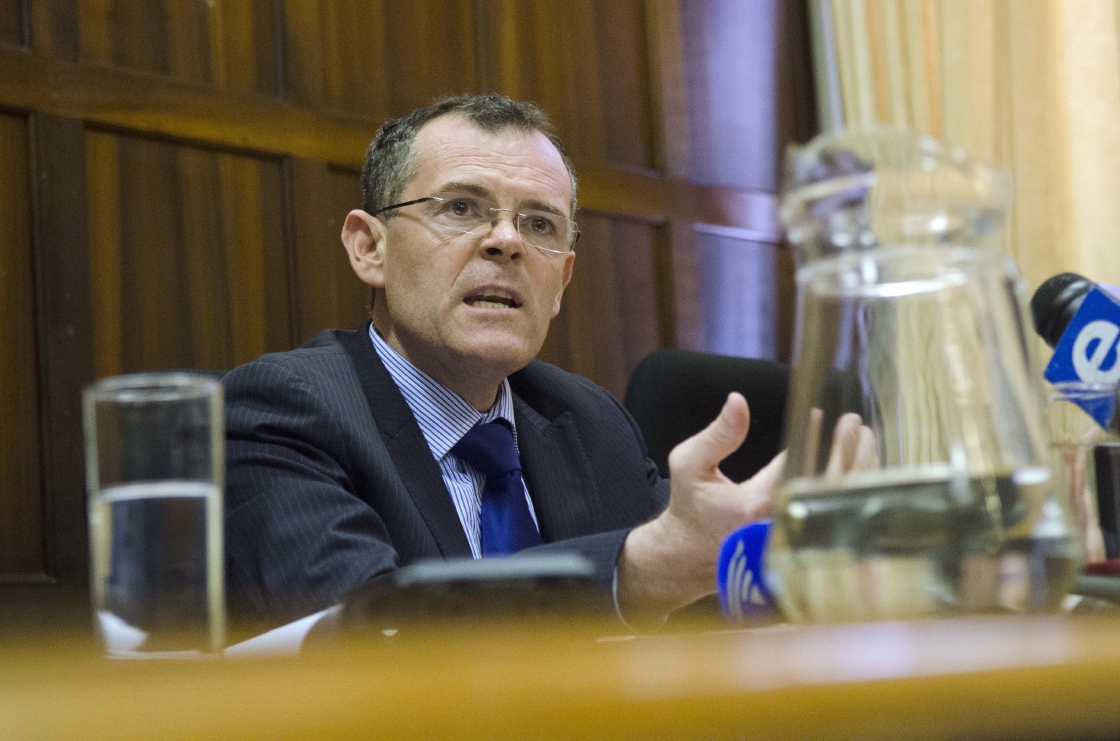
Dr George announced his MES decision, which he said sought to balance the imperatives of energy security, economic stability, and enviromental protection.
During a briefing in Cape Town, he announced that two of the stations (Duvha and Matla) had been granted exemptions until their decommissioning date in 2034.
The other six, were granted five-year exemptions until April 1, 2030, during which time actions would need to be taken to mitigate their pollution and to prepare the stations to operate legally thereafter.
Dr George even went so far as to suggest specific energy policies that he said required priority if South Africa were to transition to a point where there would be security of supply, while also meeting the obligation outlined in Section 24 of the Constitution guaranteeing a right to an enviroment that is not harmful to health and well-being.
Some of his recommendations included transitioning the Independent Power Producer Office into an independent Transmission System Operator to streamline procurement; accelerating transmission infrastructure under the National Transmission Company South Africa to facilitate seamless grid integration of renewable projects; and the establishment of a competitive power market by April 1, 2026.
Dr George also outlined the following specific decision for each of the affected coal-fired power stations:
- An MES exemption for the Duvha power station until its planned decommissioning date of February 21, 2034, alongside conditions for mitigating the station’s environmental impact until it is phased out.
- A five-year exemption, until April 1, 2030, for Kendal that also requires Eskom to implement targeted emission reduction measures and accelerate renewable-energy integration to offset Kendal’s environmental footprint.
- A five-year exemption for Lethabo until April 1, 2030, along with conditions to address its emissions profile as well as health impacts, considering the station’s proximity to populated areas.
- A five-year exemption to April 1, 2030, for the Majuba power station alongside requirements to enhance the plant’s operational efficiency and flexibility, while adhering to stringent monitoring and mitigation requirements.
- A five-year exemption for Matimba until April 1, 2030, with a requirement that Eskom implements socioeconomic offset and emission reduction studies.
- An MES exemption for the Matla power station until its planned decommissioning date of July 20, 2034, with a condition that its environmental impact is curtailed through mandatory health and air quality measures.
- A five-year exemption until April 1, 2030, for the new Medupi power station to achieve full MES compliance, notably with the installation of FGD technology. This exemption mandates a revised cost-benefit analysis for FGD within six months, alongside other conditions to minimise emissions.
- And a five-year exemption to April 1, 2030 for Tutuka to provide Eskom with a window to stabilise the troubled station’s contribution to the grid while accelerating renewable-energy projects to reduce its coal dependency.
Describing his decision as “pragmatic” and “sensible”, the Minister highlighted that Eskom, which had received several exemptions over the past number of years, had not been granted its request for longer exemption periods.
He also insisted that he intended holding the State-owned company accountable for meeting its air-pollution obligations.
“I do not believe that this puts Eskom under undue pressure.
“It certainly puts them under pressure and that is actually my intention, because more of the same thing is not going to work . . . the game has changed, “Dr George said.
The exemption will help Eskom spend on running its plants for longer in a country that’s suffered from rotational blackouts for decades. Eskom’s plan to stabilize supply relies on extending the decommissioning dates of some coal stations.
The Minister added that he was eager to receive Eskom’s response, as well as to engage with both the utility and Electricity and Energy Minister Dr Kgosientsho Ramokgopa on ensuring practical implementation.
Ramokgopa this month warned that the system remained vulnerable because of delays in the procurement of more generation capacity.
The nation’s sole nuclear power station, once regarded as Eskom’s most-reliable plant, has been among the units that have broken down. The health effects of running coal plants for longer could take a bigger toll than the economic constraints of loadshedding.