
By Lehlohonolo Lehana.
President Cyril Ramaphosa says South Africa faces challenges that are far different to those experienced in the earliest days of democracy.
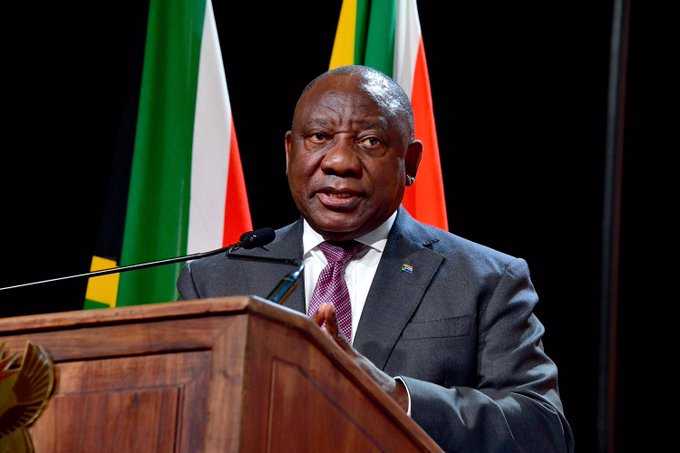
Ramaphosa took a few minutes before starting his Freedom Day speech at the Alabama stadium in Klerksdorp in North West, to persuade the crowd to pay attention.
He was like a principal in a rowdy classroom with lots of commotion.
But it may also have been a sign of South Africans frustration and disillusionment 29 years into democracy. There may also be a lack of trust in the government’s ability to deliver.
Joined by deputy president Paul Mashatile and other ministers, Ramaphosa said the benefits of the progress made are not yet being felt.
Freedom Day is commemorated every year to honour those unsung heroes and heroines who fought for freedom and paved the way for an equal, representative, non-racial society.
“The day also honours the masses of South Africans who resisted and suffered under apartheid, and faced death, injury and repression from the security forces. Many others battled forced removals, discrimination, and other injustices, which the global community classified as a crime against humanity. The celebrations offer the nation an opportunity to reflect on progress made in transforming the South African society, while also examining the challenges.”
Ramaphosa said Freedom Day should be used to reaffirm a shared commitment to the promise of that momentous day.
“On Freedom Day, we recall the great progress made in nearly three decades of democracy, but we also acknowledge that so much of the promise of 1994 still needs to be realised,” he told his audience.
“Schools are now open to all races and millions of learners from poor homes attend no-fee schools. Everyday, 9-million learners receive a meal at school.”
Ironically, learners in just over 5 000 schools in KwaZulu-Natal go to school hungry because of a collapsed school nutrition programme. Several schools are not getting enough food or none at all since the start of the year.
Ramaphosa highlighted the 70 000 tertiary students from poor, working-class backgrounds who received financial support through the National Student Financial Aid Scheme, it is disturbing that thousands of these young people have to embark on #FeesMustFall protests every year.
As for public health, the president said services had improved since democracy.
The recent Covid-19 pandemic severely tested the country’s healthcare system, and many facilities were not up to standard. However, the government responded well to the pandemic.
Another positive factor for post-democracy South Africa is the provision of social grants to support about 18-million poor and vulnerable people.
“This is what progress looks like. These are some of the fruits of democracy,” Ramaphosa said.
Poverty, unemployment and inequality still define the lives of millions of our people. At this time in particular, families across the country are experiencing great hardship and uncertainty.”
But loadshedding was an elephant in the room as Ramaphosa spoke about energy security.
He said: “Freedom cannot be meaningful when South African homes and businesses are without electricity for several hours in the day. That is why we are using every means at our disposal to restore Eskom’s power stations and build new generating capacity as a matter of great urgency.”
He promised a better tomorrow, saying that “the benefits of the progress we have made are not yet felt – loadshedding has not abated – but we will soon experience the impact of the unprecedented investment being made in new power generation”.
After this crisis, “our energy system will be fundamentally transformed, he said, adding that the system will be more reliable, more affordable, and more sustainable”.
On the unemployment front, the president said: “Freedom cannot be meaningful when more than 10-million South Africans are out of work.
“Government reforms are under way to make our economy more competitive, inclusive, and investor-friendly.”
Coming to his speciality, business and the economy, he said government will multiply efforts in the next phase of the investment drive because South Africans need jobs.
He set the target for the investment drive at R2-trillion in capital investment over the next five years.
He also urged citizens to be inspired and encouraged by those who brought freedom to the country and built South Africa’s democracy.
As South Africans celebrate this momentous day in world history,many are questioning what there truly is to celebrate.
The National Union of Metalworkers of South Africa (Numsa) says the ANC has not produced meaningful transformation.
“The governing ANC, which was voted into power by the majority of the working class, has failed to deliver on the promises that it made to the masses, to transform their lives after Apartheid,” said Numsa national spokesperson Phakamile Hlubi-Majola.
“South Africa is the most unequal society in the world.
“We have the highest unemployment rate in Africa – our rate of unemployment is even higher than the Ukraine and they are a country at war!
“For more than two decades, the ANC has been implementing policies to benefit the wealthy capitalist elite.
“The economy remains untransformed, and the land and mineral wealth are owned and controlled by white monopoly capital.
“At the same time, the National Treasury is worsening the suffering of workers and their families, by implementing austerity measures, and drastically cutting costs, resulting in the poor getting poorer and the rich getting richer.”
Opposition party Congress of the People (Cope) expressed similar concerns, saying that the future looks bleak for South Africans.
“The situation in the country is going from bad to worse,” said spokesperson Dennis Bloem.
“Healthcare is on the verge of collapse, hospitals and clinics go for weeks without medicine, and people are turned back empty-handed.
“Almost all municipalities have collapsed and cannot deliver basic services to their residents.
“The safety and security situation in the country is very scary – nobody is safe anymore and lawlessness has taken over.
“For the vast majority of the people in the country, there is nothing to celebrate after twenty-nine years in this hard fought democracy.”
The Freedom Front Plus (FFP) is calling on South Africans to use the 2024 elections to regain their freedom.
“The ANC is misleading the public by pretending that it stands for constitutional rights and freedom for all,” said party leader Pieter Groenewald.
“When millions of people do not have a job or food or a roof over their head, the notion of freedom is meaningless.
“That is why it is imperative to remove the ANC in next year’s elections to gain true freedom
“The longer this government remains in power, the more freedom in all areas is eroded and the weaker the economy becomes.”
Watch Live in the video below:
Video Courtesy of SABC.