
By Lehlohonolo Lehana.
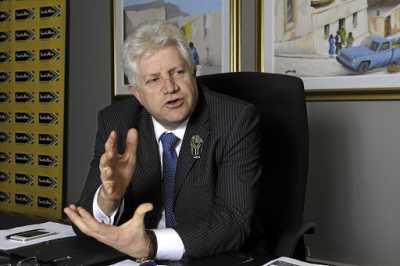
Western Cape Premier Alan Winde says the province is ready to arrest Russian President Vladimir Putin should he decide to visit Cape Town.
“Even in the face of this arrest warrant, the national government seemingly intends to push ahead and host President Putin at a BRICS summit in South Africa, scheduled for later this year. This is unacceptable and deplorable,” Winde said.
“Putin has consistently and violently eroded the freedoms of the Ukrainian people and those in his own country who dare take a principled stand against his brutal actions.
“If the Russian leader sets foot in the Western Cape, we as the provincial government will have him arrested by our own Western Cape Government funded Law Enforcement Advancement Plan (LEAP) officers. If the South African Police Service (SAPS) is not instructed to act, we will,” he added.
The International Criminal Court (ICC) issued a warrant of arrest for Putin in March for his alleged involvement in the unlawful deportation of Ukrainian children to Russia.
Putin is expected to travel to Johannesburg later this year to attend the 15th BRICS summit.
Winde said the Western Cape government will fight for the fundamental rights and freedoms of its citizens, but is also willing to show solidarity with Ukraine.
Winde’s announcement follows two days after the governing ANC “erroneously” announced it would no longer be a member of the ICC. President Cyril Ramaphosa said the same while speaking alongside his Finnish counterpart on Tuesday.
During a joint media appearance with Finland’s President Sauli Väinämö Niinistö in Pretoria, Ramaphosa said the ANC had decided it was “prudent” for South Africa to withdraw from the ICC.
“The governing party has decided once again that there should be a pull-out,” said Ramaphosa. The president’s remarks followed after the ANC’s four-day national executive committee (NEC) conference.
ANC secretary general Fikile Mbalula said at a separate press conference after the NEC meeting that a resolution had been taken to withdraw from the ICC and that the ANC “just have to implement that”.
“The conference said this ICC does not serve the interest of all, it serves a few,” said Mbalula.
He said that the United States was not a signatory of the ICC, nor were “all the big powers … who are messing up the world. They cannot be arrested but they influence others to be arrested.”
Both the presidency and NEC have since tried to explain the blunder.
In a statement titled “Clarification of ANC position on the ICC” the secretary general’s office said the resolution to withdraw from the ICC was “raised as a measure of last resort”.
A withdrawal from the ICC “would arise if — and only if — the other options outlined do not yield the desired results of fairness and consistency in the administration of international law”.
“In outlining this broad context of discussion, an unintended impression may have been created that a categorical decision for an immediate withdrawal had been taken. This is not so,” maintained Mbalula’s office.