
By Lehlohonolo Lehana.
Government and organised labour had agreed to work much more closely to address the immediate challenges that confront South Africa’s economy.
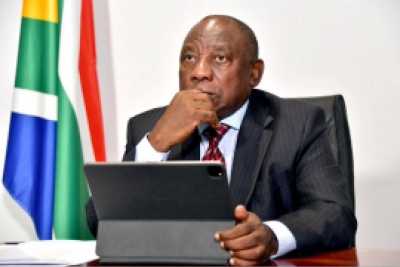
President Cyril Ramaphosa, Ministers and leaders of organised labour [COSATU, FEDUSA, NACTU and SAFTU] met virtually on Tuesday in a bid to address the immediate challenges facing South Africa’s economy.
The Presidency said this agreement is critical to accelerate efforts to deliver lasting and sustainable progress in building an inclusive economy, creating jobs and tackling poverty and inequality.
The meeting discussed, amongst other issues, the immediate measures needed to unblock economic growth and create employment. Participants agreed that urgent steps must be taken to deal with low growth and the unemployment crisis.
According to the Presidency, organised labour committed to working with government to end load shedding and achieve energy security, improve the efficiency of the freight logistics system, reduce violent crime and protect economic infrastructure.
Representatives from organised labour raised several related issues including the current fiscal situation, the structure of the economy, State-owned enterprises (SOEs), strengthening public services, tackling crime and corruption, local government and providing economic and social relief, particularly to poor South Africans.
“Given the scale of the challenge, we require support from all social partners to urgently accelerate the implementation of government’s plans and drive additional interventions.
“While there is encouraging progress, the energy shortfall remains the single biggest constraint to economic growth. We need to accelerate and expand our efforts even further, not only to overcome the immediate crisis, but to fundamentally reform our energy sector and ensure that we never face such a shortfall again, “Ramaphosa said.
Organised Labour Overall Convenor, Gerald Twala, welcomed the engagement and expressed hope that it will be the beginning of further discussions on various measures to grow the economy, create jobs, rebuild the State, and tackle crime and corruption.
“Labour is deeply concerned about the variety of crises affecting our SOEs, municipalities, government, the economy and workers. They require decisive action to resolve them. It is critical these interventions are directed towards the fundamental causes of our many challenges, and that they uplift the poor and protect the hard won rights of workers. Measures must capacitate the State to deliver quality public services, unlock economic growth and set the nation on a sustainable path,” Twala said.
The meeting agreed that addressing unemployment and poverty is an immediate imperative that will improve social and political stability, creating a virtuous cycle that supports growth.
Cosatu acting national spokesperson Matthew Parks said it was a pre-arranged meeting, adding that Cosatu meets with the presidency every few months to discuss key economic issues.
“This was actually an outstanding meeting to receive reports and updates on interventions to rebuild Eskom and Transnet.
“We didn’t get a presentation on the Treasury’s proposals.
“I think they are still proposals that I don’t think even government has agreed to,” he said.
“But we did raise our concerns about what we have seen in the media around Treasury’s possible proposals, and we’ve also raised our proposals about what needs to be done to grow the economy – from Eskom to Transnet, to local government, corruption and unemployment and poverty.”
Parks said Cosatu did not receive any feedback from government about the budget proposals, but they have agreed to meet again in the next few weeks to have further discussions about treasury and Cosatu’s proposals.
The Presidency emphasised the opportunity to build on existing interventions with proven track records of success, including the Presidential Youth Employment Intervention, the Presidential Employment Stimulus, the Youth Employment Service and the SME Fund.
The Presidency further highlighted the need to expand and scale these initiatives through wider engagement to drive participation and uptake, as well to identify regulatory, policy and other measures to support and grow SMMEs, and unlock job creation at scale.
Ramaphosa and labour leaders agreed that further in-depth engagement is needed to fully address the issues raised. A follow-up in-person meeting will soon be convened to build on Tuesday’s discussion.