
By Lehlohonolo Lehana.
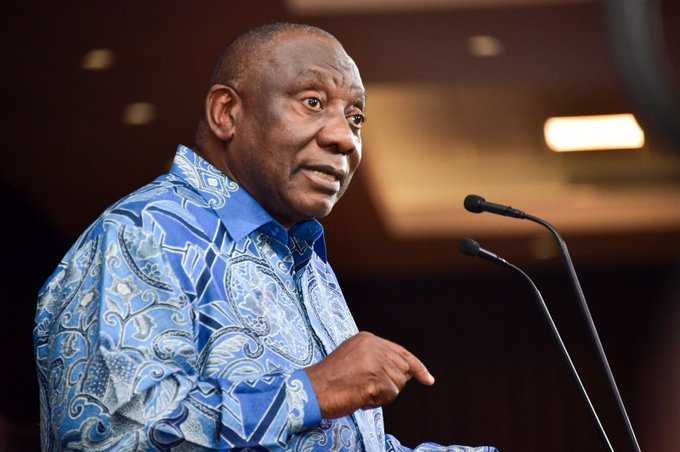
President Cyril Ramaphosa lamented that developing countries have borne the brunt of the negative impacts of climate change, but the commitments of developed countries are “not being met.”
“It is a serious concern that commitments by countries with developed economies have not been met and very little funding has been channeled through the financial mechanism of the UNFCCC [United Nations Framework Convention on Climate Change], including the Green Climate Fund and the Adaptation Fund, said Ramaphosa.”
In his weekly newsletter, following his attendance at the United Nations Climate Change Conference in Dubai, known as COP28, he said, “the operationalisation at COP28 of a fund to help vulnerable countries with loss and damage caused by climate change is a step in the right direction, but it will need substantial funding if it is to fulfil its purpose”.
He stated that funding through entities such as the Green Climate Fund and Adaptation Fund had been negligible.
Ramaphosa is mindful that the discussions at COP28 have significant implications for South Africa. The impact of climate change is a measurable reality in South Africa, with poor, rural communities in particular bearing the brunt.
For the transition to lower carbon economies to be just, affected communities cannot live on promises. Workers and communities currently dependent on coal and other fossil fuel industries need viable alternative livelihoods,”he said.
He outlined that as a country “in the midst of an energy crisis”, South Africa was aware that the pace of the just energy transition (JET) would be guided by developmental priorities.
He believes that South Africa’s JET Implementation Plan can ensure that effective action against climate change, while pursuing energy security for all, is possible.
But if we are to implement these and the other actions outlined in the JET Investment Plan we – like all other developing economies – will require massive financial support from those countries whose development has been the primary cause of climate change. The countries that have contributed most to global warming must support those countries that now bear the brunt of its effects,” he said.
The plan announced at COP27 last year, outlines South Africa’s path towards reducing carbon emissions in the energy sector, which is the largest contributor towards the country’s total greenhouse-gas emissions.
The plan focuses on investment in electricity infrastructure, new energy vehicles, green hydrogen, skills development and municipal electricity distribution.
Ramaphosa stressed that the transition must be underpinned by engagement and partnership with workers, communities, business and civil society.
“It also includes interventions to support affected communities, notably in Mpumalanga, “where most of our country’s coal-fired power stations are located”.
Ramaphosa emphasised that the overriding message the South African delegation took to COP28 was that “our climate commitments will be implemented in a manner that both addresses our current energy crisis and strengthens our efforts to reduce poverty and unemployment”
South Africa, one of the most developed countries on the continent, is currently experiencing an energy crisis with frequent and prolonged blackouts.
Despite this, government this week proposed a plan to transition the economy away from fossil fuels within five years for a country that now gets 80% of its energy from coal.
South Africa’s course is in line with the Just Energy Transition partnership agreement with France, Germany, the UK, the US and the EU. The agreement, under which Western countries have pledged $8.8 billion to help Pretoria phase out coal more quickly, includes accelerating the closure of coal-fired power plants.