
By Lehlohonolo Lehana.
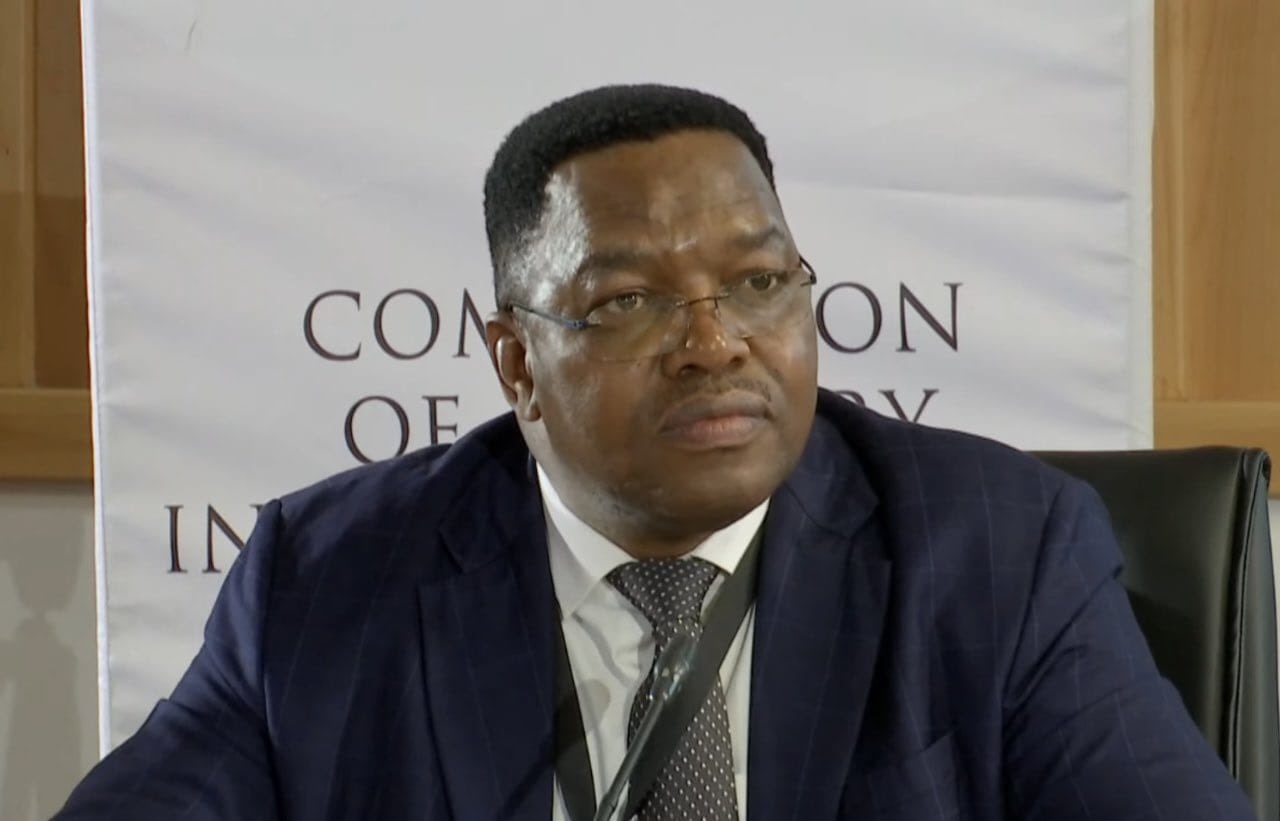
The National Police Commissioner Fannie Masemola, and the suspended police minister Senzo Mchunu, had absolute opposite views about a team cracking down on political killings, it has emerged at the Madlanga Commission of Inquiry.
Masemola confirmed Mchunu disbanded the KZN Political Killings Task Team (PKTT) without informing him.
On Tuesday, Masemola disclosed under oath that he had personally appealed to President Cyril Ramaphosa to step in after Mchunu issued an instruction to dissolve the PKTT—a specialised unit tasked with probing politically motivated murders, particularly in KwaZulu-Natal (KZN).
Four years ago Ramaphosa seated in front of a commission of inquiry, he may find himself in that situation again.
In Parliament’s parallel inquiry probing the alleged infiltration of law enforcement by criminal syndicates, Ramaphosa has also been named as a potential witness.
In response, presidency said, it would not respond to evidence piecemeal, but would “look at the entity of the evidence delivered before deciding the manner and approach of our response”.
The commission’s terms of reference give it the power to summon witnesses.
In his evidence, General Nhlanhla Mkhwanazi sketched the history of the contested KwaZulu-Natal Political Killings Task Team (PKTT), which itself grew out of a previous task team, which was then followed by another commission of inquiry — in itself a bleak reflection of how intractable the problem of KwaZulu-Natal political violence has been.
It also reflects the two favourite political instruments of ANC presidents: task teams and commissions of inquiry, often costing vast amounts and taking years.
Following the work of the Moerane Commission, which was established to look into KZN political violence in 2016, Ramaphosa appointed an inter-ministerial committee (IMC) in 2018 drawn from the security cluster to address the problem.
It was this IMC that gave the green light to a reformulated task team, officially known as the Integrated Multi-Disciplinary Political Killings Task Team, which Mkhwanazi described in his evidence as: “essentially an ad hoc, interdisciplinary unit within SAPS, tasked with investigating political killings, with an initial operational focus in KZN that later extended nationally”.
Mkhwanazi’s testimony, in other words, didn’t pose any difficulties to Ramaphosa. But Masemola did when he took the stand.
Masemola’s narrative has been that he was shocked when he received the instruction from Mchunu to disband the PKTT on 31 December 2024 because, in his estimation, the PKTT was so successful that the decision was downright sinister.
Masemola said he was distressed that Mchunu had not sought to consult more widely about this decision and took his concerns to Ramaphosa on 1 February 2025.
The President did come back to me to say he talked to Mchunu but did not tell me about the outcome,” he said.
At this stage, nothing further is known about the discussion between Ramaphosa and Mchunu.
Masemola testified that Mchunu subsequently told him that “he [Mchunu] did not understand why we were so adamant that the PKTT must not be disbanded. He said the President was in agreement that the PKTT be disbanded.”
He made it clear to the commission, however, that he did not believe Mchunu, because during his own meeting with the President, Ramaphosa was “taken aback” when he heard of the PKTT disbandment.
The national commissioner also testified that the phone records obtained during a search of Vusimuzi “Cat” Matlala’s house connected the suspects to deputy national police commissioner Shadrack Sibiya, who played a central role in enforcing Mchunu’s instructions.
Subsequent phone records obtained from an attempted murder accused revealed communication implicating Lieutenant-General Sibiya in the forceful and immediate implementation of the minister’s directive to disband the [task team],” he said.
“This record suggests that Sibiya’s actions were not merely procedural but rather tied to deeper connections with people identified as members of the cartel. The timing and urgency of his compliance appeared to be in line with the imperative to shield cartel members from investigation.”
Masemola said the records showed communication between Sibiya and Matlala, confirming concerns that senior police officials had helped undermine the team.
Masemola said Sibiya sent out a letter to transfer 121 dockets from the task team to the national police office. He argued that the objective was to strip the team of Gauteng murder cases to protect the cratels linked to drugs and killings.
“What I considered to be irrational and inexplicable encroachment to operational issues is now explained by [Mchunu’s] desire to hold investigations against criminal cartels by disbanding the [task team], “he said.
“It is clear now that the arrest of Matlala in main has assisted us to understand the real motive for the disbandment of the [task team]. There was no other motive than to prevent the investigation of the cartels that are involved in drugs and murder.”
He said Mchunu had even convened a meeting in January 2025 to mediate a “nonexistent crisis” between him and Sibiya rather than receive a critical briefing on the task team’s successes.