
By Lehlohonolo Lehana.
South Africa and China have reaffirmed their commitment to strengthen their economic ties through investment and cooperation, with an emphasis on promoting the export of 100 South African specialty products to China.
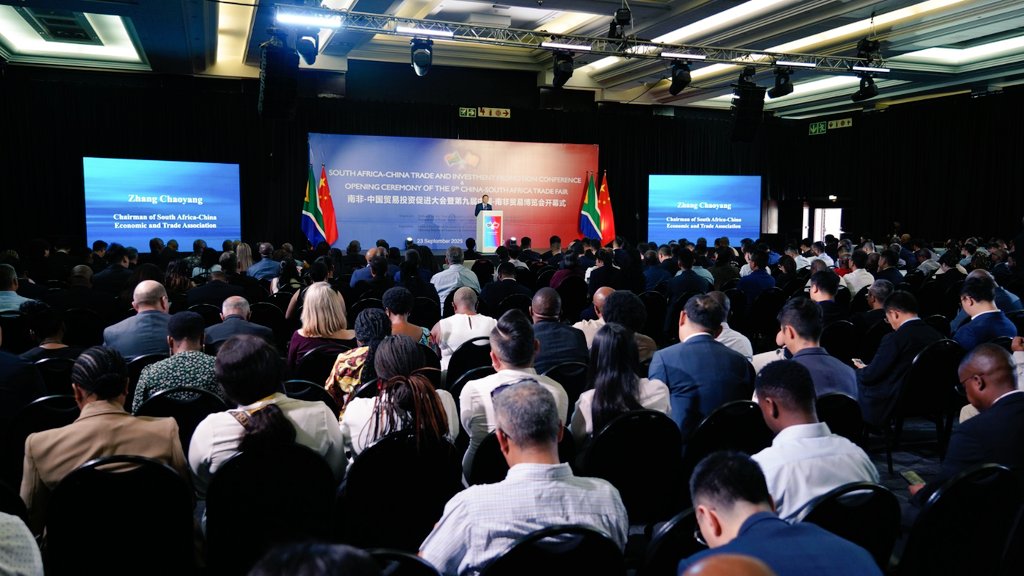
The two countries signed various memoranda of understanding (MoUs) at the 9th South Africa-China Trade and Investment Promotion Conference at Gallagher Convention Centre on Tuesday.
Chinese Ambassador to South Africa Wu Peng pointed out that China had invested more than $13.2-billion in South Africa in foreign direct investment (FDI), while South Africa’s FDI flow to China totalled $8-billion.
More than 26 000 jobs have been created as a result of Chinese investment in South Africa, while almost 9 000 jobs have been created in China as a result of South African investment.
Some of the key Chinese investors in South Africa include Hisense, BAIC, Sinosteel, FAW and Seraphim Solar, while key South African investors in China include Sasol, Standard Bank, Mondi, Altech and Onafriq.
Peng said trade relations between South Africa and China had developed rapidly over the last ten years; he expected more products to be able to enter the Chinese market duty-free from South Africa in the near future, including stonefruit.
China currently imports 66 categories of South African agriculture and food products every year. Particularly, 50% of South Africa’s macadamia nuts are exported to China and 98% of its pecan production is exported to China.
As South Africa headed the G20 Presidency this year, Peng said these countries, including China, must support Africa’s development, including industrialisation and modernisation, as a strategic opportunity, including in the automotive sector.
Trade, Industry and Competition Deputy Minister Zuko Godlimpi addressed conference delegates by calling for more investment in mining, manufacturing and infrastructure, including a battery manufacturing corridor in Southern Africa.
“The South Africa Investment Conference in March 2026 aims to exceed $1.2-trillion in investment commitments,” Godlimpi stated.
He tasked the private sector with conducting a proper market analysis of the Chinese consumer economy to understand the segments of the market that local companies could potentially build their innovative capacity in.
Godlimpi also encouraged organised business to continue collaborating with the Department of Trade, Industry and Competition (dtic) to better understand the dynamics of the Chinese economy and identify opportunities for capacity building, including by learning from China’s rapid technological and manufacturing advances – a model that the nation had perfected.
The Deputy Minister lauded Chinese firms for having invested in sectors such as renewable energy, green hydrogen, energy storage, infrastructure, logistics and the digital economy in South Africa; however, he wished to see more beneficiation investment for South Africa to be able to export less raw material and more manufactured goods.
The dtic investment mobilisation chief director Lester Bouah said South Africa’s exports to China totalled $12.4-billion in 2024, while China exported $21-billion worth of goods to South Africa.
Exports to and from both nations have grown by 42% since 2020, with South Africa exporting mostly mineral products (93% of exports to China) and China mostly exporting manufactured goods to South Africa (92% of exports).
This needs to change, Peng emphasised, expressing a call for more beneficiation to take place in South Africa, especially in the battery manufacturing space, given South Africa’s proximity to these critical mineral producers in Africa.
Chinese President Xi Jinping announced plans to expand zero-tariff treatment for African countries having diplomatic relations with China, aiming to support Africa’s industrialisation and agricultural modernisation.