
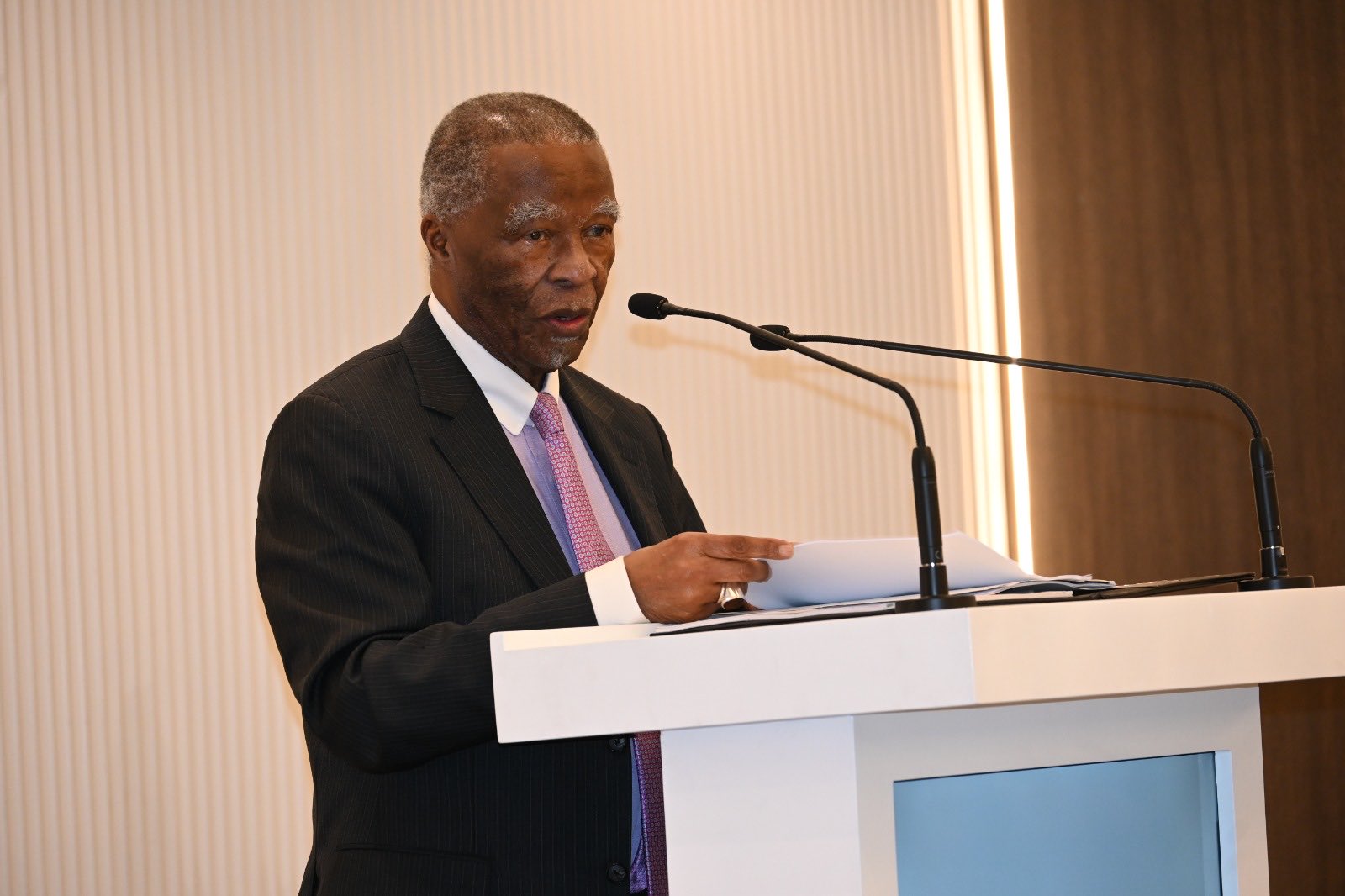
By Lehlohonolo Lehana.
The former President Thabo Mbeki is scheduled to appear before the Truth and Reconciliation Commission (TRC) Cases Inquiry on 19 and 20 October 2026.
Ahead of his appearance, the Thabo Mbeki Foundation revisited his September 2006 ANC Today letter, “Learning to listen and hear”.
The letter begins with a concern expressed by Oliver Tambo: that the gulf between South Africa’s opposing sides might become so deep that a genuine message of peace would go unheard.
Mbeki reflects on how the willingness to listen helped open a path towards negotiations and democracy.
He also addressed the enduring pain of unresolved loss. Writing about his brother, Jama Mbeki, his son, Kwanda Mbeki, and his cousin, Phindile Mfeti, he expressed regret that the TRC did not uncover what happened to them.
Kwanda is believed to have been killed by agents of the apartheid-era government.
He went missing in South Africa while attempting to join his father and other anti-apartheid activists in exile. His body, like those of hundreds of others who disappeared while resisting white minority rule, was never found.
As the TRC Cases Commission examines allegations concerning interference in apartheid-era investigations and prosecutions, the foundation shared this letter as an invitation to reflect on truth, human dignity and the responsibilities of reconciliation, said TMF CEO Max Boqwana.
The evidence before the Commission must be considered on its merits, with the seriousness owed to all who suffered, said Boqwana.
Read the letter here: Learning to listen and hear.
The establishment of the commission of inquiry is part of an agreement reached in settlement discussions in a court application brought by families of victims of apartheid-era crimes.
In his affidavit to the Commission, the former president charged that post-TRC prosecution delays were rather caused by former apartheid-era prosecutors inherited by the NPA who may have been “unmotivated” to prosecute their former “comrades” among the security forces, as this would have “exposed their leaders”.
Mbeki was accused of personally halting the planned 2006 arrests of former minister of police, Adriaan Vlok, and former police commissioner Johan van der Merwe, for the attempted murder by poison of Reverend Frank Chikane.
He denied this categorically, saying that neither he nor his administration ever adopted a policy, issued instructions, or made any attempt to halt, delay or suppress the investigation or prosecution of TRC cases.
Mbeki denied also authorising or directing the suspension of planned arrests in the Chikane matter, stating that he was unaware of the planned arrests and that the allegation rested on hearsay.
Mbeki noted that three weeks before his parliamentary speech he had issued a presidential proclamation establishing the Priority Crimes Litigation Unit within the Office of the National Director of Public Prosecutions (NDPP) to handle TRC-related prosecutions.
In the speech, he said he had explicitly declared there would be no general amnesty and had reaffirmed that those who were refused amnesty or who had failed to apply to the TRC “remained fully accountable”.
He had also exclusively dealt with “pardon cases” (convicted offenders seeking presidential pardons under Section 84(2)(j) of the Constitution) and not the 300 cases referred by the TRC directly to the NPA for prosecution, he noted.
Mbeki argued that the creation of this dedicated prosecutorial machinery for TRC cases directly contradicted allegations that his intentions had been to suppress these prosecutions.
He contended that the failure to prosecute TRC cases lay with the NPA’s failure to discharge its “exclusive statutory mandate, rather than any executive obstruction”.
TRC spokesperson Lionel Adendorf said Mbeki’s testimony is crucial for the commission’s work, which began in 2003, when he was head of state.
“Our work basically starts in 2003 at the time when he was the president, and we’re trying to understand what has happened with those cases that were referred by the TRC to the police for further investigation and the NPA for prosecution during a period where he was president,” Adendorff said.
The inquiry wants to establish what Mbeki knew about the cases, what discussions took place at the political level and whether any decisions affected the progress of investigations and prosecutions.
Former president Jacob Zuma is also expected to appear before the commission on 22 October 2026, although his testimony remains subject to his health after he was discharged from the St. Anne’s Hospital in Pietermaritzburg on Sunday.
“Our evidence leaders have been in contact with his lawyers, and we do have an arrangement to interview him at a time when he is much better and able to travel and take the stand,” Adendorff said.
Last month, Mbeki and Zuma failed in their attempt to recuse retired justice Sisi Khampepe from chairing the commission.
Meanwhile Gerrie Nel, head of AfriForum’s Private Prosecution Unit, has applied to cross-examine Mbeki.
The cross-examination would pertain to Mbeki’s alleged political interference aimed at preventing the prosecution of himself and other senior leaders.
This was linked to the murder of, among others, Kobie van Eck and her two young children, Nelmarie and Nasie, in a 1985 ANC landmine attack near Musina.
The late Dirk van Eck requested AfriForum’s assistance to ensure that equality before the law would also be applied to ANC leaders such as Mbeki.
“Mbeki, whose amnesty application was rejected, was allegedly a party to the decisions taken by the ANC at Kabwe, Zambia, in June 1985,” AfriForum CEO Kallie Kriel said.
“These decisions taken by ANC included targeting innocent civilians through acts of terror, including landmine attacks. The request seeks his prosecution for his alleged complicity in the gross human rights violations that stemmed from those decisions.”