
By Lehlohonolo Lehana.
The Electricity and Energy Minister Dr Kgosientsho Ramokgopa released details of the 2025 Integrated Resource Plan (IRP), which maps out the country’s future energy mix.
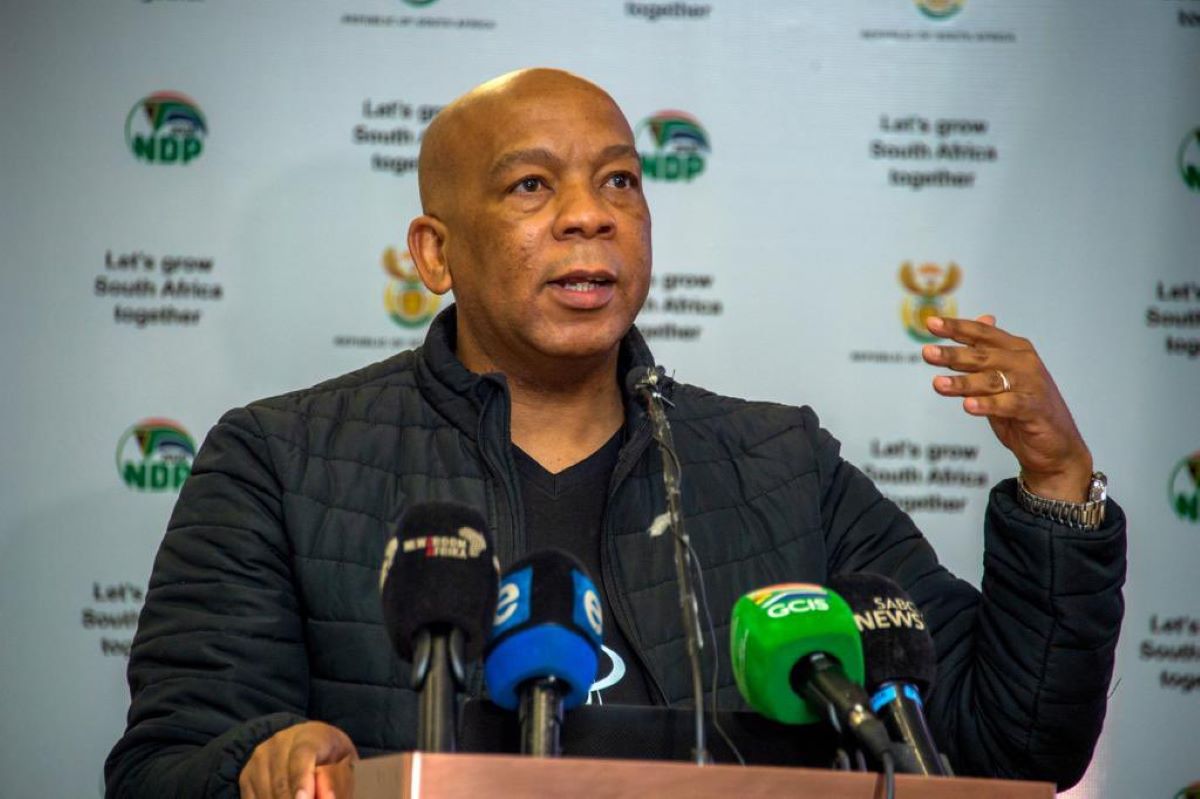
Ramokgopa briefed media on the Integrated Resource Plan (IRP) 2025 on Sunday, October 19.
Cabinet has approved the new Integrated Resource Plan for electricity, which is being referred to as ‘IRP 2025’.
In addition, the full IRP 2025 would be published in the Government Gazette.
The IRP is a comprehensive, forward-looking strategy that outlines the allocation of SA’s primary energy resources, ensuring that the country’s electricity demand is met both sustainably and cost-efficiently.
Ramokgopa said the newly published IRP is an integral part of growing South Africa’s economy, which had still not reached its pre-Covid levels. He said now that the country has turned the corner on power supply, energy will cease to be a national crisis and instead will become a “catalyst for growth”.
“We are now getting the South African economy to grow with sufficient electricity demand going into the future. So, we are projecting until 2042 there must be a deliberate, well-constructed and well-orchestrated plan on how we don’t get back to situations of load shedding, and we’re able to secure energy security. And energy security, and in particular electricity … must be affordable, “Ramokgopa said.
“So, here we are directing the private sector where these opportunities are… This is really an instrument to guide the private sector on these opportunities.”
Ramokgopa said there are risks regarding the programme.
Firstly, he is worried about the lack of a skills pipeline, saying the country has not built infrastructure for a major programme since the 2010 World Cup.
“So, it means that the skills that are required to support this programme are in short supply, and that’s why we’ll be engaging with the universities and TVET (technical and vocational education and training) colleges, especially on the engineering side and the built environment,” the minister said.
The second risk is the “decimation” of the construction industry.
“Historically, we’ve had the big five construction companies, I think now we’re only left with one… We are not likely to have an industry that is in a position to take advantage of these opportunities, and that’s why we’ll be sitting with industry to see how best they can ramp up their capacity and capability to meet the demands of this programme,” Ramokgopa said.
“Of course, the assurance they want from us is that we’re not going to do ‘start, stop, start, stop’, because they won’t make the necessary investments that are going to support this programme.”
Gas Load Factor
Ramokgopa linked the decision to raise the GtP load factor to both the impending decommissioning of 8 000 MW of coal-fired capacity over the period (a schedule that is reaffirmed in the plan) and a decision to use the GtPs to “anchor” gas demand for industrial users.
Such demand is expected to facilitate the liquefied natural gas imports required to avoid an impending “gas cliff”; a supply disruption that would affect industrial users later in this decade that currently rely on natural gas imports from Sasol’s depleting Pande and Temane fields in southern Mozambique.
Previously the IRP envisaged the GtP plants being used far more flexibly, in a range of between 25% to 65%, so as to cost-effectively close any gaps that might arise in the system, particularly as the share of variable renewable electricity rose.
The Minister confirmed that the high load factor outlined for the initial plants would be reviewed for subsequent GtP generators, with the IRP 2025 including a 16 000 MW allocation for the technology by 2039.
Nuclear
Ramokgopa also reaffirmed that government intended reviving the pebble bed modular reactor nuclear technology, which was currently under care and maintenance at Eskom, by placing it under the control of the South African Nuclear Energy Corporation, or Necsa.
Necsa would be expected to demonstrate the technology, and prove its competitiveness relative to other SMRs currently under development globally.
Ramokgopa insisted that the generation build-out would be shaped by the IRP 2025 and led by the State, arguing that an over-reliance on the market had failed to ensure security of supply in the past.
He, thus, continue to punt mega-scale procurement bid windows despite the efforts currently under way to launch a South African Wholesale Electricity Market in line with the now legislated vision for the emergence of a more competitive electricity supply industry.
Ramokgopa said the IRP2025 had a cumulative net present value cost of R2.2-trillion and argued that it would reshape South Africa’s electricity supply away from its current reliance on coal towards a mix of technologies.
Watch Live in the video below:
Video Courtesy of GCIS.