
By Lehlohonolo Lehana, Live from Nasrec.
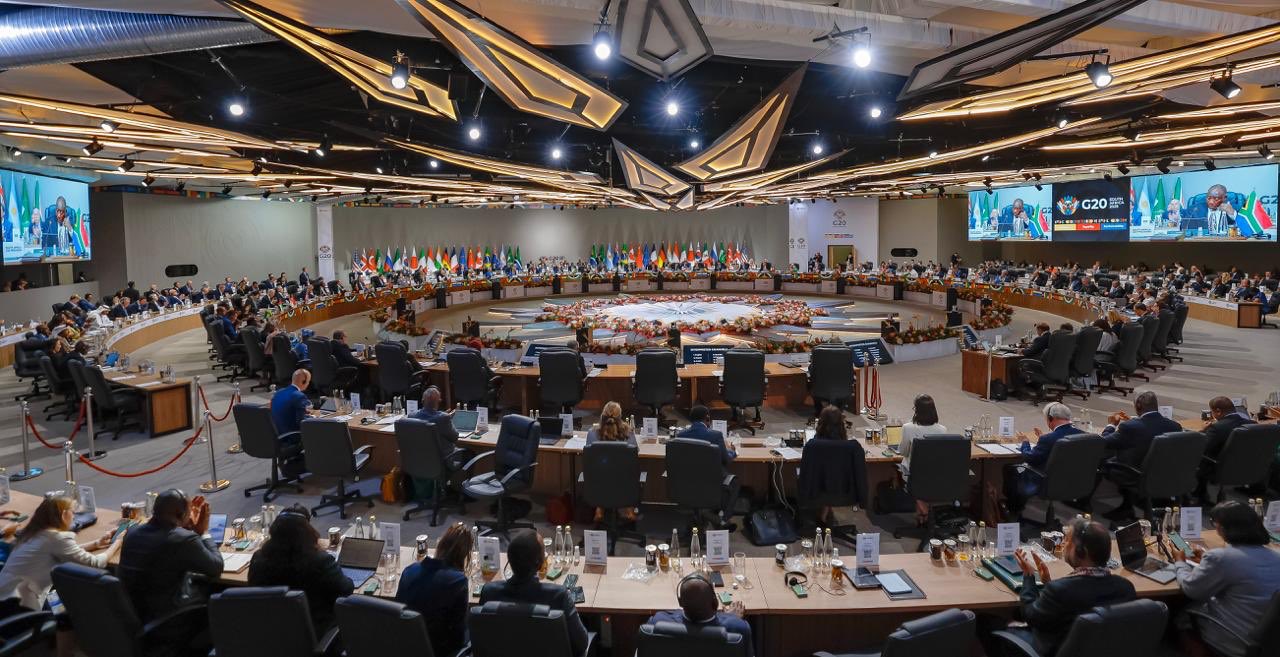
The G20 Leaders Summit has adopted the declaration without any objection by all the members despite the United States boycotting the event in Johannesburg.
President Cyril Ramaphosa moved away from G20 custom by asking fellow G20 leaders to adopt the declaration from the summit at the start of the meeting on Saturday, rather than at the end of the summit on Sunday.
Ramaphosa did this without realising that the cameras were live, which was supposed to be done off-camera.
The cameras continued to roll when he asked the leaders to adopt the outcome of the declaration by a show of hands. He went onto say there was “overwhelming consensus” for a summit declaration.
Fullview understands there was a “slight change” in the program, with the summit declaration moved to the first order of the day, after a sense emerged during bilateral talks that it should be adopted before the rest of the session.
The adopted summit declaration said the organisation will work for a comprehensive and lasting peace in Sudan, the Democratic Republic of the Congo, the occupied Palestinian territory and Ukraine.
The declaration placed pointed emphasis on the seriousness of climate change, in a snub to US President Donald Trump, who has repeatedly cast aspersions and doubts on the scientific consensus that global warming is caused by human activities.
It stressed that increasing large-scale disasters disproportionately affect people in vulnerable situations in ways that exacerbate poverty and inequality, adding that a high level of debt is one of the obstacles to inclusive growth in many developing economies.
“We are committed to strengthen the implementation of the G20 common framework for debt treatments in a predictable, timely, orderly, and coordinated manner,” the declaration said.
The G20 is a group of 19 countries that includes the richest but also the top developing economies in the world. The European Union and the African Union, which joined in 2023, are also members, making it now a group of 21.
It was formed in 1999 and unlike the Group of Seven, which only includes the richest democracies, it offers some developing countries a forum to raise their problems.
Its focus is the global economy and international development, though it has no charter or permanent secretariat — unlike organizations such as the United Nations. It also doesn’t issue binding decisions and critics say there’s no meaningful mechanism for it to put words into action.