
By Lehlohonolo Lehana.
President Cyril Ramaphosa has acknowledged that priority has to be given to solving the electricity crisis if the country aims to attract the investment required to raise growth and tackle high levels of unemployment.
Solving the electricity crisis is necessary if we are to realise the potential of our economy. In 2018, we launched an ambitious investment drive to raise R1.2 trillion in new investments over five years. To date, and with still a year to go, we have raised more than 90% of that amount in commitments from both domestic and foreign investors.
“Of these commitments, around R330 billion has already flowed into the economy, opening new factories, expanding production lines and creating new jobs,” the President said in his weekly newsletter.
The President said the current power crisis is a reminder of “how unstable our ageing power stations are” and the need for greater urgency to implement the measures he announced in July to bring stability to the grid.
“On Sunday, I held an urgent virtual meeting with Ministers and officials on the reasons for the current load shedding, and the steps being taken to reduce the severity and frequency of load shedding in the coming days and weeks.
Eskom has already announced some of the measures it is taking and we will remain seized with this issue until the situation is resolved,” he said without detailing any extra steps his government is prepared to take to prop up the electricity grid.
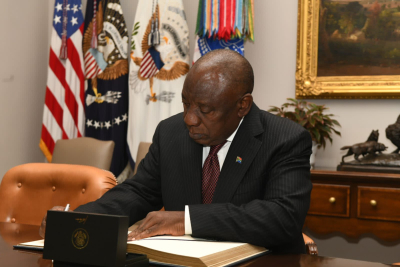
Following his visit to Washington last week, where discussions were held with US President Joe Biden, Ramaphosa said these international visits and discussions may not have the desired impact on attracting trade and investment to the country if load shedding persists.
“The visits we undertake to various countries, be they working visits, State visits or trade missions, are crucial for promoting investment and trade. They bring in investment and they create jobs. They also improve our relations with the countries we visit, thus creating great opportunities for our country.
“Building strong partnerships with other countries is important, but it is not enough. That is why we are working to make our economy more competitive, more efficient and more attractive to both international and local companies. First and foremost, we have to overcome the electricity crisis,” he said.
Eskom meanwhile said that a total collapse of the national grid would be an unforeseen event, and its system operator would not be able to provide advanced warning should it occur.
In the event that the grid collapses, this would result in a total blackout – which would leave the entire country without any power for “a few weeks” as it recovers.
The group published a guide on the load shedding process this week, informing the public about how it manages energy supply and how load shedding fits into the overall picture.
South Africa was plunged into stage 6 load shedding over the weekend, with warnings from industry experts that things could get a lot worse as the week progresses.
While load shedding was reduced to stage 5 on Tuesday, the grid remains incredibly volatile and vulnerable to further breakdowns.
In a media briefing on Sunday, Eskom noted that its load shedding schedules go up to stage 8, where 8,000MW is pulled from the grid. If capacity issues go beyond this level, it is up to the System Operator to make specific determinations, per province, for how much additional power needs to be pulled.
Eskom said that load shedding is its last resort to prevent a nationwide blackout.
When the system is under strain, it first turns to voluntary or contracted emergency demand reduction where large energy consumers – mostly industrial – are asked to reduce their load on the grid.
If this fails to balance the demand, load shedding is implemented.
“If preventative measures, including load shedding, are insufficient – the national grid will collapse. A blackout is unforeseen, and therefore, the System Operator will not be able to make an announcement in advance,” it said.
“A national blackout will have massive implications, and every effort is made to prevent this from occurring. Depending on the nature of the emergency, it could take a few weeks for the grid to recover from a blackout.”
Eskom CEO Andre de Ruyter said that there was no immediate threat of a blackout occurring, and the fact that Eskom was able to manage the demand and supply through load shedding – even at stage 6 – was a sign that the system is working, as load-shedding was designed precisely to prevent a total blackout.
Despite this, the utility said it is adequately prepared for a catastrophe and regularly conducts “black start” tests.
“A black start test is basically when you test various pieces of [power] plants to look at their adequacy, should we have an unfortunate situation when we black out the whole system,” it said.
“[Black start tests] happen on a three-yearly basis for different parts of the plant. There’s also a number of different tests performed at different intervals.”
The power utility conducted one of its main black start tests on 23 August 2022.