
By Lehlohonolo Lehana.
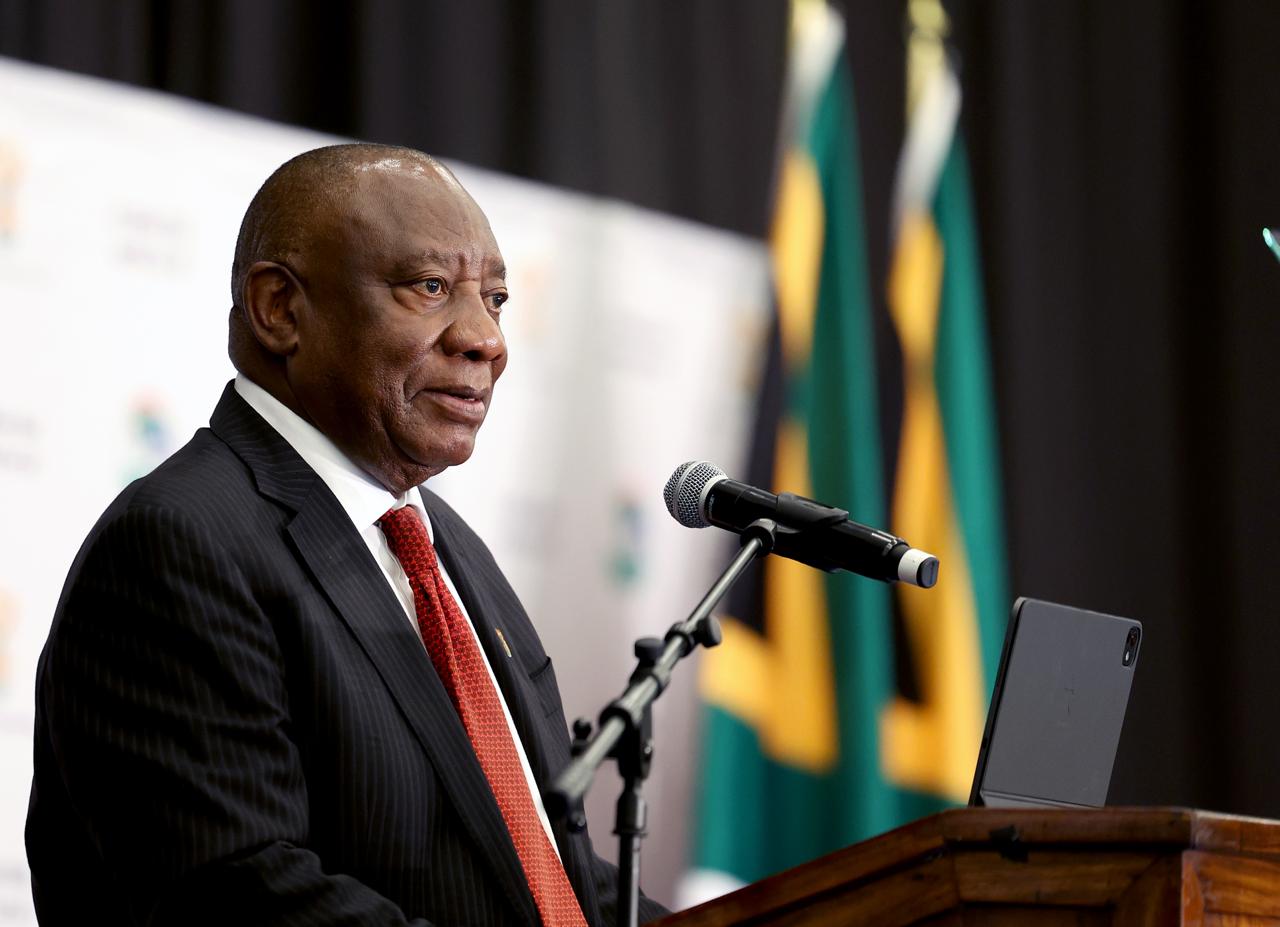
President Cyril Ramaphosa staunchly defended Black Economic Empowerment (BEE) during a Parliamentary Q&A, dismissing claims that it hinders economic growth.
Ramaphosa said that those who believe that BEE holds back economic growth should hang their heads in shame.
“This is because they only want white people to control the economy. We are not going to allow that,” Ramaphosa told parliamentarians.
Ramaphosa explained that it is a fallacy for people to believe that BEE impedes economic growth when there are many examples of the opposite.
One such example is the mining sector, Ramaphosa said, which is full of black-owned businesses growing their operations and creating jobs.
“Many more black people are invovled in mining today. That industry now has more black entrepreneurs who are expanding their operations and creating more jobs,” he said.
This overlooks the fact that the output from South Africa’s mining sector has declined steadily over the past three decades of ANC rule.
While black ownership has increased, it is of a smaller pie, with the mining sector being a shadow of its former self.
The Fraser Institute now ranks South Africa as among the worst mining jurisdictions in the world, when it previously would find itself at the top spot of the rankings.
BEE also weighs on the profitability of South African companies and results in billions of rands worth of economic activity being lost.
The Free Market Foundation and the Solidarity Research Institute estimate that BEE costs the South African economy R290 billion in direct compliance costs and lost economic activity.
Meanwhile the Independent Communications Authority of South Africa (ICASA) has said that it would not consider changing regulations on BEE ownership requirements for telecoms licences until the law is amended.
In a statement issued on Wednesday, 13 May 2026, the sector regulator repelled attempts by the communication minister, Solly Malatsi, to introduce equity equivalent investment programmes (EEIPs).
Starlink and other industry stakeholders and experts have advocated for EEIPs as an alternative to local ownership rules for telecommunications licences in South Africa.
Currently, the Electronic Communications Act (ECA) requires licensees to be 30% owned by historically disadvantaged groups (HDGs).
HDGs are classified as Black people, women, youths, and people with disabilities. “Black” is defined as black Africans, Indians, and Coloureds.
Under South Africa’s black economic empowerment (BEE) laws and regulations, people of Chinese descent may also sometimes be considered “Black” if they became citizens before 27 April 1994.
“The Authority remains committed to advancing transformation, empowerment and economic inclusion within the telecommunications sector and all other sectors it regulates,” ICASA stated.
Crime
Responding to a question from the Democratic Alliance’s George Michalakis on whether the nationwide security initiative had succeeded in meeting its objectives, the President said the joint deployment of the South African Police Service and the South African National Defence Force had made “significant progress” in stabilising crime hotspots across the Western Cape, Eastern Cape, North West, Gauteng and the Free State.
“Indicators suggest a reduction in selected crime categories within the operational action areas,” Ramaphosa told the National Assembly.
According to the President, more than 1 000 arrests have been made since the start of the operation. The highest number of arrests were recorded in the Western Cape, with 550 arrests, followed by 238 in the Eastern Cape.
Authorities have focused heavily on dismantling drug trafficking operations, illegal mining syndicates and networks linked to serious violent crime.
Ramaphosa revealed that law enforcement agencies had carried out more than 38 000 coordinated operational actions, including roadblocks and tracing operations.
These operations resulted in the seizure of 18 firearms, 792 rounds of ammunition and 186 explosives.
The President said these interventions had weakened the operational capabilities of criminal networks operating in affected communities.
He attributed the operation’s coordination to the work of the National Joint Operational and Intelligence Structure, which oversees integrated planning and daily operational briefings between police and military commanders.
Unemployment
Ramaphosa defended the outcomes of the sixth South Africa Investment Conference, which secured R890 billion in investment commitments earlier this year.
However, he admitted that many of the country’s largest capital-intensive projects create relatively few direct jobs despite being critical for economic growth and energy security.
“Labour-intensive investments in global business services and financial services generate approximately 3,900 jobs per R1 billion invested,” Ramaphosa said.
“However, capital-intensive sectors such as renewable energy infrastructure and data centres generate between 13 and 248 jobs per R1bn investments.”
Ramaphosa’s remarks come as South Africa’s unemployment crisis worsened sharply in the first quarter of 2026, with the latest data from Statistics South Africa showing the official unemployment rate climbed to 32,7% from 31,4% in the previous quarter.
The economy shed 345,000 jobs during the quarter, reducing total employment to 16.8 million people, while the number of unemployed South Africans rose to 8.1 million. Youth unemployment climbed to 45.8%, leaving nearly 4.7 million young people without work.
Although Ramaphosa said 53 companies participating in the investment conference projected around 230,000 direct permanent jobs from their investments, he stressed that employment gains would materialise gradually over many years as projects move from pledges to implementation.