
By Lehlohonolo Lehana.
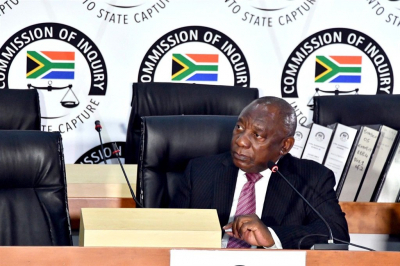
President Cyril Ramaphosa says South Africa may never know the true cost of state capture.
In his closing statement to the State Capture Commission this afternoon, Ramaphosa said that the cost of the corruption was effectively incalculable,and had caused long-lasting damage to major institutions.
“We may be able to establish how much of public funds have been stolen, by how much costs for public goods and services may have been inflated, and what it has cost to investigate these cases and prosecute those responsible.”
It may be possible to quantify the infrastructure and services that could have been provided to the people of our country with the funds that were stolen and wasted as a result of state capture.
“We could quantify this in terms of hospital beds, commuter trains, houses, social grants, water reticulation, maintenance of roads and any number of other public goods and services that state capture robbed our people of.
“But what is more difficult to measure is the broader cost to our economy and our society,” he said.
The president added that it is difficult to measure the effect of state capture on business and consumer confidence, as well as the loss of investment.
He said it was impossible to quantify the impact of state capture on South Africa’s standing and image internationally.
Ramaphosa said other long-term damage caused includes:
- State capture led to the departure from the public service of highly qualified and experienced people, either because they refused to be part of it or because they presented a threat to those who were part of such activities.
- It is likely that state capture also discouraged many talented young people from joining the government, which has significant implications for the public service of tomorrow.
- By weakening security forces and law enforcement agencies, the actions associated with state capture placed the security and integrity of the country at risk.
“Perhaps the most devastating and lasting cost of state capture and corruption is its effect on the confidence of the people of South Africa in the leaders and officials in whom they placed great trust and confidence and responsibility,” he said.
“State capture has damaged people’s confidence in the rule of law, in public institutions, in law enforcement agencies and, even to some extent, in the democratic process.”
Ramaphosa warned efforts to tackle corruption that became endemic during his predecessor Jacob Zuma’s rule will be a protracted process because of fierce opposition.
Those who sought to loot state coffers ‘populated the structures in government with their acolytes, their own people, who in some instances continue in doing their bidding’, Ramaphosa told the commission.
He added that there ‘is resistance against things being done correctly’.
The state capture inquiry report will be the only ‘final guide’ that Ramaphosa will use to determine who the perpetrators of state capture wrongdoings are who deserve to be let go from the government and its institutions.
The commission began sitting in 2018, and numerous witnesses have testified that Zuma played a central role in enabling his allies to infiltrate and plunder state institutions.
The former president – who is serving a 15-month jail sentence for defying a court order to testify before the panel and is facing trial on separate charges that he took bribes from arms dealers in the 1990s – has denied wrongdoing.
Deputy Chief Justice Raymond Zondo said he can’t wait to hand over the report to Ramaphosa and know that he is done and thanked his team for the commitment.