
By Lehlohonolo Lehana.
The Gauteng High Court on Wednesday morning ruled that former national commissioner of correctional services Arthur Fraser’s decision to place former president Jacob Zuma on medical parole was unlawful and has set aside the decision.
The application to review Zuma’s medical parole was lodged by the Democratic Alliance (DA), the Helen Suzman Foundation (HSF) and AfriForum after Fraser admitted that he had overridden the Medical Parole Advisory Board’s decision not to release the former president from jail.
The decision of the first respondent (Mr Arthur Fraser at the time) to place the third respondent (Zuma) on medical parole, taken on 5 September 2021, is reviewed, declared unlawful and set aside.
“The medical parole decision is substituted with a decision rejecting the third respondent’s application for medical parole,” the court said in its judgment.
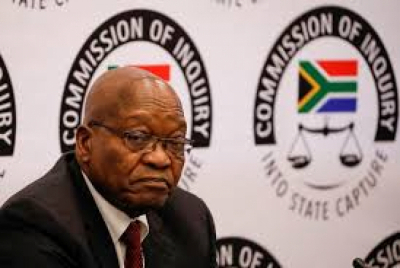
The high court also ordered that Zuma should return to jail to serve out the remainder of his 15 month sentence imposed by the Constitutional Court (ConCourt) in late June for refusing to obey court orders to appear before the Commission of Inquiry into Allegations of State Capture.
The nearly three months that Zuma has been out on medical parole does not count toward the fulfilment of his sentence, meaning the time he has spent at home cannot be considered as part of his 15-month jail sentence.
According to the judgment, Zuma defied the commission, the judiciary and the rule of law and is resolute in his refusal not to participate in the state capture commission’s proceedings.
“He continues to attack the Constitutional Court while unlawfully benefitting from a lesser punishment than what the Constitutional Court has imposed.
“He states in his answering affidavit that he considers himself ‘a prisoner of the Constitutional Court’ and claim that he was ‘incarcerated without trial’.”
Fraser’s “unlawful intervention” mitigated the punishment imposed by the ConCourt, “thereby rendering the constitutional order ineffective, which undermines the respect for the courts, for the rule of law and for the Constitution itself,” according to the judgment.
“The commissioner’s unlawful intervention has resulted in the third respondent (Zuma) enjoying nearly three months of his sentence sitting at home in Nkandla, not serving his sentence in any meaningful sense.”
Zuma and the national commissioner were ordered to pay the costs of the medical parole challenge.
Meanwhile, the Department of Correctional Services said in a terse statement it had noted the high court’s judgment on Zuma’s medical parole and was studying the ruling.
The department’s spokesperson Singabakho Nxumalo said they would make further pronouncements in due course.