
By Estea Rademeyer, Sports Journalist.
Photo Credit: @Springboks/X.
The Springboks have wasted little time looking beyond their latest chapter in Rugby’s Greatest Rivalry.
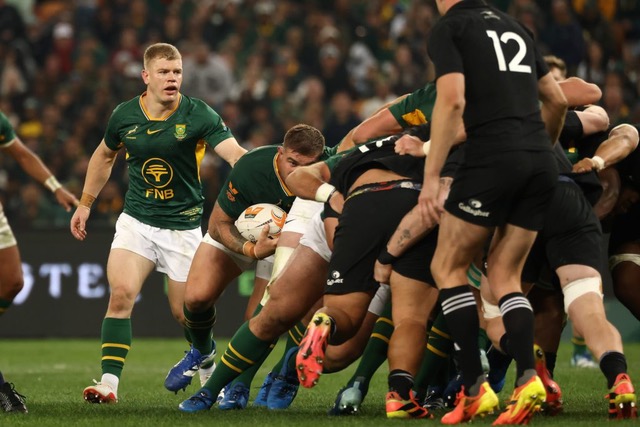
Just days after completing a four match series against New Zealand in Baltimore, Rassie Erasmus has made 13 changes to his starting XV for Sunday’s one off Test against Australia in Perth, underlining a shift in focus towards the next phase of the World Cup cycle.
Only lock Eben Etzebeth and wing Ethan Hooker retain their places from the side that started the 43- 28 victory over the All Blacks.
The changes are not simply about resting established players. With the 2027 Rugby World Cup in Australia now firmly on the horizon, the Wallabies Test provides another opportunity for players within the wider squad to make their case.
At the centre of that approach is André Esterhuizen, who will captain South Africa for the first time and become the 68th player to lead the Springboks.
Erasmus believes the 32 year old has earned the opportunity through his willingness to put the team ahead of personal preference. Esterhuizen has played at inside centre and has also been used as a loose forward, making his versatility an increasingly valuable part of the Bok squad.
“He captained the Sharks last season and he has brought so much to our squad,” Erasmus said.
“He thoroughly deserves this opportunity and we trust that he is the right man to take over the captaincy in this match.”
Erasmus also pointed to the way Esterhuizen handled difficult periods as Sharks captain and his willingness to accept whatever role the Springboks require.
“He’s been one of the players that really, whenever you ask something from him, being a hybrid player or playing behind Damian de Allende and Damian Willemse, sometimes not playing a lot and then accepting to play as a forward and a back, we just feel we would love to see him in this situation against a really strong Australian team.”
The decision not to simply hand the captaincy back to Etzebeth or Handré Pollard also reflects Erasmus’ broader approach to building leadership within the squad.
“We could have just given it to Eben again, but we know what Eben brings as a captain,” Erasmus said.
“We just think being Bok captain, you suddenly feel how it feels to lead a country, and then you become better in supporting the other captain when he’s captain. “We try to build our leadership group in that way.”
The selection changes extend throughout the team.
Jan Hendrik Wessels and Zachary Porthen start at prop alongside hooker Johan Grobbelaar, while Etzebeth partners Franco Mostert in the second row. Paul de Villiers, Elrigh Louw and Marco van Staden form a new loose forward combination.
Van Staden’s role will be particularly important at the breakdown, where Australia are expected to pose a significant challenge.
“There’s not a specific role for the eighthman apart from scrumming,” Erasmus said. “If you take Paul, Marco, Elrigh, Jasper Wiese if he comes on, André Esterhuizen and others, I think the breakdown battle is going to be massive. “Marco will have a massive impact there.”
The halfback pairing is also new, with Herschel Jantjies partnering Pollard, who has recovered from the injury niggle that ruled him out of the second Test against New Zealand.
Canan Moodie joins Esterhuizen in midfield, while Hooker, Edwill van der Merwe and Aphelele Fassi form the back three.
There are further opportunities on the bench. Ox Nché, Malcolm Marx and Wilco Louw provide front row cover, while Lood de Jager covers lock and Jasper Wiese is set to earn his 50th Test cap if he comes on.
Erasmus also revealed that the Boks have been exploring the possibility of using Marx on the flank, another example of the experimentation taking place within the squad. “We’re trying to save the bodies, and manage the guys while winning but also building some squad depth,” Erasmus said.
That balance will be central to the next year. The Springboks are still expected to compete for every Test they play, but the journey towards the 2027 World Cup requires more than a settled starting XV.
Players need opportunities. Combinations need to be tested. Versatility needs to be developed and the wider squad needs to be ready when injuries or form force changes.
Sunday’s clash at Optus Stadium therefore carries significance beyond the result. For Esterhuizen, it is a first chance to lead his country. For the returning and developing players, it is an opportunity to put their names firmly into Erasmus’ World Cup plans.
And for the Springboks, Australia provides the next test in a journey that is already moving towards 2027.
SPRINGBOKS – 15 Aphelele Fassi, 14 Edwill van der Merwe, 13 Canan Moodie, 12 André Esterhuizen (c), 11 Ethan Hooker, 10 Handré Pollard, 9 Herschel Jantjies, 8 Marco van Staden, 7 Elrigh Louw, 6 Paul de Villiers, 5 Franco Mostert, 4 Eben Etzebeth, 3 Zachary Porthen, 2 Johan Grobbelaar, 1 Jan-Hendrik Wessels.
Bench: 16 Malcolm Marx, 17 Ox Nché, 18 Wilco Louw, 19 Lood de Jager, 20 Jasper Wiese, 21 Morné van den Berg, 22 Sacha Feinberg-Mngomezulu, 23 Quan Horn.