
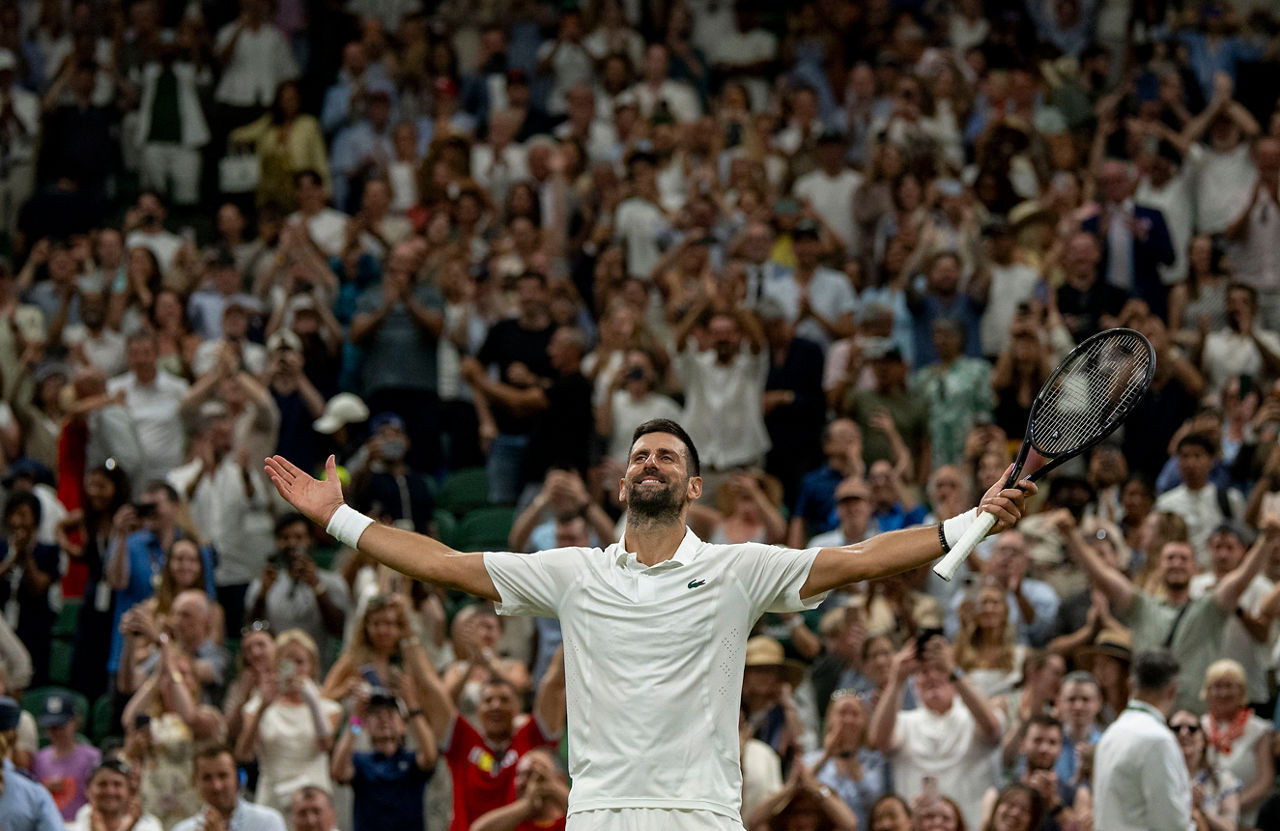
By Kevin Rademeyer Sports Journalist in London.
Photo Credit: AELTC/Jon Super.
There are Wimbledon days that gently unfold, and there are those that arrive carrying the weight of history before a ball has even been struck.
Friday belongs emphatically to the latter.
One semi-final offers the game’s oldest champion still refusing to surrender his throne. The other features Britain’s unlikeliest hero attempting to stretch a fairy tale beyond the point where fairy tales are usually allowed to exist.
Two matches. Four men. Two entirely different stories.
Second up on Centre Court will be a battle of the ages, with a rivalry that has quietly become tennis’ defining generational battle. Jannik Sinner against Novak Djokovic is no longer simply youth versus experience. It is tomorrow attempting to convince yesterday that its time has finally passed.
Twelve months ago Sinner dismantled Djokovic in straight sets at this very stage. Afterwards, the seven-time Wimbledon champion spoke with unusual honesty. “I don’t think it’s bad fortune,” he admitted. “It’s just age.”
For the first time, even Djokovic appeared willing to acknowledge that time might finally be winning. Yet here he is again.
At 39, after surviving the longest Wimbledon quarter-final in history against Felix Auger Aliassime, the Serbian has once more dragged himself to within touching distance of another Grand Slam final. His body complains more loudly than it once did, but his belief remains stubbornly intact.
“I still try to prove to myself and others that I’m able to compete with the best players in the world and beat them on the biggest stage,” Djokovic said this week.
History suggests it would be foolish to doubt him. Standing opposite, however, is perhaps the most complete player in the men’s game.
Sinner arrives as the world No.1 with a serve that has become one of the tournament’s most devastating weapons, backed by movement that disguises extraordinary power with deceptive ease. He has won five of the last six meetings between the pair but knows that Centre Court has a habit of rewriting scripts.
“Every match has its own story,” Sinner said. “He has won this tournament so many times and knows exactly how to approach it.”
That respect is mutual. Neither man expects comfort. Neither expects rhythm. Every service game will feel like a small victory, every break point like a championship point.
If experience and excellence dominate the opening act, the first match belongs entirely to possibility.
Arthur Fery has become Britain’s unlikely heartbeat over the last fortnight.
Ranked outside the elite only weeks ago, the 23 year old wildcard has produced the sort of run Wimbledon specialises in creating but rarely sustains. Every round has demanded something different. Every victory has required another layer of composure.
Now comes the second ranked player in the world, Alexander Zverev.
Fresh from his Roland Garros triumph, the German finally appears liberated by having captured the major title that had eluded him for so long. His victory over Taylor Fritz was close to flawless, ending a seven match losing streak against the American with the authority of a man who now fully trusts his own game.
For Fery’s coach, Jeroen Benard, the surprise is not that his player can compete at this level, only that the world is discovering it all at once. “I’ve seen him in practice,” Benard said. “I knew the potential was there.”
The challenge now is substantial.
Zverev’s first serve has been among the most effective at Wimbledon, while his baseline power can overwhelm almost anybody. Yet Fery has confounded expectations by refusing to play to opponents’ strengths. His speed, early ball striking and willingness to rob rivals of time have unsettled everyone he has faced.
Former doubles great Todd Woodbridge believes that is exactly how the Briton must approach Friday. “You have to take Zverev out of his norm,” he said. “Bring him forward. Make him uncomfortable.”
Simple enough to describe. Infinitely harder to execute. But then, almost everything Fery has accomplished over the last two weeks seemed unlikely before he walked onto court.
That is the enduring magic of Wimbledon.
One semi-final asks whether the greatest survivor in modern tennis can hold back the future one more time. The other asks whether Britain’s newest dream can continue gathering momentum against one of the game’s most powerful players.
By sunset, Centre Court will know its finalists.
Whether they are legends, dreamers, or perhaps a little of both, Friday promises to remind us why Wimbledon remains the sport’s greatest theatre.