
By Kevin Rademeyer, Sports Johnson in London.
Photo Credit: AELTC/Simon Bruty.
Live from London: There is something wonderfully appropriate about Wimbledon producing its most unexpected final through two players who have spent years living in each other’s shadow.
Not rivals. Not enemies. Friends.
On Thursday afternoon Centre Court belonged to the Czech Republic, and by the time the last forehand drifted beyond the tramlines, the oldest tennis championship in the world had found itself a distinctly Czech affair.
Karolina Muchova and Linda Noskova will contest Saturday’s ladies’ final after two very different victories that nevertheless spoke the same language: courage under pressure.
One survived one of the matches of the tournament.
The other barely blinked.
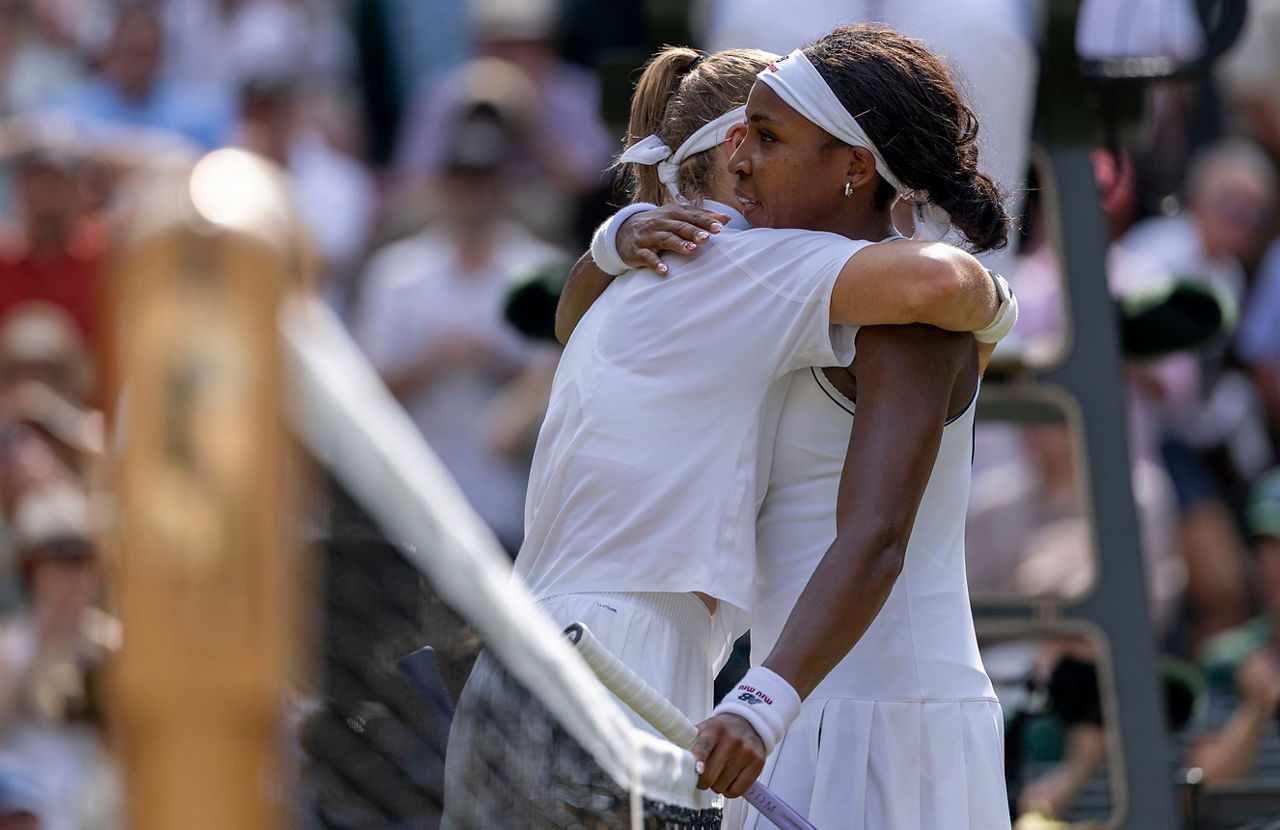
Muchova’s breathtaking victory over Coco Gauff was tennis played with the sort of conviction that cannot be coached. Against an opponent who had beaten her six times in seven previous meetings, she made a simple decision. If she was going to lose, it would be playing her own tennis.
That meant moving forward. It meant trusting delicate hands at the net against arguably the finest athlete in women’s tennis. It meant refusing to retreat, even when Centre Court seemed ready to carry Gauff over the line.
“In my head, I was just like, ‘I have to keep hitting,'” Muchova explained afterwards. “If I’m going to lose this, I want to lose on my own terms.” Those terms produced one of Wimbledon 2026’s defining moments.
The deciding set tie break became an exhibition of nerve. Muchova sprawled across the grass chasing volleys. Gauff produced impossible retrievals that only Gauff seems capable of finding. Momentum changed owners almost every point until, at 9-8, the American earned match point.
The margins at Wimbledon are often measured in millimetres rather than metres. Gauff chose a forehand drop shot. It found the net.
Minutes later Muchova collapsed onto the grass in celebration after sealing a remarkable 6-2, 1-6, 7-6 (12-10) victory, her first Wimbledon final finally secured after years of frustration on these lawns.
For Gauff, there was disappointment but little self pity. “I’m going to think about it tonight,” she admitted. “Every great champion has this happen in their career. Maybe this is something I need to be on their level.”
It was the response of a champion who already understands that defeat is often a better teacher than victory.
Earlier in the fortnight Gauff had spoken about finally discovering how to play on grass. Thursday did not end with the Venus Rosewater Dish still within reach, but it confirmed something perhaps just as valuable. Wimbledon is no longer a puzzle she cannot solve.
If Muchova’s victory demanded every ounce of emotional energy, Linda Noskova’s route to the final resembled a masterclass in controlled ambition.
Only hours before her semi final she stepped onto Centre Court for the first time, granted permission to practise on the famous stage she had never before experienced in competition. Seven hours later she owned it.
The 21 year old defeated Ukraine’s Marta Kostyuk 6-4, 6-4 with the composure of a player ten years older, becoming the youngest Wimbledon finalist since 2014 and extending the remarkable Czech production line that previously gave the Championships Martina Navratilova, Jana Novotna, Petra Kvitova, Marketa Vondrousova and Barbora Krejcikova.
“A semi final at a Grand Slam is never easy,” Noskova said afterwards. “I tried to stay patient, stay cool and somehow get the last point.” It sounded uncomplicated. It rarely is.
Kostyuk carried with her far more than a tennis racket. Throughout the Championships she has balanced elite sport against the daily reality of war in Ukraine, often waking to news of missile attacks close to where her family still lives. Her run to the last four had become one of the emotional stories of Wimbledon.
But against Noskova, the precision deserted her at the moments it mattered most. A double fault surrendered the opening set before the Czech calmly extinguished every flicker of resistance in the second.
Sometimes pressure arrives loudly. Sometimes it arrives disguised as opportunity.
For Noskova, there was no panic. Only patience. And now Wimbledon has its final.
It is not the one most predicted when the fortnight began, but perhaps it is the one this remarkable championship deserves.
Muchova brings artistry, imagination and the courage to attack when caution feels safer. Noskova brings fearless ball striking, quiet confidence and the certainty that she belongs on this stage.
One has waited years for this opportunity. The other has arrived ahead of schedule.
On Saturday, Centre Court will witness more than a battle for the Venus Rosewater Dish. It will crown Czech tennis once again. Checkmate, Wimbledon.