
By Kevin Rademeyer, Sports Journalist.
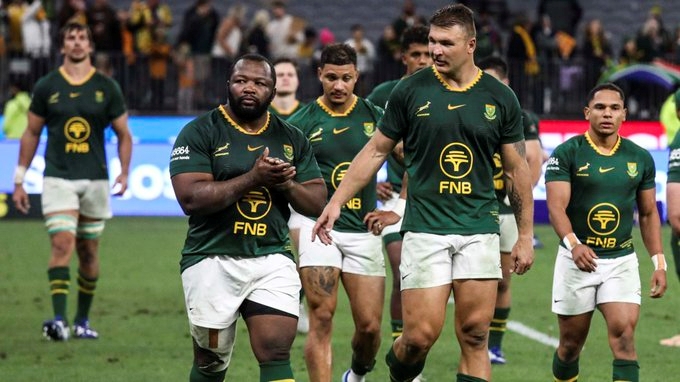
Photo: Springbok X Account.
It was a test like no other.
The Springboks were 25 points behind Australia with 15 minutes left in Perth. Four Wallabies were in the sin bin before the final whistle. The referee was communicating with the television match official through a mobile phone after the match technology failed.
And somehow, for a few extraordinary minutes, South Africa looked capable of winning.
They didn’t.
Australia held on for a 42-38 victory, reclaimed the Nelson Mandela Challenge and left the Springboks with a defeat that was as strange as it was revealing.
This was not the South Africa that had dismantled New Zealand. It was not particularly close, for 70 minutes.
Rassie Erasmus made 13 changes to the starting XV after the 43-28 victory over the All Blacks in Baltimore. The selection was deliberate, designed to manage a squad that had been together for months and had just come through an arduous four Test series.
But changing the personnel also changed the way the Springboks played.
Against New Zealand, their contestable kicking had been precise, their set piece powerful, they dominated the scrums and mauled effectively from line outs. They controlled territory and made possession count.
In Perth, those foundations disappeared.
Australia had 57 per cent possession and 54 per cent territory. The Springboks had 43 and 46 respectively. The Wallabies carried 126 times to South Africa’s 96 and kicked for 615 metres, almost twice the Boks’ 346.
It was the aerial battle that perhaps told the clearest story.
South Africa attempted eight contestable kicks and won only three. Australia kicked seven times in that fashion and came down with four. A team that has built so much of its game around pressure in the air was suddenly being beaten at its own game.
Even the lineout, normally a source of certainty, became unreliable. Australia lost only one of eight. South Africa lost three of 11, while the rolling maul that had caused New Zealand so many problems was largely blunted.
The scrum only began to give South Africa genuine dominance after the 65th minute.
By then, Australia had already done the damage.
They led 24-17 at half-time after a match that had begun with the Boks showing plenty of urgency. Johan Grobbelaar’s early rolling maul try suggested the visitors might impose themselves after all.
Instead, Len Ikitau scored twice, Ben Donaldson finished another Wallaby attack and Harry Wilson powered over as Australia repeatedly found ways through a South African defence that had spent much of the afternoon under pressure.
Max Jorgensen’s try after Canan Moodie’s dropped pass was the moment the game appeared to disappear completely.
The score moved to 42-17.
For most teams, that would have been the end of the conversation. The Springboks made it something else.
Australia’s discipline collapsed. Wilson was yellow carded for a high tackle on Malcolm Marx. Ryan Lonergan followed after diving into a retreating scrum, with the Boks awarded a penalty try. Joseph Sua’ali’i was then sent to the sin bin for an offside tackle on Marx.
Hunter Paisami became the fourth Australian player dismissed when he made a late, high tackle on Sacha Feinberg-Mngomezulu.
At one point, the Australian sin bin looked more crowded than the field.
South Africa scored 21 unanswered points, within 10 minutes.
Ox Nche crossed. Morne van den Berg followed. The penalty try had already brought the Boks within striking distance. The final minutes became frantic, almost surreal, as Australia tried to survive and South Africa searched for the four tries they needed.
They came close. But they had left themselves too much to do.
Erasmus was blunt afterwards.
“For us, we lost in a Springbok jersey against Australia, and with all the disruptions, we have nobody else to blame but ourselves for the result,” he said.
The technology failures, including a clock that continued running when it should have stopped, provided an obvious talking point. Erasmus refused to use them as an excuse.
“I know the technology failed a bit, the clock kept running and didn’t stop at times for example, but that didn’t influence how we played. We controlled that. We didn’t play well enough tonight to beat a stronger team.”
The numbers support him.
South Africa made 13 unforced errors to Australia’s 11 and committed eight ruck offences to the Wallabies’ four. They actually won more turnovers, 16 to 13, and matched Australia for defenders beaten and line breaks, both sides recording 25 and 12 respectively.
The problem was what the Boks did with their opportunities.
At least 10 of those unforced errors came between the Australian 22 and halfway, precisely where South Africa needed to turn possession into pressure. Too often, promising attacks simply ended.
And Australia were good enough to punish them.
Captain André Esterhuizen, leading the Springboks for the first time, understood the frustration. “It was pretty intense. At one stage, we were concentrating on getting one try, then getting another, and taking it step by step. But like we said, we should never have been in that situation.”
“We put ourselves there. I think the fans and people watching the game really enjoyed it, but we should be better and not get into such situations.”
That is perhaps the uncomfortable truth of this Test.
The Springboks did not lose because of the final 10 minutes. They lost because Australia were the better side for the first hour.
They were stronger in contact, more accurate in the air, more secure at set piece and more efficient with the territory they earned.
Australia also showed something South Africa will have noticed carefully. They can hurt the Boks without waiting for them to make mistakes.
Les Kiss has built a Wallabies side that is increasingly comfortable playing against the best teams in the world. For long periods in Perth, Australia looked like the side with the clearer plan and greater control.
The 42 points conceded were the most South Africa have allowed in the Erasmus era.
That statistic will sting.
So will the knowledge that the Springboks had spent 16 weeks together, only to produce one of their least convincing performances in that period.
Erasmus would not dress it up. “When you’re 25 points behind, there’s nobody else to blame but yourself,” he said. “We rolled the dice a bit, and some guys haven’t played a lot together in a long time, but it’s not an excuse.”
“We picked the team, and we had a game plan, and I thought we had a chance at the end, but the better team won on the night.”
There is, however, something useful in the discomfort.
Australia will host next year’s World Cup. A meeting between these teams in a knockout match is entirely possible, and the Wallabies have now given South Africa something far more valuable than a defeat to analyse.
“They’re a good team and they’ve definitely improved a lot,” Erasmus said. “We might meet them in a vital playoff game, and it was nice to get a taste of them tonight. When we play them next year, we’ll know a little bit more about each other.”
He resisted calling it a lesson learned.
Perhaps that is because this was not a match that needs a neat conclusion.
It was a Test of extremes. South Africa were ordinary for an hour, then extraordinary for 10 minutes. Australia were composed when the game belonged to them, then suddenly vulnerable when the Boks found momentum.
In the end, the comeback was spectacular but incomplete. The Springboks had the final word in Perth.
Australia had the result. And perhaps that is what will make this defeat linger. It was a Test like no other, but the part South Africa will remember most is the simple part.
They had the chance to win it. They had created that chance themselves.
They had also spent most of the afternoon making sure they would have to perform a miracle to take it.
Scorers:
Australia – Tries: Len Ikitau (2), Ben Donaldson, Harry Wilson, Max Jorgensen. Conversions: Ryan Lonergan (5), Penalties: Lonergan (2)
South Africa – Tries: Johan Grobbelaar, Edwill van der Merwe, penalty try, Ox Nche, Morne van den Berg. Conversions: Handrè Pollard (2), Sacha Feinberg-Mngomezulu (2). Penalty: Pollard.