
By Lehlohonolo Lehana.
The South African Navy has taken delivery of the first of three multi-mission inshore patrol vessels at its naval dockyard in Simon’s Town, Cape Town.
The vessel formed part of Project Biro, which “aims to rejuvenate the South African Navy patrol capability” through the acquisition of the three patrol vessels.
The delivery of P1571 (future SAS King Sekhukhune I) heralds a new era for both the local shipbuilding industry and the South African Navy.
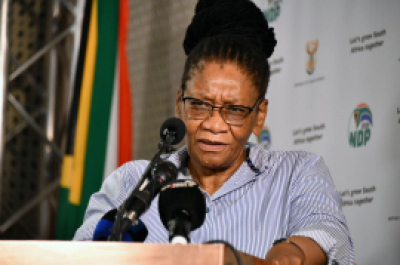
Minister of Defence and Military Veterans Thandi Modise noted that the delivery of the first MMIPV is “a good milestone.”
“It means we are hopefully picking up the pace to renew the National Defence Force, to renew and to be able to say we are protecting South African waters, South African sovereignty and its resources better,” she said.
“It will enable us to really do everything that the Navy is supposed to do for South Africa,” Modise continued. “Obviously, with the responsibility we have in the region, we probably will not keep the ship for ourselves only. We’ll probably, if Chief Joint Ops has his way, be deploying the ship for even more than we thought.”
Under the command of Commander Jabulani Mashamba, P1571 will be officially commissioned into the SAN at a ceremony in Durban on 15 June.
The second MMIPV is scheduled for launch in September 2022 and delivery in April 2023, whilst the third vessel is scheduled for delivery in April 2024.
All three MMIPVs are DSCT Stan Patrol 6211 design platforms. The 62m long, 750 ton vessels have a 20 knot economical speed and a range of 2 000 nautical miles. Besides a 9 m and a 7 m RHIB (rigid hull inflatable boat) for boarding operations, each vessel is fitted with a Reutech 20 mm Super Sea Rogue marine gun and Reutech FORT (Frequency Modulated Optical Radar Tracker) Low Probability of Intercept (LPI) optronics radar tracking system.
She is crewed by 49 persons (including eight Officers) and space is available for a further 14 persons. Additional accommodation or mission equipment can be placed on the aft deck in special containers.
DSCT has exceeded Project Biro’s 60% local content requirements by issuing contracts to a large number of local suppliers and as a result of their work on Project Biro, many of these suppliers are now earmarked for work on Damen projects in and outside of South Africa.
The project has created over 300 direct jobs by DSCT, with another 1 000 indirect jobs in line with the South African Government’s Operation Phakisa objectives.