

By Lehlohonolo Lehana.
ActionSA presented its Comprehensive Review of the Government of National Unity (GNU) two years since the formation, using the party’s performance tracker.
The coalition government was formed after African National Congress (ANC) lost its parliamentary majority in elections for the first time since Nelson Mandela led it to power in 1994 at the end of white-minority rule.
The review was revealed during a briefing led by its leader Herman Mashaba, National Chairperson Michael Beaumont, Parliamentary Leader Athol Trollip MP, Parliamentary Chief Whip Lerato Ngobeni MP, and all ActionSA Members of Parliament.
Trollip revealed that the party’s “GNU Performance Tracker”, which gives government’s overall performance an F rating, citing a severe lack of urgency, accountability, and results.
He heavily criticised President Cyril Ramaphosa’s decision to expand the Cabinet rather than streamline State expenditure. The executive has grown to 32 Ministers and 43 Deputy Ministers.
According to ActionSA, this “bloated executive” costs taxpayers R6-billion a year, with R600-million going to salaries for Ministers, Deputy Ministers and support staff; R350-million going to travel and accommodation expenses; and R4.5-billion for VIP protection services.
Trollip argues that this massive financial investment has yielded zero returns, pointing to a string of recent ministerial scandals.
He highlights a suspended Police Minister linked to institutional infiltration, a Higher Education Minister who lied to Parliament, and a Social Development Minister who concealed luxury SUV gifts.
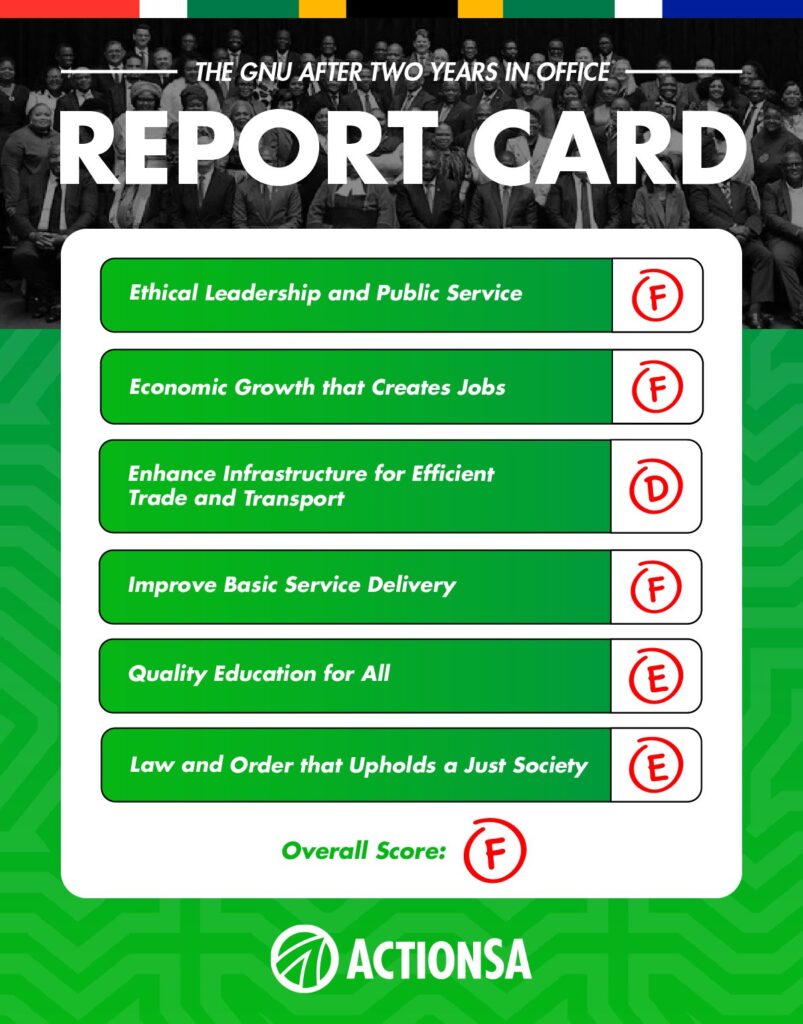
Mashaba quipped that they were a bit generous with the safety score and he would have given the GNU a lower score.
“I’m sure you’ve used date to give this, but for me, from outside, I think you were generous. I would have given them an ‘H’.”
The party painted a grim picture of the country’s economic trajectory, noting that the expanded unemployment rate has climbed to an historic 43.7%.
The economic indicators highlight a deep-seated crisis, with 345 000 jobs lost in the first quarter of 2026 alone, 12-million total South Africans currently unemployed and 0.5% GDP growth in Q1 2026, following weak growth of 0.6% in 2024 and 1.1% in 2025.
Mashaba raised major concerns over recent revelations from the Madlanga Commission of Inquiry and Parliament’s Ad Hoc Committee, saying both probes exposed how deeply criminal syndicates have penetrated the top tiers of South African law-enforcement institutions.
Meanwhile National Treasury technical advisor and former acting director-general Ismail Momoniat warned members of parliament’s Standing Committee on Finance on Tuesday that the country’s ability to investigate organised crime, successfully prosecute and recover criminal assets could come under the spotlight if weaknesses in law enforcement persist.
“I think the events at the Madlanga Commission and the ability of the country to deal with organised crime – particularly if many of our top police are implicated in their links to organised crime – impacts on South Africa,” Momoniat said.
South Africa exited the FATF grey list in October 2025, but the next assessment has already begun.
Momoniat said some of the toughest measures South Africa will face in the upcoming FATF mutual evaluation relate directly to the country’s ability to investigate and prosecute financial crime.
Treasury said South Africa currently largely complies with 38 of the 40 FATF recommendations, including one that is not applicable, while two recommendations remain partially compliant.
The first key reports in the mutual evaluation process are due in July and October this year, followed by an onsite visit by FATF assessors from 2 to 19 March 2027.