
By Lehlohonolo Lehana.
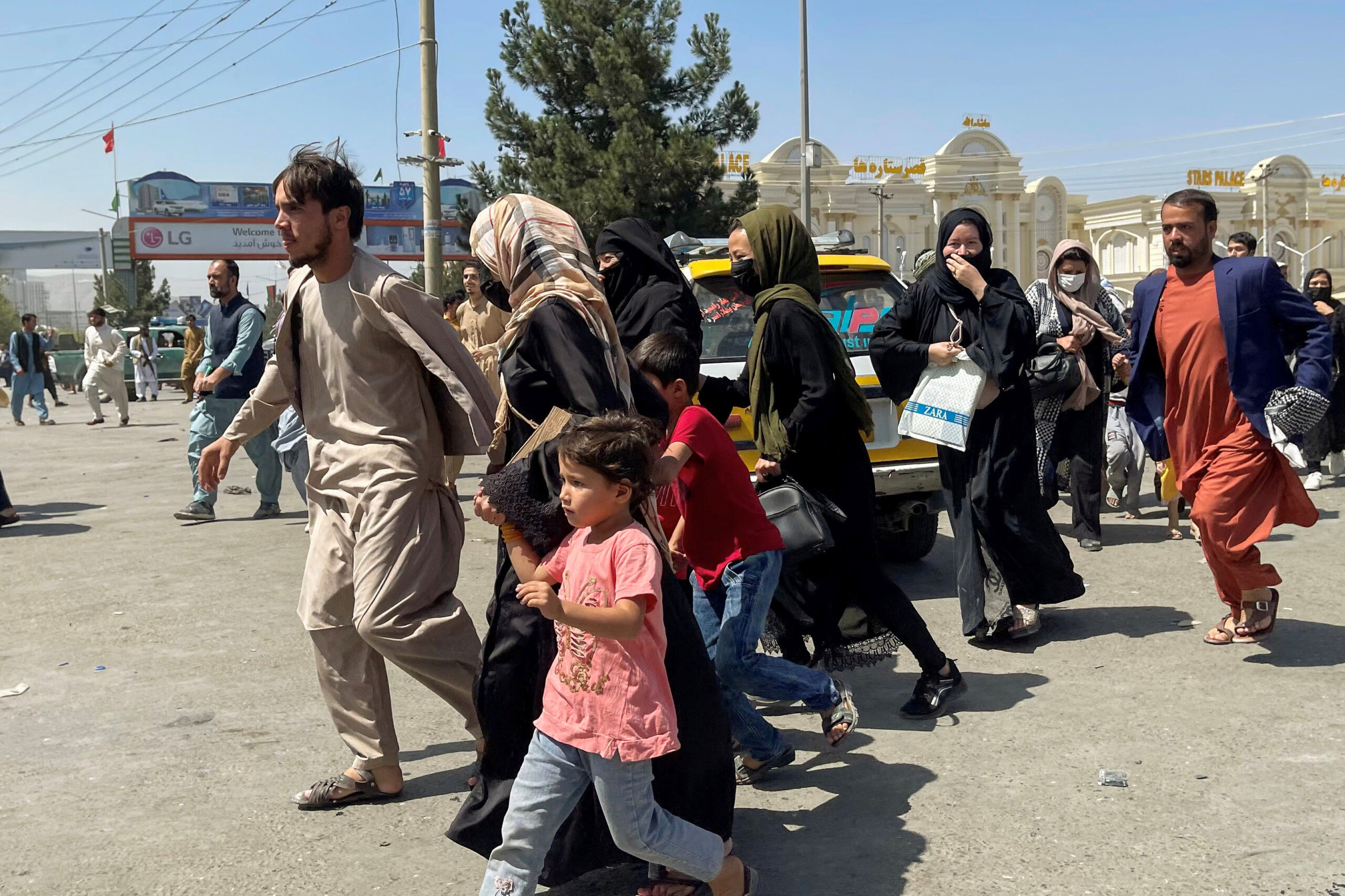
People try to get into Hamid Karzai International Airport in Kabul, Afghanistan August 16, 2021.Photo Credit:Reuters.
Afghan Ambassador to the United Nations Ghulam M. Isaczai said during Monday’s ongoing Security Council meeting that the UN must call for an end to violence in Afghanistan.
“There is no time for a blame game anymore. We have an opportunity to prevent further violence, prevent Afghanistan descending into civil war, and becoming a pariah state. Therefore the Security Council and the UN Secretary-General should use every means at its disposal to call for an immediate cessation of violence and respect for human rights and international humanitarian law,” Isaczai said.
The ambassador stressed on Monday that he was speaking on behalf of millions of people in Afghanistan “whose fate hangs in the balance, and are faced with an extremely uncertain future.”
“I am speaking for millions of Afghan girls and women who are about to lose their freedom to go to school, to work, and to participate in the political, economic, and social life of the country. I am speaking for thousands of human rights defenders, journalists, academics, civil servants, and former security personnel whose lives are at risk for defending human rights and democracy. I am speaking for thousands of internally displaced people who are desperately in need of shelter, food, and protection in Kabul and other places, “Isaczai said.
Isaczai added that the UN should also call upon the Taliban to abide by humanitarian laws, call on Afghanistan’s border counties to open their borders to displaced civilians and humanitarian goods, and call for a transitional and representational government.
He also called upon the United Nations to “stress that the council and the United Nations will not recognize any administration that achieves power through force or any government that is not inclusive and representative of diversity of the country,” Isaczai said.
What went wrong in Afghanistan?
Nearly 20 years after United States forces entered Afghanistan, this is what it has come down to: The government has effectively collapsed and President Ashraf Ghani has left the country. The military has lost its will to fight and disintegrated. A brutal and emboldened Taliban advance, already having instituted draconian legal systems and curbed women’s rights in areas under its control, has taken over Kabul. The population has been plunged into a new humanitarian crisis. And American soldiers and diplomats are sprinting for the exits.
The al-Qaeda-allied Taliban is now about to assume the lion’s share of political power – if not total power.
Many understandably blame US President Joe Biden’s withdrawal decision for Afghanistan’s current mess. But the reasons are also rooted in the longstanding strength of the Taliban and the fundamental weakness of the Afghan state.
For years, the Taliban had prepared the ground for this final battle. Taliban forces established deep footprints and eventual control in districts around the country, including near cities – thereby positioning themselves for the urban offensives of recent days. They amassed large quantities of heavy weaponry seized from Afghan forces. They diversified their sources of financing beyond the drug trade, making a wealthy armed group even richer. The Taliban’s current advances did not come out of nowhere.
Meanwhile, ever since the NATO war formally ended in 2014, Afghan forces – despite training, advising, and dollars galore from Washington – have struggled to lead the counterinsurgency from the front. The Afghan Special Forces – the most effective fighting unit of the Afghan military – were overused, taxing the capacities of the military’s best asset.
As Taliban offensives intensified in recent years, foot soldiers struggled with insufficient equipment and were often not paid. Corruption flourished and morale plummeted. Afghan troops received little support from the government, which struggled to develop a counterinsurgency strategy.
To be sure, Biden’s withdrawal announcement contributed to Afghanistan’s current crisis. His announcement had an intoxicating effect on the Taliban – and its allies. Foreign military presences have long been an underlying grievance of “Islamist” militant groups. Al-Qaeda was born out of Osama bin Laden’s hatred for the presence of US soldiers on Saudi soil.
A US withdrawal was bound to energise the Taliban and prompt it to step up its fight against the Afghan state, which had long hosted US forces. Since April, 20 armed groups – including al-Qaeda – have fought alongside the Taliban.
Biden’s withdrawal announcement was as deflating for Afghan forces as it was intoxicating for the Taliban. Already beleaguered, they knew they would lose critical US safety nets, from air power support – a powerful tool to repel fighters from entering cities – to technical expertise to maintain their military equipment. Deprived of strong government leadership and a clear strategy, they melted away in the face of Taliban advances, leading to surrenders and negotiated handovers to the Taliban.
The withdrawal has showcased Taliban strength and exposed Afghan state weakness. But both were entrenched long before Biden’s decision. Washington’s inability to adjust to these factors much sooner amounts to a major policy failure.
It is worth noting, however, that Afghanistan would have been plunged into deeper instability even if Biden had chosen not to withdraw. The Taliban would not have reacted well to a US decision to renege on its commitment, framed in a 2020 agreement with the Trump administration, to withdraw forces. They would have launched fresh offensives against Afghan forces, with US soldiers – spared by the Taliban ever since the 2020 accord – in their crosshairs too.
The US military presence was neither a brake on the Taliban nor a broader stabiliser. Even with boots on the ground in recent years, Afghanistan suffered record-breaking civilian casualty figures and a relentless targeted killing campaign against civil society. Even back in March, weeks before Biden announced the withdrawal, the Taliban controlled more territory than at any time since US forces entered the country.
Still, this is not to understate the seriousness of the political, military, security, and humanitarian crisis triggered by the withdrawal.
Afghanistan’s mess is also America’s mess. Washington owes it to Afghanistan to help clean it up – not for reasons of charity, but of self-interest. A Taliban-dominated government would not in and of itself pose a direct threat to US security interests. But it would provide space to international terror groups, like al-Qaeda, that do. If war resumes and intensifies, regional spillover effects – refugee flows, drug trade, cross-border terrorism – could imperil US stability goals in the broader region.
Eventually, the US will be written out of the Afghanistan script, with regional players taking on more prominent roles. Some of them – China, Iran, and Russia – are top US rivals, but share Washington’s interest in a more stable Afghanistan with less terrorism.
The US should host a summit with Afghanistan’s neighbours to discuss how it can help mitigate potential regional spillover effects. That is the least it can do. Regional actors, unlike Washington, do not have the luxury of leaving.
Source:Fullview and News Agencies.