
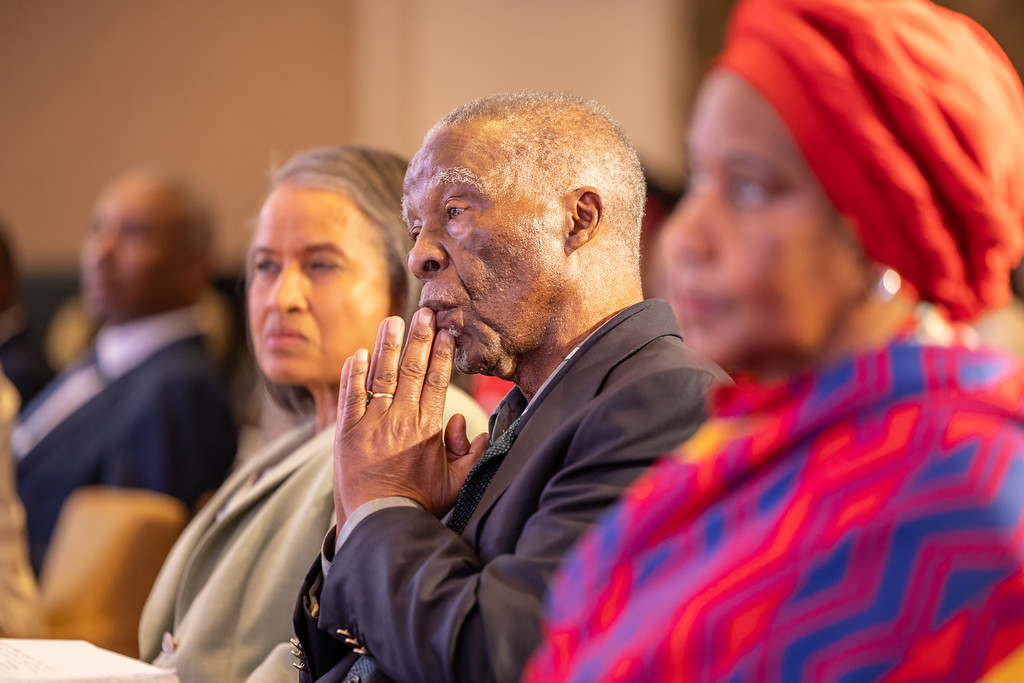
By Thabo Mbeki Foundation.
The Thabo Mbeki Foundation (TMF) hosted a historic gathering in its ongoing mission to catalyse Africa’s Renaissance through critical dialogue and African-led solutions to the continent’s peace and security challenges.
The three-day event brought together over 150 esteemed African leaders, policymakers, scholars, diplomats, and members of civil society to engage in robust discussions aimed at addressing the pressing peace and security issues facing our continent.
The foundation believes that the African Peace and Security Dialogue (APSD) is a testament that sustainable development in Africa is inextricably linked to ensuring peace and security, and serves as a platform to explore the root causes of conflict, share best practices, and mobilise resources towards lasting solutions.
Dr. Phumzile Mlambo-Ngcuka, former South African Deputy President, Ramtane Lamamra, Personal Envoy of UN Secretary-General for Sudan, Ronald Lamola, South Africa’s Minister of International Relations and Co-operation, Juvenal Marizamunda, Rwanda’s Minister of Defence, Mahmoud Thabit Kombo, Tanzania’s Minister of Foreign Affairs and East African Cooperation, Frederick Shava, Zimbabwe’s Minister of Foreign Affairs, and Liberia’s Minister of Defence, Geraldine Janet George, were among dignitaries who, each provided invaluable contributions to the dialogue.
Their participation reaffirmed the TMF belief that peace and security in Africa must be a collective endeavour, owned and driven by Africans themselves.
This year’s African Peace and Security Dialogue theme was “Towards a Peaceful and Secure Africa.
The various topics during the dialogue, were of a particular focus on the regions of West Africa and the Horn of Africa.
These regions have experienced some of the most complex and protracted conflicts in recent years, and the African Peace and Security Dialogue sought to provide actionable insights into the root causes and potential solutions for these crises.
Participants engaged in critical discussions on how weak governance, poverty, political instability, and external interference fuel conflicts across the continent.
The Dialogue underscored the importance of strengthening the African Union’s peace and security mechanisms and enhancing collaboration between regional economic communities to advance continental stability.
Gauteng Premier Panyaza Lesufi kicked off the event with a plea for African unity, urging attendees to place the continent’s interests above all else and collaborate for a brighter future.
Geraldine Fraser-Moleketi, Chairperson of the Thabo Mbeki Foundation, echoed this sentiment, noting the urgency of the peace and security crises.
She challenged attendees to devise actionable solutions that would move beyond dialogue into meaningful change, drawing on Africa’s history and lessons learned from peace initiatives like nuclear disarmament.
Delegates also heard from Professor Funmi Olonisakin, Vice President of International, Engagement, and Service at King’s College London, who highlighted critical blind spots in Africa’s approach to securing peace across the continent.
She said the three main blind spots were uncritical acceptance of external blueprints for responding to African conflicts, the gap between African peace and security norms and their implementation, and flawed leadership approaches at national, continental, and global levels.
Calling for a collective and cohesive response to tackle the deep systemic issues affecting Africans, Professor Olonisakin emphasised the need for unified action to achieve lasting peace and stability on the continent.
The gap that exists between our intention and action, which is the blind spot, is considerably wide, in addition to which the desire to do the bidding of external power often overrides the common agenda that we set for ourselves in Africa,” she said.
She proposed some solutions for consideration, which included rethinking leadership infrastructure, and reforming the African Union Commission leadership selection to include public participation and competency testing. She also proposed empowering the African Parliament in appointing AU Commission leaders.
She added that African leaders must take collective responsibility and ownership of the continent’s security and development agenda.
Opening the second day of the Dialogue, South Africa’s Deputy Minister of Defence and Military Veterans, General Bantu Holomisa, also addressed delegates on peacebuilding efforts across the continent, saying, “The growing focus on militarised conflict resolution rather than diplomacy will undoubtedly train resources that should be directed towards social security, education, health care, and poverty alleviation.
“The resources of African nations should be used to uplift people, not to perpetuate wars,” he added. “A shift towards empowering institutions for peace and conflict resolution is not only necessary, but urgent, if we are to build a stable and prosperous future for the continent.”
South Africa’s International Relations and Cooperation Minister Ronald Lamola also shared his reflections on the continent’s peace and security landscape, expressing hope that this dialogue will help find solutions to conflicts in places like West Africa and the eastern Democratic Republic of Congo.
Equally powerful was the voice of Ramtane Lamamra, the UN Secretary General’s Personal Envoy for Sudan, who emphasised that “direct engagement, continued dialogue, and the implementation of commitments represent the only way to end war.” His words resonated deeply, as the Dialogue provided a timely space for reflecting on the ongoing conflict in Sudan and the crucial role that African regional organisations and international actors must play in resolving these crises.
President Thabo Mbeki, Patron of the Thabo Mbeki Foundation and former President of South Africa, in his closing remarks, reminded all in attendance of the urgency of our mission: “All of us have a responsibility to carry on our shoulders the outcomes of this dialogue, because that is the expectation of the continent—that we couldn’t have met for idle reasons; we met to address what is actually a serious challenge on the continent.” He emphasised that Africa would be looking to the dialogue to use its conclusions to move forward towards the resolution of Africa’s challenges.
Compiled by Lehlohonolo Lehana.