
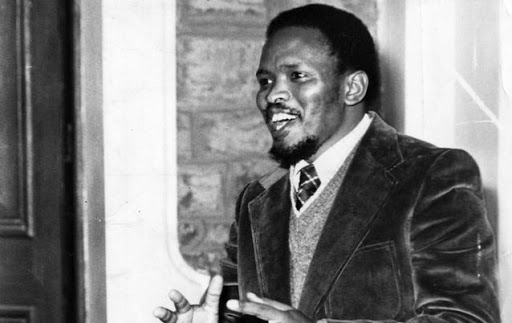
By Lehlohonolo Lehana.
Nkosinathi Biko, who was six when his father died, says the family is confident a new inquest into the death of his father 48 years ago will lead to the prosecution.
Stephen Bantu Biko, the Black Consciousness Movement (BCM) founder died from a brain injury aged 30 almost a month after being arrested at a roadblock.
Police at the time said he had banged his head against a wall, but after apartheid ended in 1994, former officers admitted to assaulting him – although no-one has been prosecuted.
“What is required from this process is simply to follow the facts, and we have no doubt that a democratic court, in a democratic state, will find that Steve Biko’s murder was an act, orchestrated and executed by those who were with him – the five policemen who are implicated in this case,” his son said.
Two former security policemen, Johan Beneke, and Daniel Siebert, who are now in their eighties, are the only two left out five and were named as persons of interest in the matter.
The family’s legal counsel, Advocate Tembeka Ngcukaitobi, urged the court to move with the necessary speed in finalising the inquest, given the ages of the two men.
“The only two of the eight policemen are old, and it is important that we move with the necessary speed to ensure that no information gets lost,” said Ngcukaitobi
Ngcukaitobi also noted the significance of the date of the enrollment of the inquest which was on Friday, 12 September, the day that Biko died in police custody.
Nkosinathi said they have not received any justice for his father’s death.
“Well, justice has been delayed. But our sense of justice is broader than justice. the process that must play out in court,” he said.
He said the family marked the 48th anniversary of his father’s death with a graveside service on Friday morning.
National Prosecuting Authority spokesperson in the Eastern Cape, Luxolo Tyali said: “The inquests follow the Minister of Justice and Constitutional Development’s approval of the National Director of Public Prosecutions’ requests.
“The main goal of holding them is to lay before the court evidence that will enable the court to make a finding in terms of section 16(2) (d) of the Inquests Act 58 of 1959, as to whether the death was brought about by any act, or omission, which prima facie involves or amounts, to an offence on the part of any person.”
The matter was postponed to 12 November for case management in the High Court.
Biko had been a medical student at the University of Natal when he founded the Black Consciousness Movement, aimed at empowering and mobilising the urban black population.
He was determined to combat the psychological inferiority that many black South Africans felt after years of white-minority rule and at a time when anti-apartheid activists like Nelson Mandela had been silenced and incarcerated by the regime.
The Truth and Reconciliation Commission (TRC), set up in 1996, uncovered apartheid-era atrocities like murder and torture, but few of these cases progressed to trial.
Biko’s case was heard at the TRC, which is where the policemen involved admitted to having made false statements 20 years earlier, but they were not prosecuted.