
By Lehlohonolo Lehana.
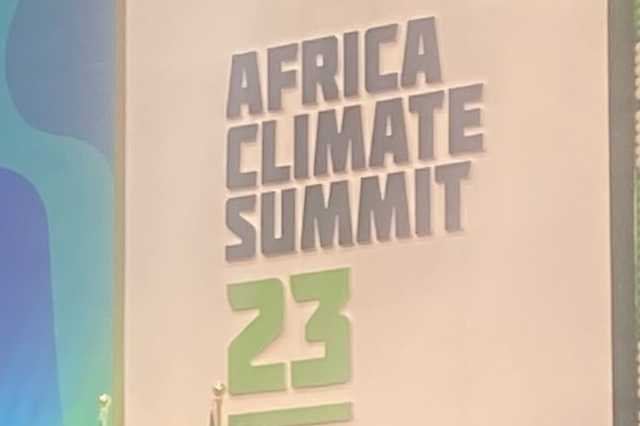
The first African Climate Summit opened Monday with heads of state and others asserting a stronger voice on a worldwide issue that affects their continent the most even though its 1.3 billion people contribute to global warming the least.
The three-day Nairobi summit, which began on Monday, has attracted heads of state, government and industry, including leaders from Mozambique and Tanzania, as well as United Nations head Antonio Guterres, European Union chief Ursula von der Leyen and United States’ climate envoy John Kerry.
Kenyan President William Ruto and the African Union launched a ministerial session as more than a dozen heads of state began to arrive, determined to wield more global influence and bring in far more financing and support. The first speakers included young people, who demanded a bigger voice in the process.
“For a very long time we have looked at this as a problem. There are immense opportunities as well,” Ruto said of the climate crisis, speaking of multibillion-dollar economic possibilities, new financial structures, Africa’s huge mineral wealth and the ideal of shared prosperity.
And yet there is some frustration on the continent about being asked to develop in cleaner ways than the world’s richest countries — which have long produced most of the emissions that endanger climate — and to do it while much of the support that has been pledged hasn’t appeared.
“This is our time,” Mithika Mwenda of the Pan African Climate Justice Alliance told the gathering, claiming that the annual flow of climate assistance to the continent is a tenth or less of what is needed and a “fraction” of the budget of some polluting companies.
“We need to immediately see the delivery of the $100 billion of climate finance pledged annually by rich countries to developing ones, said Simon Stiell, executive secretary of the U.N. Framework Convention on Climate Change. More than $83 billion in climate financing was given to poorer countries in 2020, a 4% increase from the previous year but still short of the goal set in 2009.
Kenya alone needs $62 billion to implement its plan to reduce national emissions that contribute to global warming, the president said.
We have an abundance of clean, renewable energy and it’s vital that we use this to power our future prosperity. But to unlock it, Africa needs funding from countries that have got rich off our suffering,” Mohamed Adow of Power Shift Africa said ahead of the summit.
“Of 20 countries most affected by the climate crisis, 17 are here in Africa,” Kerry said.
The U.N. has estimated that loss and damage in Africa due to climate change are projected to be between $290 billion and $440 billion in the period from 2020 to 2030, depending on the degree of warming.
The second day of the summit commenced with a welcome Statement by Kenya’s Cabinet Secretary, Environment, Climate Change, and Forestry, Soipan Tuya.
This was followed by high-level statements from distinguished guests, including Moussa Faki, chairperson, African Union Commission; Ursula von der Leyen, president, European Commission; Mostafa Madbouly, prime minister of Egypt; Sultan Al Jaber, COP 28 president; António Guterres, secretary-general, United Nations; Azali Assoumani, president, Comoros; and William Ruto, president of Kenya.
Heads of State in attendance at the summit delivered national statements on their respective climate pledges to forge the Africa agenda in the climate financial architecture globally.
The United Arab Emirates has pledged $4.5bn in clean energy investments in Africa at a landmark climate summit aimed at showcasing the continent’s potential as a green powerhouse.
Sultan al-Jaber, who heads the UAE’s national oil company ADNOC and government-owned renewable energy company Masdar, said the investment would “jumpstart a pipeline of bankable clean energy projects in this very important continent”.
Al-Jaber, who is also president of the COP28 climate summit, said a consortium including Masdar would help develop 15 gigawatts of clean power by 2030.
Africa’s renewable generation capacity was 56GW in 2022, according to the International Renewable Energy Agency.
Guterres urged the international community to help “make Africa a renewable energy superpower”.
“Renewable energy could be the African miracle, but we must make it happen,” Guterres told government and industry leaders.
With the world falling far short of its global goals to limit warming, Guterres spoke directly to the Group of 20 nations, whose leaders are meeting in India at the weekend, and told them to “assume your responsibilities “in the battle to reduce planet-warming emissions.
“We must all work together for Africa to become a renewable energy superpower, just as the injustice of climate change here in Africa. I am convinced Africa can be at the heart of a renewable future.”
He said the continent accounts for less than 4% of global emissions but suffers some of the worst effects of rising global temperatures.
The secretary-general said Africa is home to 30% of the mineral reserves that are critical to renewable and low-carbon technologies.
“Africa is home to 60% of the world’s best solar resources but only two of global investment in renewable energy over the last two decades.
“Now is the time to bring together African countries with developed countries financial institutions and technological companies to great an African renewable energy alliance.”
A clean energy transition across the world’s developing nations will be crucial to keep alive the Paris Agreement goal of capping global warming “well below” 2 degrees Celsius (3.6 degrees Fahrenheit) since pre-industrial times, and 1.5C (2.7F) if possible.
To make that happen, the International Energy Agency says investment will need to surge to $2 trillion a year within a decade – an eightfold increase.
Watch Live in the video below:
Video Courtesy of African Union.