
By Lehlohonolo Lehana.
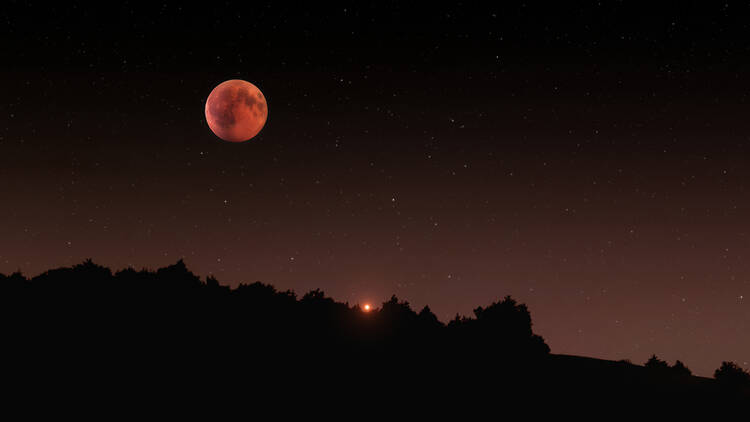
The first visuals of the Blood Moon show a stunning red-hued full moon lighting up the night sky during a total lunar eclipse.
Visible across the world, the rare celestial event has captivated stargazers and photographers worldwide.
The blood moon effect occurs when sunlight passes through Earth’s atmosphere, filtering out blue light and casting red and orange hues onto the lunar surface. Unlike solar eclipses, this event is safe to view with the naked eye, making it accessible to all.
For optimal viewing, stargazers are advised to find locations away from city lights and face the eastern sky as the moon rises higher. The report emphasised that this is the longest total lunar eclipse since 2022, adding to its rarity.
The South Africa Agency for Science and Technology Advancement (SAASTA), a business unit of the National Research Foundation (NRF), explained that for those interested in seeing the lunar eclipse, they should look East/East-North-East from a spot with a clear low horizon (the moon is low as totality begins).
“Unlike a solar eclipse, no eye protection is needed. Binoculars or a small telescope will enhance the view. For photos, stabilise your phone or camera, tap-focus on the Moon, lower the exposure a bit, and try a short-to-moderate zoom,” they said.
“As the moon moves fully into Earth’s shadow, it will glow deep red—the classic ‘Blood Moon’. Expect the red colour to be most striking between 7.30pm and 8.52pm SAST, fading as the eclipse exits totality. The partial phase will end around 9.56pm, with penumbral shading lingering until 10.55pm (Cape Town time), “they said.
The Blood Moon eclipse presents a rare chance for South Africans to engage with a dramatic natural phenomenon, highlighting the wonders of astronomy and the shared experience of celestial events.