
By Lehlohonolo Lehana.
The reports from some key cities and industries show that the planned “national shutdown” for today wasn’t quite as impactful as its organisers hoped.
The Nelson Mandela Bay Business Chamber said that while some factories and industries were impacted due to a spike in absenteeism, it was largely business as usual for the region.
The City of Cape Town issued a similar statement, noting several instances where protesters tried to cause damage and threatened to disrupt businesses, but were ultimately dispersed.
This included stone throwing, attempts to block roads with burning barricades and attempted arson.
“But thanks to the coordinated and swift response of enforcement agencies, we’ve managed to contain the situation. Our staff remain on high alert, and are continuing their proactive patrols and checkpoints to ensure law and order prevails,” the city said.
“In general, most manufacturers who had planned normal operations were able to do so at the required production levels, while those in the services and retail sectors were able to operate without major disruptions,” said Denise van Huyssteen, chief executive of the Nelson Mandela Bay Business Chamber.
“There were some manufacturers that were impacted by higher than normal absenteeism levels, which in certain instances resulted in adjusted production or rescheduling of shifts. Certain manufacturers in turn opted to produce over the weekend and then to close on Monday and Tuesday (the public holiday),” she said.
A few manufacturers were impacted by gas shortages due to the Coega IDZ sub-station explosion incident, which resulted in a number of businesses in the IDZ not having power for more than a week.
The chamber said that the protest action is not the answer to ills raised by the organisers, echoing other sentiments from businesses that they were in fact making matters worse for the country.
“Stayaways, protest actions and threats to business are not a solution to the country’s electricity and load shedding crisis and are deterring investors from risking capital investment into rebuilding our economy and retaining much-needed jobs.
“The ongoing sustainability of businesses has been severely impacted by load shedding, and now more than ever before, we need all the role players to work together to accelerate the implementation of solutions which will provide reliable power which can meet the country’s existing and long-term energy requirements,” it said.
The route from Durban on the N3 highway to the province’s capital, Pietermaritzburg, was clear.
Law enforcement agencies were activated in various districts.
The province saw widespread looting in July 2021, and the police said that they were taking no chances.
Public transport, including taxis, was operating normally.
However, this did not come as a surprise, with the South African National Taxi Council (Santaco) mentioning that it would not form part of the mass action by the EFF.
EFF has been calling for the resignation of president Cyril Ramaphosa and an end to load shedding. It has also attempted to rally support under the banner of many other ills facing South Africa, including high unemployment, gender-based violence, and the lack of free tertiary education.
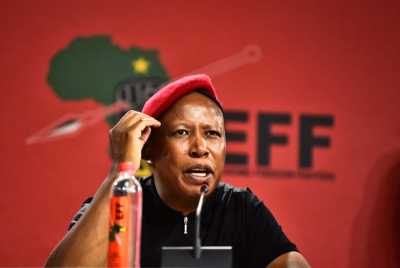
The party leader Julius Malema says nationwide protests calling for the resignation of Ramaphosa over load shedding, the high cost of living and other socio-economic challenges plaguing South Africans was a great success.
Malema joined hundreds of EFF members, supported by several other organisations, in a march to the Mahlamba Ndlopfu presidential residence in Tshwane on Monday.
The protestors called on Ramaphosa to step down over load shedding, the high cost of living and other socio-economic challenges plaguing South Africans.
Malema used the opportunity to take a swipe at Police Minister Bheki Cele – who earlier labelled the shutdown as “a non-event”.
Cele told the media on Monday morning that most people were going about their business as the EFF had failed to bring the country to a standstill.
But Malema insisted the protest was a success.
“This is the most successful shutdown ever in the history of struggle in South Africa,” Malema told supporters at Church Square in Pretoria.
“On my way here they said they are cancelling load shedding for today because there is no demand for electricity today.
“The factories are closed, and the biggest consumers of electricity are closed, that’s why scientifically you should measure the success of this shutdown. Today there is no big malls, no small mall, no shop, no factory, no school, no nothing. All of them are closed.
“In Richards Bay, there is no single truck that was seen, there is no single train that was seen today. South Africa is shut down.”
Malema said some will say the shutdown was unsuccessful as there was no looting or burning of property.
“Buses and taxis are driving around the townships and cities empty, because our people have heeded the call of the EFF to not allow the country to be business as usual, and call for the resignation of Cyril Ramaphosa.
“The success of the national shutdown so far proves that our people are sick and tired of load shedding, corruption, unemployment, crime, gender-based violence and a lack of service delivery.”