
Staff Reporter.
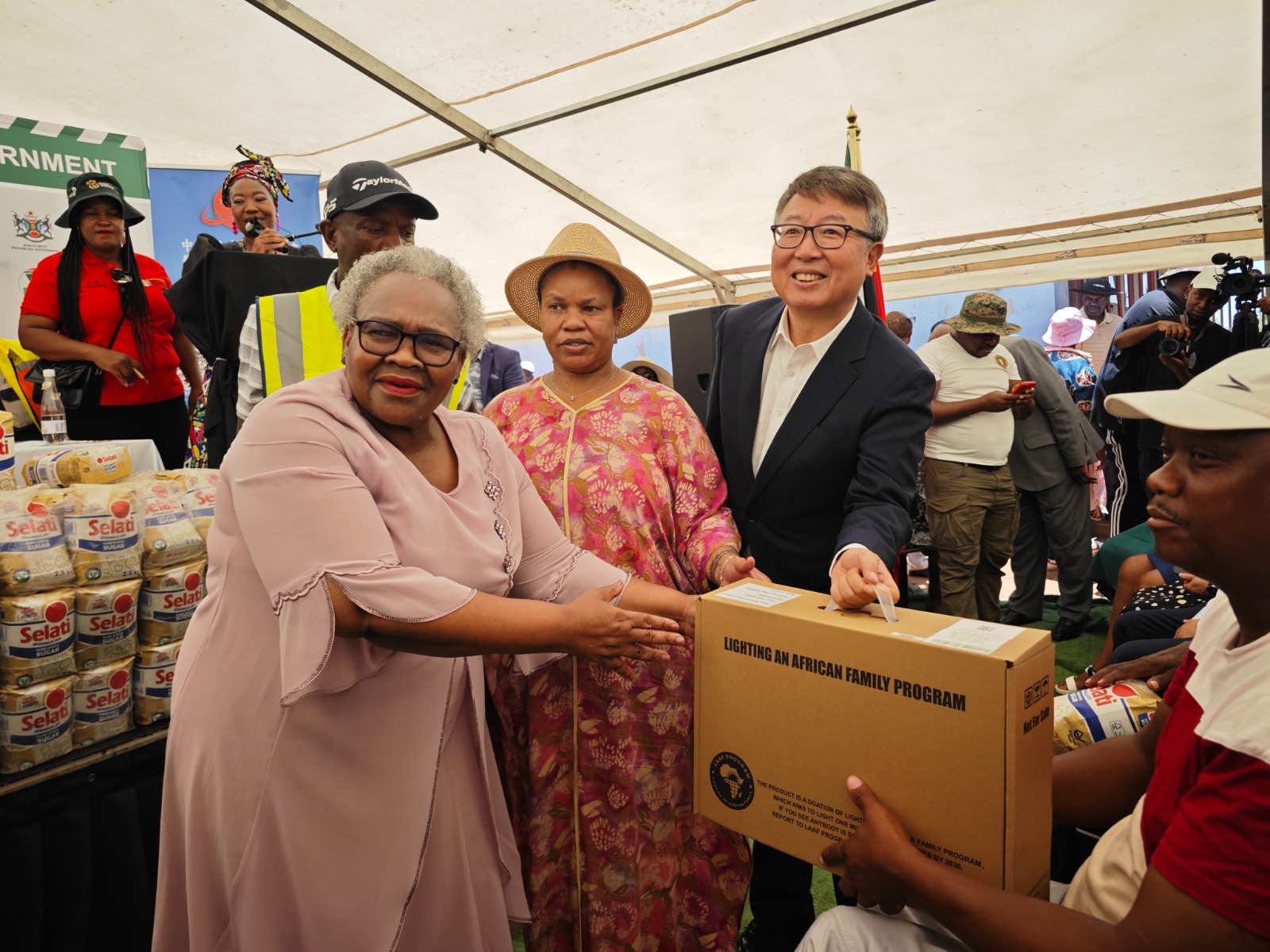
Caption: Social Development Minister Sisisi Tolashe, North West acting Premier Basetsana Dantjie and Chinese ambassador to South Africa, Wu Peng, in Kgomo-Kgomo.
As he delivered truckloads of food hampers and solar systems – in a significant donation to residents of Ward 21 in the impoverished Kgomo-Kgomo village of the North West – Chinese ambassador to South Africa, Wu Peng, this week conceded that installing infrastructure and establishing industries, was a sustainable option.
In terms of agreements signed by Chinese and South African governments, Kgomo-Kgomo was targeted to be transformed into a smart and self-sustainable smart town – based on a Chinese model.
During the September Forum on China-Africa Cooperation (FOCAC), President Xi Jinping and his South African counterpart Cyril Ramaphosa agreed to strengthen the bilateral cooperation on poverty alleviation – advancing the
Poverty Alleviation Model Village Project.
Addressing residents carrying umbrellas, some in hats – braving the scorching summer heat – Wu said while the gesture was noble, it was “not sustainable in the absence of factories being set up to create jobs and business opportunities”.
“From China’s experience – embarking on a sustainable road to prosperity – it is necessary to develop production-oriented agricultural and processing manufacturing projects, such as developing township enterprises. “Me and colleagues from the Chinese embassy, came here to listen to everyone’s true demands and suggestions.
“We also invited some representatives of Chinese companies in South Africa to do research. We look forward to thoughtful suggestions on improving local livelihood infrastructure.
“Right now, the Chinese side is actively discussing with the South African government, about how to deliver livelihood projects in Kgomo-Kgomo – to truly benefit all the villagers.
“We are looking at projects like building roads, clinics, schools, improving electricity and water supply infrastructure,” said Wu.
“As former president Nelson Mandela once said, poverty is not natural, but man-made – can be overcome and eradicated by the actions of human beings. “Let us move towards the goal of no poverty, as we together advance the Poverty Alleviation Model Village project at Kgomo-Kgomo – creating a better tomorrow without poverty or hunger, but with common development and shared prosperity,” he added.
“I am moved by your warm reception here. “As the new year is only a few weeks away, the Chinese embassy in South Africa prepared some food parcels and home solar batteries for everyone,” said Wu, amid a loud applause from the crowd of mostly women and pensioners.
Wu said poverty reduction cooperation “has always been an important part of China-South Africa practical cooperation”.
“Right now, we are working hard to help South Africa implement the Poverty Alleviation Model Village project.
“It is a practical way to implement the important consensus reached by our two presidents. “Eliminating poverty has been a common pursuit of mankind for thousands of years.”
Wu said when the People’s Republic of China was founded in 1949, “we have one of the highest poverty rates in the world”.
“The rural population accounted for 87% of the total population and they were mostly in extreme poverty.
“After more than 70 years of efforts, China lifted nearly 800 million rural people out of poverty, accounting for over 70% of the global reduction during that period.
“While achieving its own poverty alleviation, China has always adhered to the spirit of international humanitarianism and actively participated in global poverty reduction efforts,” he said.
During the FOCAC summit, Xi announced Ten Partnership Action Plans, saying China was “ready to leverage these actions together with Africa to better achieve modernisation in the next three years”.
“We are ready to provide financial support, to make sure the development achievements can better benefit the people of China and Africa,” said Wu.