
By Kevin Rademeyer, Sports Journalist.
Photo: @silvestreszpylma / Premier Padel.
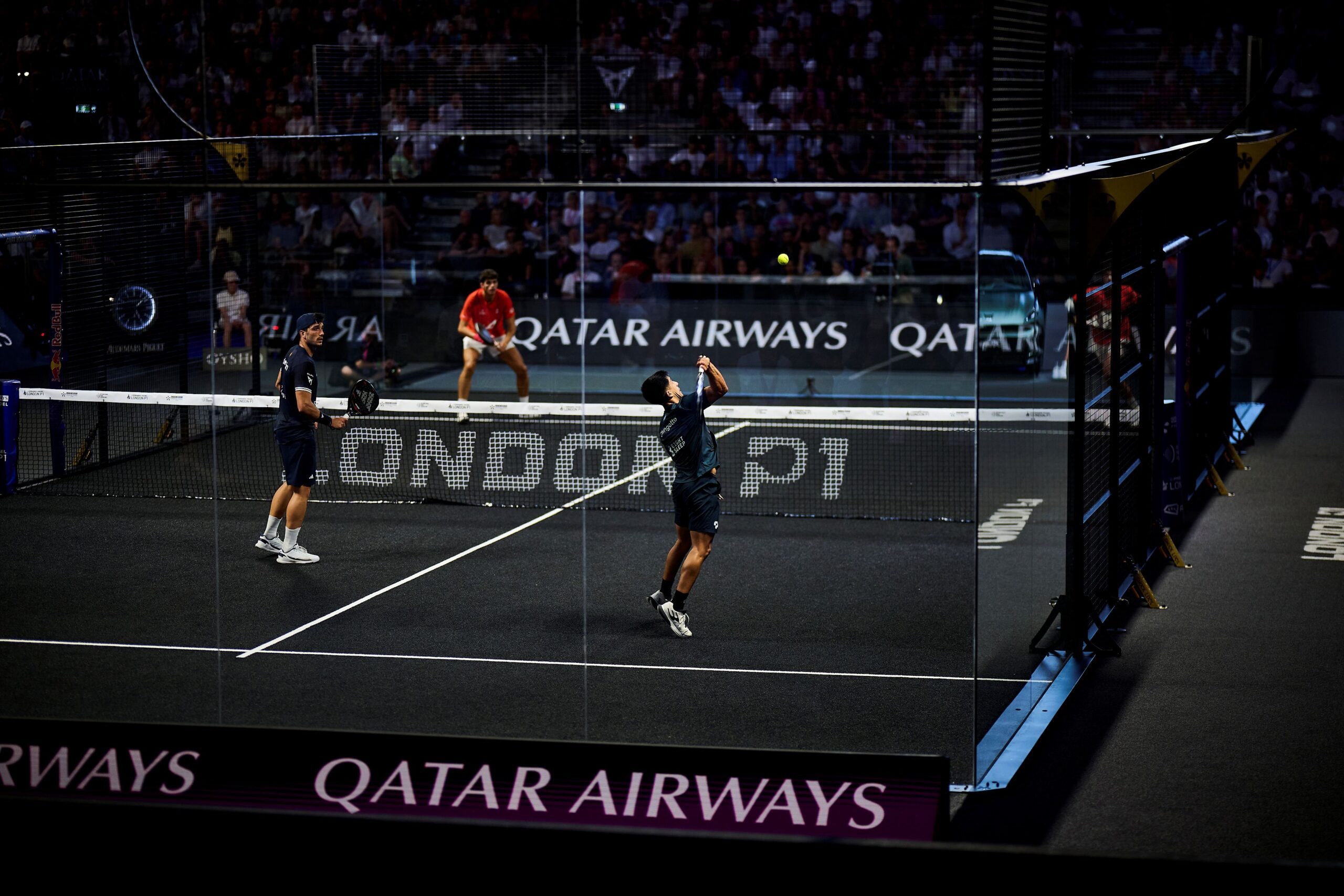
There was a point in the London Premier Padel final when the match seemed to be drifting towards the pair who had spent the second set taking it away from the world number ones.
Alejandro Galán and Federico Chingotto had recovered from losing the opening set, slowed the tempo and begun to make Arturo Coello and Agustín Tapia work for every inch of court. At 5 5 in the third, though, the balance shifted again.
The important thing was not a spectacular winner. It was the absence of a mistake.
In the tenth “Superclasico” match of the season, London finally learnt why Padel is the fastest growing sport in the world. More importantly, it was another demonstration of why this rivalry remains the defining contest in men’s padel.
Coello and Tapia stayed calm, found their aggression again and broke in the final game to beat Galán and Chingotto 6 3, 5 7, 7 5 and claim the inaugural London Premier Padel P1 title at Olympia London.
It was the eighth title of the season for the world number ones and a useful response after their unexpected semi final defeat in Pretoria the previous week.
The match lasted just under two hours, but it felt considerably longer by the time the final ball was played. The four players exchanged momentum repeatedly and there was remarkably little between them statistically.
Coello and Tapia won 52 per cent of the total points. They won 74 per cent of points behind their first serve, compared with 68 per cent for Galán and Chingotto, while their first return figures were 32 per cent against 26 per cent.
Those numbers do not scream domination. They describe a final decided by moments.
The opening set belonged to Coello and Tapia because they were able to impose the game they wanted. The aerial exchanges favoured their reach and power, and they attacked early rather than allowing Chingotto to settle into the methodical rhythm that makes him so difficult to play against.
“We were perfect in the first set. We played very nice,” Coello said afterwards. It was an accurate assessment.
The problem for the world number ones was that Galán and Chingotto did not allow the match to remain on those terms.
The second set was a different proposition. Chingotto began finding more control from the back of the court, while Galán became increasingly influential around the net. Rather than attempting to beat Coello and Tapia at their own game, they made the points longer and forced the champions to earn their opportunities.
At 7 5, the match was level. Suddenly, the final was anybody’s.
That was when the quality of the contest became most apparent. There were no easy passages in the deciding set. Both pairs held serve under pressure and the atmosphere inside Olympia became increasingly tense. And then came 4 4.
Coello later identified that moment as the point at which the champions changed their approach. “At 4 all in the third set, we changed everything,” he said.
That change was subtle but decisive. The errors that had begun to creep into the Coello and Tapia game disappeared. Their shot selection became more purposeful and they stopped giving Galán and Chingotto cheap opportunities.
The other side of the net was less composed. Chingotto, normally one of the most controlled players on a padel court, appeared to feel the weight of the occasion. He wanted the title desperately and, in those decisive exchanges, that emotion seemed to work against him.
It was not a collapse. It was something much smaller, and much more significant at this level: a few decisions made a fraction too quickly, a few balls that were not quite as precise as they had been earlier. That is how these matches are won.
The statistics underline it. Galán and Chingotto converted every break point they created, while Coello and Tapia converted half of theirs. Neither side was simply overpowering the other.
The longest run of consecutive points was seven for the champions and six for their opponents. There was almost nothing in it.
Which is why the final game mattered so much. At 6 5, Coello and Tapia found the break they needed and closed out the championship.
For Coello, there was satisfaction in the way they responded when the match became difficult. “In the second set we lost concentration and we allowed them to continue to grow in the match,” he said. “At 4 all in the third set, we changed everything.”
There was also something bigger about winning in London. “We are proud. A battle like this in London is amazing,” Coello added.
The tournament itself represented something new for the sport. Premier Padel had never staged an official professional tournament in London before, and the London P1 has arrived at a fascinating moment for the professional game.
The result also provided another twist in a rivalry that has already seen momentum swing from one partnership to the other during 2026.
Galán and Chingotto had dominated parts of the early season before Coello and Tapia reasserted themselves during the European summer. London offered another reminder that neither pair can afford to relax when the other is across the net.
For Tapia, perhaps the most telling part of the victory was not the trophy or even the ranking points. It was the confidence that comes from knowing who is beside you when a match starts going wrong.
“It might not have been the best year, but you can look at the court and know that you have the strongest partner, even if things do not go your way, like in Pretoria,” Tapia said.
There is a quiet confidence in that statement. Pretoria ended their extraordinary run of consecutive Premier Padel finals. A week later, they have won again.
The Golden Boys now have eight titles in 2026, and they leave London with their reputation intact. But they also leave knowing that the gap between them and Chingotto and Galán remains small enough for a single lapse in concentration to alter everything.
That may be the most encouraging thing about this rivalry. It is not becoming predictable.
The Premier Padel tour now moves to Madrid from 29 August to 6 September before the Paris Major from 7 to 13 September.
London, meanwhile, has produced its first champions. And what a way to start. Long live the Kings of Padel.