
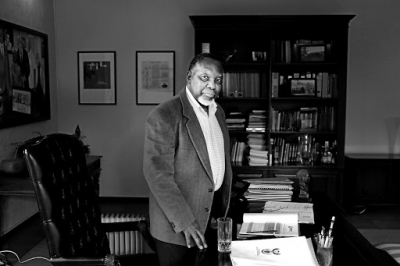
By Carol Paton.
Photo Credit: Alon Skuy.
South Africa is on a precipice, and the time for new ideas and change has never been more urgent.
This is the message emerging from the Kgalema Motlanthe Foundation Inclusive Growth Forum, under way in the Drakensberg this weekend. The forum brings together various civil society organisations, intellectuals and thought leaders to discuss political, economic, and development challenges.
At the forum’s opening on Friday night, Motlanthe – a former president of SA and ANC deputy president – warned that both the country and the world were in deep trouble. Said Motlanthe: The time for ideas and the time to exchange has never been more pressing for the survival of democracy and humanity than it is now. All markers point to a precipice. And from here, on the edge of the Drakensberg mountains, we may observe how far the cliff edge falls for all. This forum is an urgent invitation to all sectors of society to respond to the situation they find themselves in.
Former deputy finance minister and MTN chairperson Mcebisi Jonas, who has become an outspoken critic of the ANC, also used the word “precipice” to describe the state of the country.
“This year’s assembly is more important than ever before. The current trajectory of our country is unsustainable as we get nearer and nearer the precipice. The warning lights are flashing on all key economic and social indices, and yet the only new idea gaining momentum across political lines is to attack and scapegoat foreign nationals and the Constitution,” said Jonas.
Jonas said the 1994 consensus on which SA’s democracy was built has run its course. With political parties out of ideas, civil society needed to mobilise to develop a new, coherent political and economic vision.
Jonas, who has rebuffed all his former party’s attempts to return to political office, said the way forward was “a national convention” in which those not actively engaged in changing SA re-ignite their political agency. He suggested to the audience, made up of many former anti-apartheid activists and leaders, review their historical loyalties.
Said Jonas: We cannot continue to hold our noses when we vote, or worse, not vote at all. Loyalty should be earned, not taken for granted. The truth of the matter is that there needs to be hard work, driven by the people in this room in partnership with civil society, business, religious leaders, youth and labour to develop a new national vision and agenda for change.
Songezo Zibi, chairperson of the Rivonia Circle, a new civil society organisation advocating political change, also believes that “the post-1994 consensus” has broken down. Twenty-five million South Africans no longer vote, and those “who are sufficiently desperate and activated resort to violence to attract the attention of the elites.”
Repairing SA’s “deficient democracy” was urgent, he said.