
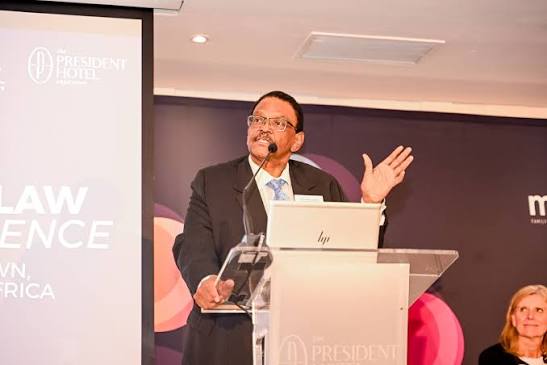
By Lehlohonolo Lehana.
Constitutional Court Justice Steven Majiedt will retire from active judicial service, according to a media statement issued on 20 November 2026 by the Judiciary.
In a statement, the Office of the Chief Justice confirmed that Justice Majiedt will officially retire from the Constitutional Court of South Africa on December 31, 2026.
Justice Majiedt was appointed to the Constitutional Court on 11 September 2019 by President Cyril Ramaphosa.
His appointment followed nine years of service at the Supreme Court of Appeal, to which he was appointed in 2010, and a decade on the Bench of the Northern Cape Division of the High Court, where he served from 2000.
According to his biography on the Constitutional Court website, His journey in the legal profession began in 1984 when he joined the Cape Bar in Cape Town. During his years in practice, he became closely associated with the legal struggles of the liberation movement, representing and defending people from diverse backgrounds, including those who were politically persecuted during apartheid. It was during this period that he worked alongside and was mentored by the late Adv Dullah Omar, whose contribution to the legal profession and the liberation struggle left a lasting impression on him.
Reflecting on the defining moments of his career, Justice Majiedt has identified his work representing people during the liberation struggle as his greatest professional highlight, particularly his commitment to defending not only those involved in high-profile political cases but also ordinary citizens facing seemingly minor charges.
Beyond his work at the Bar, Justice Majiedt also played a role in South Africa’s democratic transition. In 1994, he was called upon to assist with the country’s first democratic elections in the Northern Cape. He subsequently served as Chief Legal Adviser in the Northern Cape Premier’s Office, contributing to the establishment of the governance structures of the newly constituted province.
During his tenure on the Bench, Justice Majiedt adjudicated a wide range of complex and significant matters, spanning areas including international criminal law, hate speech, citizenship, taxation, immigration and the interpretation of statutory licensing requirements. His contribution to the development and interpretation of South African law forms part of his legacy at the various levels of the judiciary at which he served.
During his stint at the Constitutional Court, Justice Majiedt authored several landmark judgments. In a unanimous judgment of National Commissioner of the South African Police Service v Southern African Human Rights Litigation Centre, he affirmed South Africa’s obligation to investigate allegations of torture committed abroad, emphasising the country’s international and domestic obligations and the need to prevent impunity for international crimes.
In the majority judgment in Cool Ideas 1186 CC v Hubbard, he emphasised purposive statutory interpretation, consumer protection and the principle that courts should not give effect to conduct prohibited by legislation. In Qwelane v South African Human Rights Commission, he underscored the need to balance freedom of expression with dignity and equality, while ensuring that limitations on expression remain constitutionally justified. In Mineral Sands Resources (Pty) Ltd v Reddell and Reddell v Mineral Sands Resources (Pty) Ltd, (the “Reddell” judgments), he recognised the SLAPP defence as part of South African common law, affirming the need to protect litigants against the use of litigation to intimidate and silence public-interest advocacy.
His judgments reflect an appreciation that freedom of expression and public participation are indispensable to a functioning constitutional democracy, and that the law must guard against its own processes being weaponised to undermine those values.
His dissents in Thubakgale v Ekurhuleni Metropolitan Municipality and NVM obo VKM v Tembisa Hospital spoke to his concerns about effective remedies and the practical barriers people face in vindicating their rights. Most recently, in Scalabrini Centre of Cape Town v Minister of Home Affairs, he affirmed the constitutional protection afforded to asylum seekers by confirming the invalidity of legislative provisions that impeded access to a substantive determination of their asylum claims.
Justice Majiedt’s judgments reflect a deep-seated commitment to ensuring that the law serves the interests of justice in a meaningful and tangible way. He has consistently looked beyond the immediate legal question to the human consequences of the Court’s decisions. It is in this willingness to press for principled, effective and just outcomes, even where he stands in the minority, that Justice Majiedt became a conscience of the Court.
Throughout his judicial career, Justice Majiedt has maintained a philosophy grounded in humility, fairness and the understanding that judicial office is ultimately a responsibility to the people. He has consistently emphasised that Judges, as human beings, are imperfect and must remain mindful of their role as servants of the public.