
By Lehlohonolo Lehana.
President Cyril Ramaphosa says corruption has wounded South Africa’s democracy in a number of ways and has shaken its people’s faith in a number of institutions.
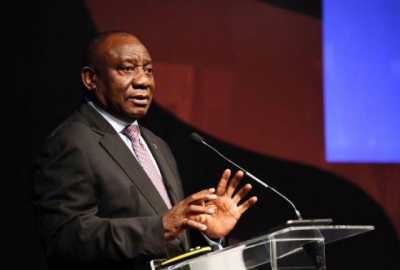
Ramaphosa delivered a keynote address at the National Anti-Corruption Advisory Council (NACAC) National Dialogue in Boksburg on Wednesday.
The dialogue was also attended by Chief Justice Raymond Zondo, Police Minister Bheki Cele, National Director of Public Prosecutions Shamila Batohi, civic organisations, and others.
The president said that over the last five years, government has invested significant resources to rebuild the law enforcement agencies and other bodies that were devastated by State Capture.
“While there is a long road ahead, the fight against corruption is gaining momentum.”
Ramaphosa reported that so far nine separate cases, involving 47 individuals and 21 companies, have been brought to court.
Freezing orders amounting to R14 billion have been authorised by the Asset Forfeiture Unit, and a total of R5.4 billion has been recovered and returned to the State.
Government departments, municipalities, and professional bodies were taking disciplinary action against individuals identified by the State Capture Commission.
The South African Revenue Service (Sars) has collected R4.9 billion in unpaid taxes as a result of evidence brought before the Commission.
Ramaphosa commended the efforts of the Judicial Commission of Inquiry into Allegations of State Capture, Corruption and Fraud in the Public Sector including Organs of State, the State Capture Commission, saying that the State capture enquiry was a watershed moment in South African history.
Not only did the commission lay bare the extent and the depth of State capture and corruption, but it also presented the country with the means to both remedy and deal with corruption, and also to create conditions that would prevent its recurrence,” Ramaphosa stated.
He noted, however, that the full impact of State capture was only being manifested now.
Ramaphosa has also conceded that the government made a mistake by outsourcing the procurement of Personal Protective Equipment (PPE) during the Covid-19 pandemic.
He said people quickly set up companies specifically to get tenders to supply the resources.
“When we went through Covid-19 PPEs, and mistakenly, that’s where sometimes I say we made a mistake. I also made a mistake in having the PPEs distributed to our people as this was a moment of great need, and people set up companies just days before PPEs were made available. Money was there; they saw it coming, and they grabbed the opportunity.
“But it was interesting to read that the experience that we went through was similar to the experience that other developed countries went through, the UK, US, African countries and many others. However, it was sobering.”
Ramaphosa insisted that the government had learnt a lesson and did things differently with the procurement of vaccines.
“But what we did afterwards was more important, for me much more important, was that we learnt a lesson when we had to deal with vaccines, we decided that this is centralised, it will only be distributed by the state. We had learnt a lesson.
The President further committed to adequately resourcing the NACAC going forward.
“The criticism that has been leveled against us as government is that we haven’t given them enough resources. We will make sure that [NACAC is] properly resourced because we want you to do your work properly. So you will be resourced,” he said to the NACAC council members present.
Zondo said whistleblowers, together with journalists, played an important role in flagging state capture.
“Whistleblowers and investigative journalists played a very critical role in the work of the commission. They helped to make sure that we know as much as we know about state capture today. Whistleblowers helped to stop state capture.
“Everybody talks about the protection of whistleblowers, but the commission went beyond that. Not only the protection, we also need to incentivise them to blow the whistle.”
Zondo said everything possible should be done to obtain information on corruption.
“I am aware that some are critical of the recommendation we made, that whistleblowers should get some percentage of the money that we recover if their disclosure has been material in us recovering that money.
“Some criticised that people will make disclosure just because they want money, not because it is the right thing to do. I wish that everybody would make such disclosures because it is the right thing to do, not because they want money.
“Our levels of corruption are such that I do not think that we in South Africa can afford the luxury of saying we don’t want information disclosed by whistleblowers who want money. I want all the information, whether you disclose because you want money or you disclose because it is the right thing to do, disclose all that information,” he said.
The NACAC multi-sectoral advisory body was appointed by Ramaphosa in August last year to oversee the implementation of the National Anti-Corruption Strategy (NACS) over a three-year term and to advise on the future of the country’s anti-corruption institutional architecture.
We want to strengthen the consensus on what is a sustainable anticorruption reform agenda which embraces an all-society or all-government approach. One of the critical success factors recognized internationally in the fight against corruption is the involvement of the people who have to hold their representatives accountable. If we don’t get that pillar in place, we will not succeed,” NACAC chairperson councillor Professor Firoz Chachalia said at the event.
Since its inception, NACAC has hosted monthly plenary meetings and one multi-stakeholder meeting in January, with two provincial engagements in the North West in August and in Limpopo in September. Starting in October last year, interviews have been carried out with law enforcement and government members. These interviews are still being conducted.
NACAC has four advisories to the President, two on whistleblowers, one on political party funding, and one on the monitoring and evaluation of the NACS.
Watch Live in the video below:
Video Courtesy of ENCA.