
By Lehlohonolo Lehana.
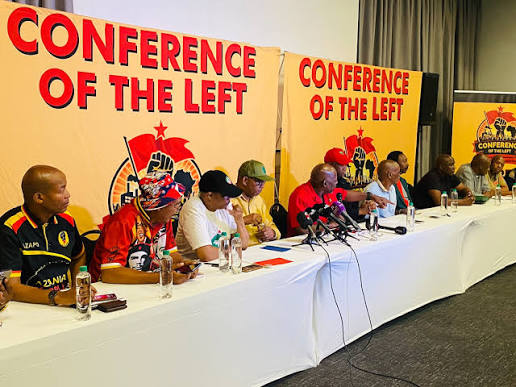
The Council of the Left, comprising of the South African Communist Party (SACP), uMkhonto weSizwe (MK) Party, African Congress for Transformation (ACT) Africa Mayibuye Movement (AFM) and the Economic Freedom Fighters (EFF), held a media briefing at the Birchwood Hotel in Boksburg, East of Johannesburg.
The briefing seeks to provide an update on the Council of the Left’s programme, resolutions and political direction following the 2026 Local Government Elections.
The African National Congress (ANC) was also holding its National Executive Committee (NEC) meeting at the same venue.
The political bloc managed to garner close to 20% of the vote in the recent local polls.
Delivering the joint statement, MK Party member Dali Mpofu said the Conference of the Left wanted progressive forces to unite behind a common political programme and challenge what it described as right-wing influence in government.
“We call on those within the current national coalition and in the former liberation movement in particular to demand the removal of right-wing reactionary forces from the so-called GNU,” he said.
“A government that claims to serve the people cannot be shaped by those who are aggressively championing the transfer of people’s assets into private hands.”
Mpofu said the Conference of the Left was extending an invitation to progressive forces, including the ANC, to support its position.
“The Conference of the Left therefore invites all progressive forces, including the ANC, to join this call.”
He criticised the Government of National Unity (GNU’) economic policies, arguing that they had made the cost of living increasingly unaffordable for ordinary South Africans.
Mpofu said the conference had resolved to work towards establishing a strong, people-centred voting bloc and joint progressive caucuses in municipalities where its members and associates were represented.
He said the organisations wanted to go beyond simply voting together in municipal councils.
“We encourage the forces of the left to go further than voting together.
“Where we share councils, we must hold joint caucuses and blend together, speak with one voice on the needs of communities on the basis of an agreed minimum programme,” he said.
Those who have agreed to form part of the GNU (including FF Plus and DA) collectively hold 287 (71.75%) out of 400 seats in Parliament, giving them a supermajority—which is one of the key reasons some have opted to steer away from the GNU.
The GNU was the mechanism used to transfer South Africa from an apartheid autocratic state to a constitutional democracy. President Cyril Ramaphosa played a significant role in the formation of the GNU, and it has again won his favour as it suits his temperament as a negotiator and a believer in big-tent politics.
It has been described as the most faithful expression of the wishes of the 16 million South Africans who voted on May 29. They did not choose any party to have a majority and spread the vote across many parties in a fractal expression of unhappiness with the country’s state and the political class.