
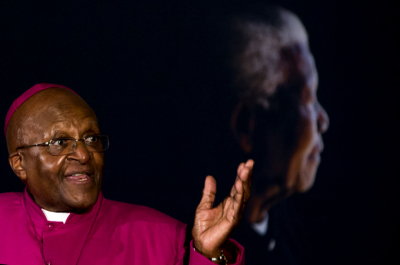
By Lehlohonolo Lehana.
Reverend Frank Chikane has told mourners at the Cathedral of St Mary the Virgin in Johannesburg on Thursday that Archbishop Emeritus Desmond Tutu was worried about the future of South Africa.
“He was stressed. He was disappointed about what was happening. He did not think this was what we struggled for. I had to plead with him not to worry,” Chikane recalled about their last encounter before the archbishop’s death.
Chikane said the former Bishop of Johannesburg and the first black dean of the Cathedral of St Mary the Virgin “fought the good fight; he has finished his race”.
He added that Covid-19 pandemic robbed the world of a real celebration of Tutu’s life.
“If it was not for the coronavirus, the whole body of Christ – the church – would be here to celebrate his life and listen to this epistle.”
Bishop of the Anglican Diocese of Johannesburg Bishop Dr Steve Moreo said Tutu was demonised by white people within the church, including the Anglican church.
“They gave him some labels; he was a priest who embarrassed the word of God. He was indeed a pastor who had to walk among many of those people.”
Moreo said Tutu took his message to everyone with great passion.
“There can be no excuse as we reflect on his legacy. Our calling must be, in this age, to bear testimony on his life and the legacy he lived as he completed his mission on Earth.”
Although his is a name now world renowned, Archbishop Emeritus Desmond Tutu’s life had humble beginnings.
He was born in 1931 to a father who was principal of a church-based primary school and a mother who was a domestic worker in Apartheid South Africa.
He was struck by Polio as a child and contracted Tuberculosis in his teenage years – both of which he overcame although with a weakened right hand from the polio and adhesions to the lungs as a result of the TB.
After completing high school, Tutu obtained entrance into Wits Medical School but could not afford tuition fees.
Undeterred by this setback, Tutu chose to study teaching which led to him meeting his wife for the next 66 years, Leah Tutu.
After the then Apartheid government introduced the Bantu Education Act in 1953, Tutu left the profession in protest – paving way for him to enter the clergy.
Tutu then attended the Theology College in Johannesburg, Tutu completed his Honours and Master’s degree from 1962 at King’s College in the United Kingdom.
When he returned to South Africa in 1966, Tutu combined his teaching and theological skills to teach at various Southern African institutions in South Africa, Botswana and Lesotho.
Tutu’s passion for social justice was triggered once more in 1968 when he joined protesting University of Fort Hare students where he witnessed the use of Apartheid state power to suppress Black anger.
By the mid-1970s, Tutu began speaking out against the racist Apartheid regime from the pulpit of the revered St Mary’s Cathedral in Johannesburg.
Mere weeks before the 1976 uprisings, Tutu wrote a letter to then South African prime minister B.J. Vorster, warning him about imminent turmoil as a result of discontent among Black South Africans.
During the 1980s, Tutu’s voice of opposition of the Apartheid government became louder as he wrote several letters to P.W. Botha denouncing several policies which gave the racist government power to forcibly remove Black people from the areas they lived in.
With these letters falling on deaf ears, The Arch began to rally the international community to take action against the segregationist government.
Tutu played a pivotal role in lobbying countries such as the USA, Canada and France to impose sanctions on Apartheid South Africa; in a bid to force the hand of the Apartheid government to resign power and accept a new and democratic dispensation.
Tutu’s life’s work as a humanitarian earned him a myriad of accolades including the Nobel Peace Prize, the Gandhi Peace Prize and the Fullbright Prize.
When the new democratic dispensation was ushered in, Tutu continued to be a strong voice for the voiceless.
He took on the mantle of Chairperson of South Africa’s Truth and Reconciliation Commission, and later became an HIV/Aids activist, a LGBTQIA+ supporter and continued his work for the attainment of universal human rights.
Tutu has been afforded a category one special official funeral which will be held at St George’s Cathedral on Saturday. He will be cremated and his ashes will be interred at the Cathedral.