
By Lehlohonolo Lehana.
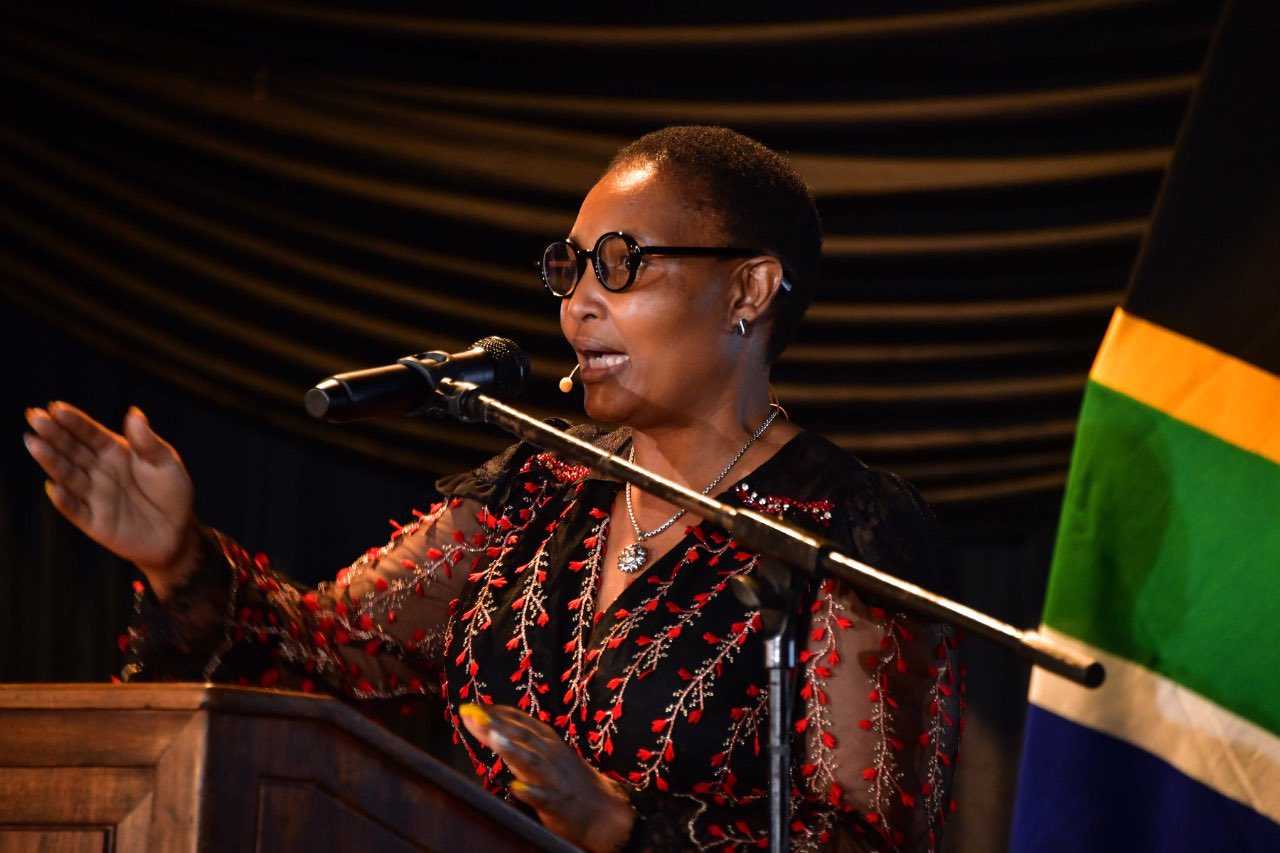
The Minister of Cooperative Governance and Traditional Affairs (COGTA), Thembi Nkadimeng, says a threshold needs to be established to guide how coalition governments are formed.
She was speaking to media on the sidelines of the National Dialogue on Coalition Governments held in Cape Town.
“You need to be elected by a certain number of people. Also, a party that has gained the highest percentage needs to be given the… first pass of ticket to negotiate within a particular timeframe to form a government. We could then agree that if they can’t, the ticket passes to the next one.
“I do believe that coalitions are a reality of democracy but managing them is what government needs to be able to learn. The good thing about political parties is that they have worked and they are sitting on the table… to discuss the possibility of… how best to manage a coalition,” the Minister said, stressing that holding to account those who are elected remains key.
The Minister pointed out that this will not leave smaller parties out of positions in council.
“The small parties will have a voice. They will have a voice in PR [proportional representation] and other ways of how you get into council and in wards. Nobody will close you out in a ward but we have to have a threshold. You can’t get 10 votes in a community where there are 10 000 people and you say you represent the entire community.”
“So we are suggesting a 1% [votes threshold]. In other countries, it goes even as high as 5% but these are other learning areas that we are getting from countries that have grappled [with coalitions],”Nkadimeng said.
Nkadimeng added that the parties agreed on the need to establish an independent body to deal with the formation of a coalition government.
She said, there’s agreement around making coalition agreements public as well as extending the time frame to form coalition governments. But parties disagreed on the proposal that mayors and speakers must come from the majority party.
Nkadimeng further pointed that political interference in municipalities must be monitored and the appointment of municipal managers must be purely an administrative process.
Meanwhile the Democratic Alliance (DA), has accused the African National Congress (ANC) of trying to hijack its efforts to create legislation to govern coalition governments.
According to DA chief whip Siviwe Gwarube, the party began a process of drafting legislation that would stabilise coalition governments in October of 2022.
“We sought the inputs of other political parties represented in Parliament in order to make sure when we get to the drafting process, we would have incorporated their diversity of views. The ANC could not be bothered to participate at the time,” she said.
GOOD Party secretary-general Brett Herron said it was clear that the ANC and DA have already made their own behind-closed-door coalition deal.
“Both party’s inputs today, especially on thresholds, were the same and are already in the Bill,” he said.
The ANC and DA, agree that electoral thresholds should be factored into the creation of coalition governments. This frustrated smaller opposition parties who all argued against thresholds as this excludes them from democracy.
ActionSA national chairperson Michael Beaumont said the dialogue was pitched as an engagement across the political spectrum to feed into a legislative process.
“To learn yesterday that this process is already far along with a draft that nobody has seen raises questions as to whether this engagement is here simply to legitimise an already drafted bill,” he said.