
By Lehlohonolo Lehana.
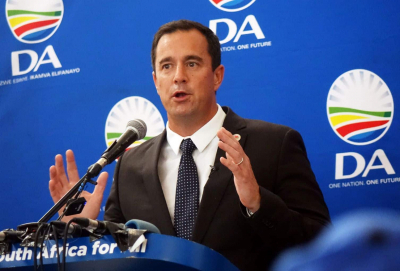
Democratic Alliance (DA) leader John Steenhuisen has slammed President Cyril Ramaphosa for suggesting that there might be election reruns in hung municipalities if coalition talks between parties fail.
Steenhuisen, speaking at a media briefing on Tuesday, accused Ramaphosa of misleading South Africans on how election reruns work.
He said in hung municipal councils where parties could not find each other, minority governments would likely be instituted, instead of by-elections being held.
“The idea put forward by the president that if coalitions are not set up, the legislation would kick in and we would have reruns, is misleading because in our opinion and certainly the advice we’ve taken, the earliest that this could possibly happen is only mid-way during next year.”
“People must not be taken by the argument that just because parties can’t find each other that there is going to be an automatic rerun,” Steenhuisen said.
The DA leader said minority governments were tricky and not ideal as the parties that would form governments in municipalities with less than 50% of votes, would have to navigate several hurdles like motions of no confidence and the passing of budgets in council.
Speaking last week at an ANC post-election event in Soweto, Ramaphosa said the possibility of election reruns existed in the country’s 66 hung councils if coalition negotiations were unsuccessful.
Not having a coalition is not a legal trigger for the dissolution of councils not constituted by the deadline of 23 November, following the 2021 Local Government Elections (LGE), an expert says.
However, as the deadline looms for hung municipal councils, political parties not reaching agreements could ultimately see councils dissolved.
The warning has been fired by the University of the Western Cape’s Dullah Omar Institute in a framework for coalitions in local government document it prepared for the South African Local Government Association. The framework was published on 4 November, the day on which the results of the 2021 election results were announced by the Electoral Commission of South Africa (IEC).
Municipalities are constituted according to the Municipal Structures Act.
Dullah Omar Institute director, Professor Jaap de Visser, said while the law was not the decisive factor in the success or failure of a coalition,it was important as it determined the parameters within which coalition partners can practice their coalition politics.
“Hung councils [determine] how they solve their predicament. Obviously it has to be done within the parameters of the law. There are laws that apply as to how you elect office bearers and how you run a municipality, so all of those apply. There’s a limit of political discretion of the politicians involved. There are no specific rules that guide councils on how they approach coalition agreements.”
The coalition framework document sets out the legal parameters within which such council could be constituted. It also gives advice, which while not legal, on good practice that could be pursued. After election results are declared, councils have 14 days to constitute.
However, de Visser said should this not happen, “it did automatically mean that an MEC for Cooperative Governance and Traditional Affairs (Cogta) could declare by-elections for the affected council”.
“The law says they (councillors) must have their first council meeting within 14 days. The first thing is that the municipal manager presides over the election of the meeting,” he said. “They elect the speaker and then the speaker takes over the reins and then the mayor and other office bearers are elected.”
He said if there was no political agreement, the meeting could still commence and “go to a vote and it all then becomes unpredictable”.
De Visser said the Institute was advising councils not ready to constitute – due to no political agreements – to still hold the initial meeting but adjourn to a later date.