
By Lehlohonolo Lehana.
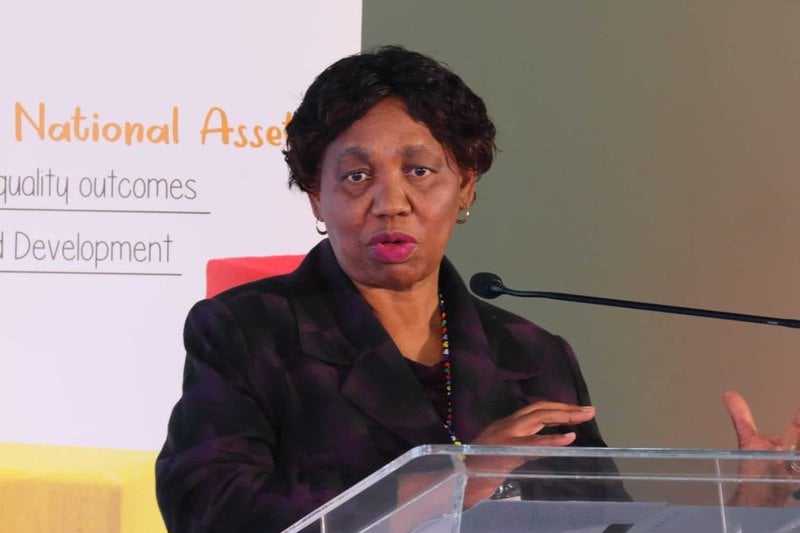
Basic Education Minister Angie Motshekga says her department is engaging National Treasury to fund a well-resourced national literacy strategy.
This comes after a report on the 2021 Progress in International Reading Literacy Study (PIRLS) revealed that 81% of South African Grade 4 pupils cannot read for meaning.
PIRLS is coordinated on a five yearly basis by the International Association for the Evaluation of Educational Achievement (IEA) and is the global standard for monitoring reading achievement at Grade 4.
Motshekga was delivering her budget vote to the National Assembly on Thursday, highlighted that in 2019, the sector had reached consensus on ten pillars to anchor its 2019 National Reading Strategy.
She said that from their continuous consultations, and lessons learnt from the regional and international assessment studies, there was an emerging view that they should reduce the ten pillars to four key interdependent strands.
These are: explicit reading literacy policy; skilled and agile teachers; age-appropriate and culturally relevant LTSMs; and involved parents and communities.
“This approach is critical, as the PIRLS 2021 has also observed that learners with higher home socioeconomic status had much higher achievement than learners with lower home socioeconomic status…
“Therefore, the consensus that the implementation of an Integrated National Integrated Reading Literacy Strategy must be well resourced, is justified. We are engaging the National Treasury in this regard, “she said.
Minister Motshekga said she had requested researchers to analyse the impact of the COVID-19 pandemic on the country’s basic education system, the lost ground and the return of the schooling system to its earlier improvement trajectory.
The researchers reported that prior to COVID-19, the country had seen progress in the reading abilities of children.
“According to the PIRLS, reading in Grade 4, had improved substantially between 2006 and 2016. Between 2011 and 2016, South Africa saw the second-fastest improvement among all PIRLS participating countries, after Morocco, She said.
By the end of 2021, the average Grade 4 learner, could read as well as the average Grade 3 learner before the pandemic.
She said there had been a loss of one year of learning, meaning the country slid backwards in terms of the PIRLS progress by a few years.
“The overall reading scores of our Grade 4 learners, who participated in PIRLS 2021, dropped from 320 points attained in 2016, to 288 points in 2021.
“Our Grade 4 girls performed better at 317 points; than their boy counterparts, who achieved 260 points. PIRLS 2021 shows that the longer the children stay in school, the better their performance,” she said.
The Minister emphasised that the longer learners remain in the system, their performance improves steadily, as the PIRLS 2021 Grade 6 score shows – that is, an upward shift of 96 points when compared with the PIRLS 2021 Grade 4 score.
Motshekga said the department will be embarking on report back and engagements sessions with its critical stakeholders, including renowned local and international scholars, to ensure that they all understand the conundrum about reading for meaning as different from oral performance in reading.
While acknowledging the devastating effects of COVID-19, she said these assessment studies continue to sharpen their understanding and plans on improving the sector’s performance on reading for meaning.
Motshekga announced that the department has been allocated an overall budget of R31.8 billion for the 2023/24 financial year, an increase of 7.0% from last year’s overall allocation.